Call: +65 6012 3433 | Whatsapp +65 87792453
Why Latin America Is A Great Source For Remote Talent
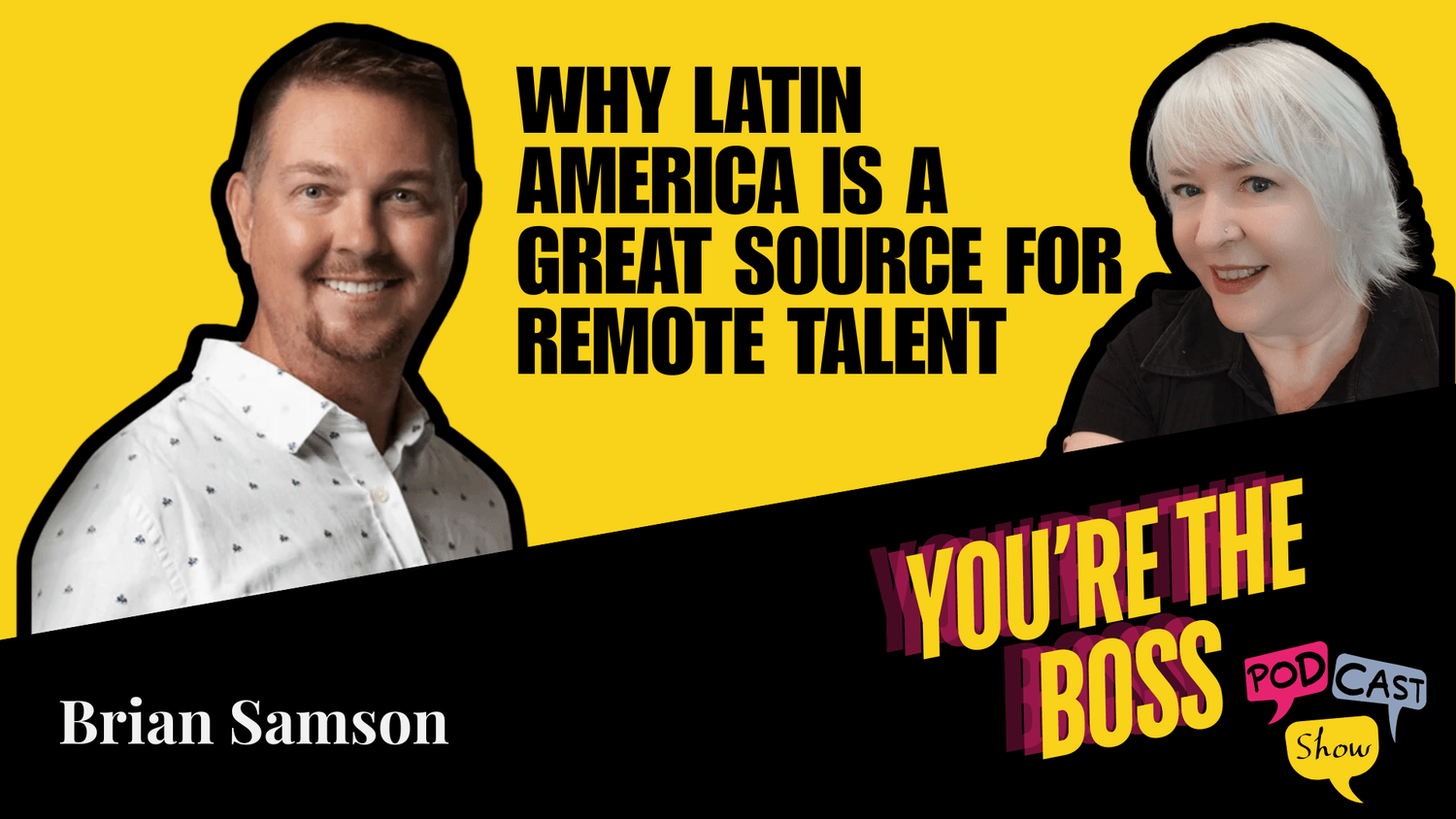
Click the image above to watch
Ange Dove (00:01)
Hey, welcome to You're the Boss podcast show. And today I have Brian Sampson with me, and he is the founder of Plug, a Latin American nearshoring staffing company. So Brian, welcome to the show.
Brian Samson (00:16)
I am honored to be here. Thanks for having me.
Ange Dove (00:19)
Great to have you. So Brian, just explain really who you are and what you do, first of all.
Brian Samson (00:27)
Sure. I’m the founder of Plug. I’ve been in the space of connecting talent from Latin America to US companies for the last 10 years. So it’s really something that I’ve been very passionate about, and I plan to spend the next decade plus of my life doing that as well.
I live in Hawaii, but a lot of my focus is on clients in the mainland US and connecting them with candidates all throughout Latin America.
Ange Dove (01:01)
Right, okay, that’s great. That’s very clear. Okay, so Brian, tell me just first of all, before we get into the whole aspect of hiring people and nearshoring and offshoring and that kind of stuff — just tell me first how you got started, because I know Plug isn’t the start of your journey. Just walk me through your whole history there.
Brian Samson (01:25)
Yeah, sure.
So when I grew up, which was in the Midwest in Chicago — not as tropical as Hawaii — I didn’t really know any entrepreneurs. It just wasn’t part of my world.
My mom was a homemaker. I have two younger brothers, so house full of boys, a lot of craziness and jumping off the furniture. And then my dad worked for the same manufacturing company basically his whole life.
And then uncles, neighbors — it was all people that worked at companies. So I didn’t know what it really meant to be an entrepreneur.
As I graduated undergrad, I kind of did the traditional thing and worked for a company in Chicago. Then I moved to California, and that’s where things started to shift.
I didn’t take the jump right away, but I got immersed in this whole world. And it wasn’t like now, having been an entrepreneur for 10 years — everything I look at, I know there’s a business behind it.
For example, I’ve got this little lid for a jar, and there’s a company that makes this. Or this pen — there’s somebody that owns or started a pen company.
Ange Dove (02:49)
That’s funny. It’s funny you should say that because that’s the same realization I had when I was doing my copywriting business. I’d go and interview companies to find out what they did so I could write about it.
So one time I went to a precision manufacturing company here in Singapore, and all they did was create the molds for the screw part of plastic bottles, like Coke bottles and stuff. That was it.
And I’ve never looked at a plastic bottle the same way since. Then you realize there’s money in there. It is amazing.
Brian Samson (03:30)
Yeah, it’s incredible. It creates jobs, careers — it’s amazing.
San Francisco is just a place like no other. And at the time I was there, it was software startups. Now it’s all about AI, but at the time it was software-as-a-service, SaaS, web apps, mobile apps — just a really cool time to be there.
Tens of thousands of startups everywhere you go. Then you also have the inspiration because Google’s there, Facebook’s there, Oracle’s there, Salesforce.com, Twitter — everybody’s there. So you could kind of see your future if you really worked hard and caught the right wave and were good and lucky.
So I wasn’t an entrepreneur there yet, but I worked in a bunch of these tech startups.
Your audience may already know there’s kind of a sequence between funding and company size: Seed, Series A, B, C, D. So Seed and A are smaller, and the further down the alphabet you go, generally the more money they have and the bigger they are.
I tended to work in the earlier part, which was impactful because I was making a bigger impact and working really closely with the founders.
And that’s something you often don’t get if you join a late-stage company, because the founder doesn’t know who you are. There’s 500 people.
But I was part of figuring the business out all the time.
I happened to run the talent function, which covered a lot of random things like office space, some IT, HR — but really where all my energy was focused was talent acquisition, because you live or die by the talent you recruit as an early-stage company.
So they would raise capital, and then all of a sudden it was up to me to use that money judiciously to find the right people.
I worked really closely with the founders on things like: What’s the right person? Let’s define our culture. It was really cool.
I think your audience will resonate with this: not only did I not know any entrepreneurs growing up, but I also went to a school that I don’t think was viewed as particularly impressive — Southern Illinois University.
I’m proud to have attended because I think it shaped me. But when I got to San Francisco, it seemed like everybody was from Stanford or Harvard or some prestigious school. No one knew where I went.
So I had this imposter syndrome, this chip on my shoulder — like, “I’ve got to prove them wrong.”
That actually fed me. I think I always need to feel a little bit like the underdog in the story.
Anyway, fast forward about five years in San Francisco. I finally got a little confidence.
I wasn’t totally ready to be a founder yet, but I was really intrigued at the time — this was around 2014 — by the possibility of being an expat in some cool place in Asia.
Singapore was one of the places I circled. I was also thinking about Shanghai.
Asia was where the excitement was. I didn’t have kids yet, and I wanted this adventure.
So I did grad school. UCLA and NUS — National University of Singapore — have a joint MBA program focused on executives who want an Asia focus.
I did that with the purpose of using it as my ticket to becoming an expat in Asia.
I was literally using Skype to cold call random companies in Singapore saying, “Hey, I’m Brian from San Francisco. Do you want to sponsor me?”
People were like, “I don’t understand.”
And I realized I’m not an engineer, so it’s a little harder to sell myself as “head of talent.”
Singapore has a lot going for it, but it’s not San Francisco. It’s not loaded with tens of thousands of startups with $10 million to spend on talent.
That eventually led me to an interesting phone call.
I connected with somebody in Shanghai who was a very successful CEO. I reached out and basically said, “I’d love to be your head of talent.”
He asked, “How’s your Mandarin?”
I said, “I don’t speak it.”
He laughed and said, “Thanks, I like the initiative. Call me if you ever have any other ideas.”
I didn’t take that as rejection. I took it as an opportunity.
So I thought about it for a month or two while still in the MBA program and still working at a tech startup.
I noticed this pattern: in San Francisco there were fintech startups everywhere. They all had lots of money, usually run by finance people with a tech idea and a product vision — but they were pretty apathetic toward the actual technology.
So I thought: what if I create more of a service business that helps these companies build prototypes and MVPs?
I took that idea back to the guy in Shanghai, and he liked it.
Then I tinkered and built out a pretty robust pitch deck, financial plan, staffing plan, go-to-market strategy — and somehow pulled it off.
He agreed to invest $2 million.
To me, coming from where I grew up, that may as well have been $2 billion.
Then I thought: okay, where should I build this company?
I didn’t think the money would last very long in San Francisco.
A couple years earlier I’d done a solo backpacking trip in Latin America and stayed in hostels. One of those places was Buenos Aires.
If you’ve never been, Buenos Aires is a mega city way down south. I think there are around 14 million people in the greater area.
There’s one modern skyscraper area, but mostly it looks like Paris 50 years ago — tree-lined streets, old Parisian architecture, cafés everywhere.
I’ve described it as “the most first-world of the third world.”
Meaning some days it feels fully developed, other days not so much. The government there is chaotic and volatile — the complete opposite of Singapore.
But I remembered there was really interesting talent there, my dollar would go farther, people spoke pretty good English, and they were on similar time zones to the US.
So I decided to go all in.
Instead of running the business remotely from San Francisco, I moved to Argentina and built the business there.
Ange Dove (15:20)
Okay, so before we get on to that — I think what you said earlier about not having any experience whatsoever in business when you were growing up really resonated with me.
I came from exactly the same place. I never intended to start a business. I had no model for it.
But like you, moving somewhere different changed my perspective. For me it was coming to Singapore. For you it was San Francisco.
And I love the fact that you were working with founders from the very beginning because that’s an education in itself. That’s absolute gold.
So where did Hawaii come into it?
Brian Samson (16:43)
Hawaii is random.
I did the expat thing in Argentina for about a year. My wife and I had been married for around two and a half years by then, and she was with me through this whole journey.
We had already gotten rid of our San Francisco apartment. We were staying in different apartments and hopping around Argentina.
“Let’s try this neighborhood for a month. Let’s try that neighborhood.”
We were basically living out of suitcases with no real commitment to any place in the world — which is kind of exhilarating.
I may suggest people try it once in their life — be intentionally homeless for a while.
But Hawaii is pretty nice too.
It’s probably the least American of all the 50 states. Huge Asian influence, very far from the mainland.
So we still kind of felt like we weren’t fully back in the US.
You have beautiful quality of life, perfect weather — and life is hard enough, so if we could live somewhere great, it made things more tolerable.
Ange Dove (18:50)
Nice, nice.
Okay, so let’s talk a little bit now about people starting a business and trying to recruit the right people.
As you mentioned earlier, getting the right people in your company is critical.
So what’s the benefit of nearshoring, especially in Latin America? Why should a startup do that?
Brian Samson (19:48)
Yeah, sure.
I think there are kind of four stages in a hiring cycle.
Stage one: it’s just the founder or founders doing everything.
Then you bring on your first couple team members — maybe people with executive potential.
At that stage, I think it’s important to co-locate. Even though I’m a huge ambassador for nearshoring, your earliest people should probably be together physically.
There’s so much context and decision-making that happens in the room.
But something interesting is happening with the funding market, especially in tech.
There was this massive funding boom in 2021 and 2022. It felt like you could raise money instantly.
Now investors are extremely tight unless you’re building an AI company.
So everything else is much harder to fund.
And if you’re a tech company, the reason you raise capital is to fund losses until you become profitable.
Normally you raise every 18 months.
But what happens if that stretches to three or four years?
You lay people off, stop hiring, and things get tense.
Nearshoring is significantly cheaper than hiring in the States.
So it allows companies to keep momentum going, keep building, keep hiring — but at a fraction of the spend.
Then there’s the benefit of same time zone.
You’re not sending an email at the end of your day and then losing a whole day waiting for feedback.
Something that could be solved collaboratively in one hour ends up taking a week because of asynchronous communication.
With nearshoring, everyone’s awake at the same time.
You can jump on Zoom, Slack, WhatsApp — it’s highly synchronous.
The talent in Latin America is also really interesting.
Yes, the cost and time zone are advantages.
But it’s also a volatile region. There’s corruption, chaos, inflation.
If you blame the population for that, you’re missing the point.
The people are actually a positive byproduct of those conditions.
They’ve been battle-tested their whole lives. They’re used to solving problems and finding workarounds.
Chaos doesn’t faze them.
And I think highly developed countries lose a little grit because life is more comfortable.
So the talent there tends to be humble, hungry, resourceful, resilient.
Those are exactly the people you want in an early or mid-stage company.
Then once companies mature and need leadership, there are also amazing leaders there.
People who can run teams, think strategically, manage dashboards — without needing an 18-step process handed to them.
They’re comfortable with ambiguity.
So I’m a huge ambassador for it, and I think more US companies are moving in this direction.
Ange Dove (27:08)
Right, nice.
So the companies you serve — what kind of companies are they typically?
Brian Samson (27:16)
Small to medium-sized businesses are really our sweet spot.
It could be tech companies, marketing agencies, financial services firms, manufacturing companies, banks — really a broad range.
A lot of them are looking for labor arbitrage.
Meaning they can hire a senior person for what a junior person would cost locally.
Ange Dove (28:03)
Nice. And what type of positions are you filling?
Brian Samson (28:08)
Nearshoring tends to focus on mid-level to senior-level contributors, but not usually executives.
Anything in that range is eligible: marketers, accountants, finance people, call center staff, operations, IT, software developers.
Almost anything you’d hire locally, you can hire in Latin America.
Ange Dove (30:29)
Right. So looking at the companies you’ve served, what changes have happened to those companies because they decided to nearshore?
Brian Samson (30:45)
A lot of companies start out tentative.
And part of that is reputation-based.
If you’re in the US, what you often see about Latin America on Netflix is narcos and cartel shows.
So companies wonder, “Do I really want to hire there?”
But then one hire becomes five, then ten, then twenty.
Companies are blown away by the level of critical thinking and creative work that can be done there.
It’s helped them hit performance goals and company goals while spending far less on labor than they’re used to.
Ange Dove (32:40)
Yeah.
So because these people are working remotely and not physically in US offices, what advice would you give to companies thinking of doing this?
How do they set up systems to make it a success?
Brian Samson (33:08)
If someone is at a really early stage, there’s no shame in taking a DIY approach first.
Platforms like Fiverr and Upwork let you practice working with people in other countries.
But once you’re looking for your fourth, fifth, sixth hire and you’ve got more traction, I’d recommend working with a recruiting agency like Plug.
An agency already has networks, recruiting teams in the region, credibility, trust.
That matters in Latin America.
People know we pay on time, take care of our people, and that allows us to access talent others can’t.
In terms of systems, it’s actually pretty straightforward.
Use the same tools you already use: Slack, Google Drive, Zoom, AI tools, whatever.
Equip your remote team exactly like your local team.
And you’ll be surprised how closely aligned they are culturally.
Ange Dove (35:57)
Okay, nice.
So where can people find you if this has sparked their interest — especially if they’re US-based and thinking about trying Latin America?
Brian Samson (36:14)
Sure. Plug — P-L-U-G-G dot tech.
And I’ll make one more plug, if you will.
I’m also an investor in a company called Talent Hero. It’s Singapore-registered but growing rapidly in the Philippines.
They focus on Asia instead of Latin America.
So if listeners in Asia are curious about nearshoring in Asia, I’d be happy to connect them with Talent Hero.
Ange Dove (37:02)
Okay, nice.
So Brian, thank you so much for coming on today.
I’ll put the links wherever people are listening or watching this so they can connect and get talent sourced no matter what part of the world they’re in.
Really a pleasure talking to you all the way in Hawaii. So lucky.
Brian Samson (37:40)
Thank you.
Don't leave without your free gifts

Check out my page of freebies designed to help you make progress towards your goals.
From free training on making $10,000 months to how to create your brand message to access to the resources I use in my business that may help you too!
I've got some
gifts for you!
Check out my page of freebies designed to help you make progress towards your goals.
From free training on making $10,000 months to how to create your brand message to access to the resources I use in my business that may help you too!
About me

Hi there 👋 My name is Ange Dove, professional copywriter and messaging strategist. I help Gen X professionals find the words to express who they have become, and to build a career or business that owns it.

GET YOUR UNCHAINED AUDIT
Let’s have coffee online for 60 minutes on Zoom, where we'll look at your profile, your message, and your next chapter together and give you the roadmap to take your next steps.

GET THE NEWSLETTER
Straight-talking insights for experienced professionals who want to turn what they know into income, options and greater freedom over what comes next.


