Call: +65 6012 3433 | Whatsapp +65 87792453
Using Small Steps to Achieve Big Goals
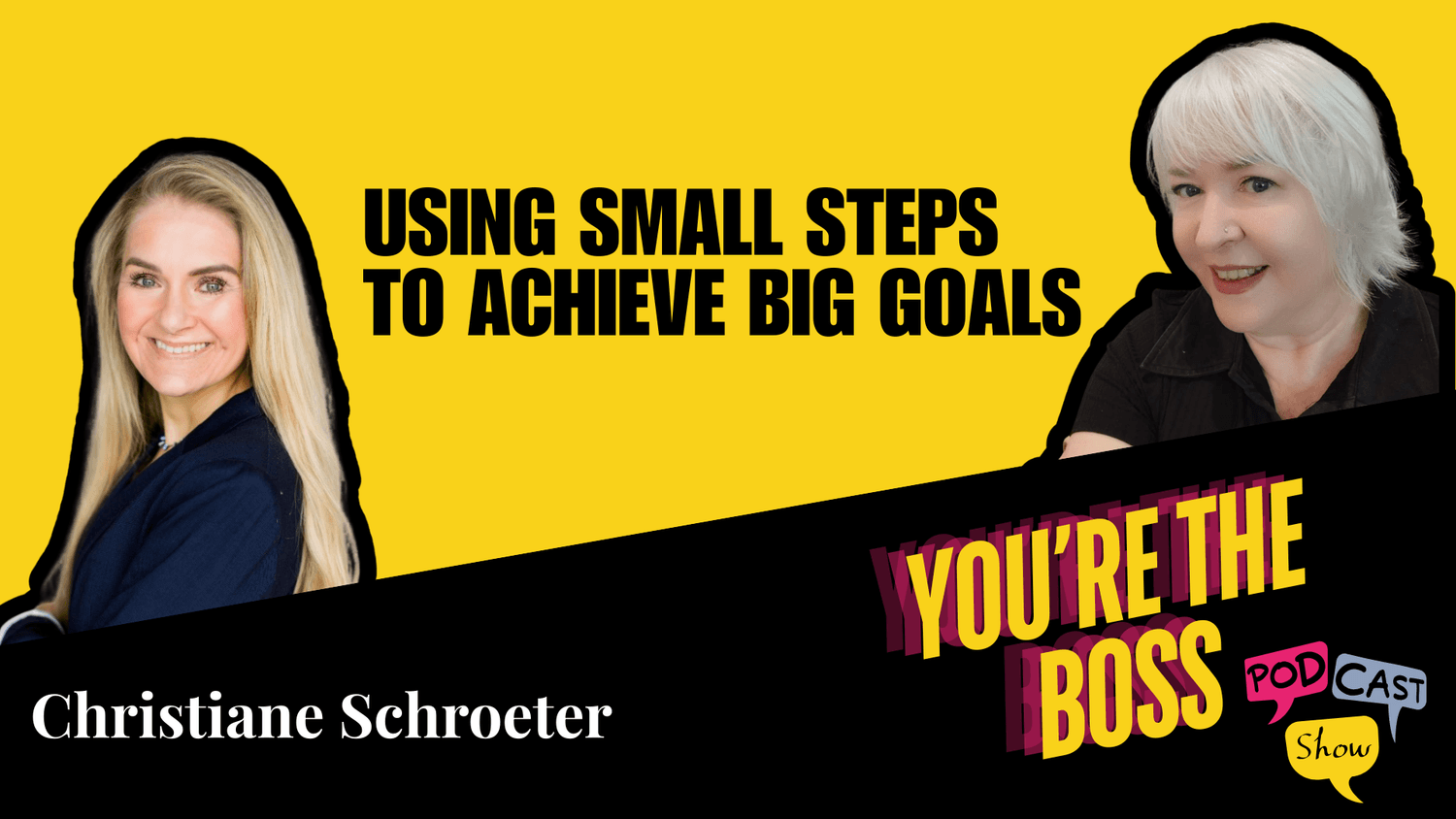
Click the image above to watch
Ange Dove (00:01)
So, welcome to You're the Boss Podcast Show. And today I have with me Dr. Christiana Schrouter, and she helps leaders build real confidence and move through change with clarity and momentum one step at a time. A TEDx speaker, Fulbright scholar, professor, and best-selling author featured in Business Insider. She hosts the top 100% Happy, Healthy, Hustle Podcast. So, Christina.
C Christiana, welcome to the show.
Dr. Christiane Schroeter (00:33)
Thank you so much. Yeah, it's the the top one percent. I was like, it's one half percent great, and then the top one percent. I love that.
Ange Dove (00:39)
Like yeah. So Christiana, just tell us a little bit more about yourself so we have context for what we're gonna be talking about today.
Dr. Christiane Schroeter (00:50)
Yeah. Yeah, so I you can tell by my accent and my name came from Germany about twenty-seven years ago. Now live in California where I'm a full professor here at the university. So I came for my graduate program on a Fulbright scholarship for my PhD and moved around the United States, worked at a couple of institutions before I took this job here teaching marketing, innovation, sales, entrepreneurship.
And I run my own business. So I think that in general you're giving a much better educational perspective if you actually build a business from the ground up. So Doctor Christiane is my coaching business. It is where I publish my books, of course run my podcast, and I give my keynote speeches.
Ange Dove (01:39)
So who are your main clients mostly?
Dr. Christiane Schroeter (01:41)
Yeah. So in general, I'm just gonna focus it around attributes. Struggling with overwhelm and I actually more like to use the word and and just feeling like maybe overambitious. So highly educated, highly ambitious leaders that really feel they have big goals, but they don't know how to break those big goals into attainable steps.
Ange Dove (02:05)
Okay. All right. So they may be feeling a bit overwhelmed with everything they've got. Probably is it a case of like too many ideas going around at one time and not being able to execute them all or?
Dr. Christiane Schroeter (02:16)
Mm.
It could be and it could be again it's it's mostly highly highly educated, having a lot of ideas and also of course feeling that you're kind of going for scale, but it would be at the sake of maybe sacrificing something else in your life. And so more really feeling like how can I scale this in a more mature, in a more human way, so that I can still lead a normal life.
Ange Dove (02:24)
Mm.
Ange Dove (02:48)
Mm, okay. All right. So and then you mentioned that you do keynote speaking as well. So what's your main topic that you talk about on keynote?
Dr. Christiane Schroeter (02:53)
Yes.
Dr. Christiane Schroeter (02:57)
Yeah. So the main topic really is, and it it's interesting that I am a keynote speaker and I'm talking about this topic is how can you build more confidence? How can you show up at a meeting and speak up and leave the meeting feeling good about what you shared with the room? So it's really the quiet confidence that you need to build. You don't need to be the loudest in the room, but you need to be a voice that's being heard and seen for who you are, again coming back.
To the education and the skill level that you most likely have. Many times people are very skilled when you educated, but they lack confidence. So that's the classic imposter syndrome that we really talk talk about, excuse me, being in that what I call imposter zone, right? So a little bit like thinking about even though you're skilled because you don't share.
People don't even appreciate all of the knowledge that you have. So how can you show up, share the knowledge, and of course make your voice and opinion being heard? And that is something that very many people are scared of. And it could be, you know, they're they're overall, you know, maybe don't get the opportunity, but it could also be when there is an opportunity, they don't say yes to it because they are afraid to fail.
Ange Dove (04:20)
Right, okay. And i is that okay, so you mentioned imposter syndrome, right? Is is that a fear of failure or is it more to it than that?
Dr. Christiane Schroeter (04:24)
Mm-hmm.
Dr. Christiane Schroeter (04:29)
Hmm, there is definitely more to that. So I I kind of look at this imposter syndrome as like a zone of four quadrants, right? So on one of the axes is your ability, and on the other one is your confidence. And you really start out with you might not know a lot, so you have low ability, and you have low confidence because you know you don't know a lot. And one way to get out of that.
Quadrant right there. Let's just call it quadrant one, low ability, low confidence, is that you need to learn more. So you learn more and you become more educated. And then it comes to the point where maybe, you know, business owners are frequently in that situation, soloprinter especially, you're very educated, very knowledgeable, but because you don't share anything about it, you have the feeling that.
Ange Dove (04:59)
Yeah. Yeah.
Dr. Christiane Schroeter (05:26)
You don't have the confidence to speak up because nobody ever gives you a high five about what you're doing, they're not praising your progress. And that's really the classic imposter zone. So you have low confidence but high reality. And the only way to get out of it, and I set it up perfectly this way, is that you still need to start sharing your wins. You need to start sharing your weekly wins. You need to have
Ange Dove (05:34)
Yeah.
Dr. Christiane Schroeter (05:52)
conversations with others where you say, all right, I worked on it and I did it this way. And I really moved clients from here to there and I scaled by this many percentage points. So you just need to start sharing your progress in a way that it feels natural, not bragging. And that will also build you confidence because you hear it out loud. And so ideally that top quadrant, high ability, high confidence is really where you want to get.
Ange Dove (06:22)
I love that. Never heard it explained that way. That's actually really clear for me to actually understand that. Yeah.
Dr. Christiane Schroeter (06:26)
Yeah, that's that's I share that in my books. So that's really when I think about things, I always think that it's a visual connection between content and creation. And in this case, because I have a PhD in economics, it works out that mathematically you can just put it in a quadrant, right?
Ange Dove (06:35)
Yeah.
Ange Dove (06:47)
Yeah. Yeah. Nice, nice. So you've taken one area of expertise and put it into another, right? And to actually help people to do that. Nice. Okay. So so what advice would you give for someone who needs to get out of imposter syndrome? You so you've mentioned sharing your wins. Is that it? It's just getting out there and sharing, just becoming more confident. Is pr is it practice?
Dr. Christiane Schroeter (06:52)
Exactly. Yeah.
Dr. Christiane Schroeter (07:03)
Mm-hmm.
Mm-hmm.
Dr. Christiane Schroeter (07:12)
It's definitely practice and it could already start with practicing sentences that you can use at the next time when you are in a meeting. So you have those sentences ready on your tongue and all what you need to do then is say that one sentence. As as simple as it sounds, is actually quite hard, right? So most of the time you might be sitting in a meeting and you don't have any intent of speaking up because you feel you are not capable.
Ange Dove (07:18)
Mm.
Dr. Christiane Schroeter (07:40)
Where in reality you are capable, you just don't feel capable because you have this low confidence. So what you need to do is you need to prepare sentences that show your capability and show your ability, and you need to have those ready. And it could just be starting with one sentence, and when the opportunity comes up in that meeting, you're going to get that one sentence out. And that's my petite practice, my very first small step. How can I make that one sentence in that?
Ange Dove (08:05)
Okay.
Dr. Christiane Schroeter (08:08)
One hour meeting, you I'm just gonna get that one sentence out. And that's it. You don't need to start with like a fifteen minute protocol of like a PDF you created. Just one sentence, leave the meeting and feel good that you got that out there and your confidence will increase that maybe next time it's gonna be a little
Ange Dove (08:25)
Yeah. So this is the step by step, just one step at a time kind of principle that you have, right? So tell me more about that. what compu what do people need to know about doing things one step at a time progressively?
Dr. Christiane Schroeter (08:32)
Correct.
Dr. Christiane Schroeter (08:38)
Yeah. Well, we talk we started talking about overwhelming and maybe even feeling overburdened with these goals and that we are maybe not feeling there is enough time in the day to get everything done. So now you're looking at your calendar, you got all these meetings, you're like, I don't have time to prepare for all these meetings. But yeah, I am telling you it's just one sentence. And look at the one sentence is the one step to move from this.
Ange Dove (09:03)
Mm.
Dr. Christiane Schroeter (09:08)
low confidence, highly educated quadrant out of the imposter zone into a zone of excellence where really people seek you out for how capable you are, but you also get confidence for that. So the the one sentence rule fully applies here, the one-step rule. And I think we can all prepare one sentence. Even if you have you know six meetings per day, you can even use the same one. Nobody might notice.
And you you can practice it first to yourself. You just say it out loud, right? So the importance really is you choose how you want to get started, whether that's saying something out loud about your accomplishments, or whether that's maybe changing a habit by just doing something that you really want to do for five minutes. You choose how you want to get started. But the key point really is.
Ange Dove (09:40)
Yeah.
Dr. Christiane Schroeter (10:04)
that you break it down into the smallest possible step and you get started today.
Ange Dove (10:09)
Right. Okay. Nice. I like that. And and then when you mentioned just that like that one sentence or whatever and maybe you can repeat it throughout the day in every meeting you go into, right? And I think part of marketing is repetition, right? We make it try to make it so complicated that we we have to do X, Y, Z and I have to come up with a new way to say this. And I'm like, No, you don't. You just say the same thing over and over and over again and it's gonna stick.
Dr. Christiane Schroeter (10:17)
Mm-hmm.
Yeah. Yeah.
Dr. Christiane Schroeter (10:34)
Mm-hmm.
Ange Dove (10:39)
Right. So and and I'm sure when you go into podcasts you're you're saying the same thing, the same principles, right, over and over and over and over again. And you come across so confident because you've said it so many times, right?
Dr. Christiane Schroeter (10:40)
Yeah.
Dr. Christiane Schroeter (10:54)
Yeah, and I think what helps too is that you become passionate about it. So it needs to come from a point of authenticity. It cannot just be like a memorized sentence that you kind of rattle down. because see we use the word overwhelm and confidence and ability, but you might say completely different, which is why it's so important that
Ange Dove (11:03)
Hm.
Yeah. Yeah.
Dr. Christiane Schroeter (11:19)
you choose the first step in a way that it feels natural to you because otherwise it will not come across as genuine and it will not make you look like you're actually capable at all. It will be like, what was this all about now? So which is why sometimes when for instance I gave a TEDx talk, right? That sometimes people think all what it takes is to memorize a talk and get on the stage and share the talk.
Ange Dove (11:31)
Yeah.
Yeah.
Ange Dove (11:38)
Mm, mm.
Dr. Christiane Schroeter (11:47)
Where reality, that's like the very first step to memorize the talk. There's so many other small steps after that. It needs to look really natural and that's really way beyond memorization. So again, if you have one sentence that feels nice and natural to you, you could repeat that sentence until you learn how to maybe swap out a few words here and there, but you're
Ange Dove (11:47)
Yeah.
Dr. Christiane Schroeter (12:14)
as you mentioned, you'll be just using it over and over.
Ange Dove (12:20)
And I think sometimes as well we fall into this comparison trap as well.
Dr. Christiane Schroeter (12:24)
Mm-hmm. Yeah, yeah.
Ange Dove (12:28)
trying to model off other people doing something. Whereas you you've mentioned that it should be it's your choice. You should be doing it your way, right? Can you speak to that? Yeah. Yeah.
Dr. Christiane Schroeter (12:36)
Mm-hmm. Completely. Yeah. Yeah, because for let me just give you an example, right? I have a long list of things that if I if I tried something, I would never use that long list of things. Like for instance, my podcast is called Happy Healthy Hustle. And I personally don't think hustle is necessarily a like a negative word because to me it just means you're kind of getting things done in a quick way.
But other people might sign say something like, like you're grinding, you're like, you know, on a deadline, or you're you're you're it's you're in the grind or in the you're like in the in the drop zone or some like sports related terms. And it's not natural to me. So you always need to think a little bit. terminology is very cultural, but it's also really saying a lot about who you are as a leader.
Ange Dove (13:14)
Hm.
Dr. Christiane Schroeter (13:33)
So eventually, because it seems natural, you're establishing yourself as a brand because you use some words more than others, and because they are natural. And this is actually a great comparison for my TEDx talk. When I memorized it, there were sometimes parts in my TEDx talk or even in keynote speeches where it just you do it over and over again and you always get stuck at the same time. And then all of a sudden you're wondering.
I don't think that that's the way that I would say it. And then you need to modify it. And all of a sudden you eliminated that little bump in the road. It's the same thing with your confidence. If you feel that what you're about to share doesn't even feel right or it doesn't sound right when you say it out loud, try to explain it to somebody who's really dear to you. And then all of a sudden you realize how it rolls off your tongue differently then.
Ange Dove (14:09)
Yeah.
Ange Dove (14:29)
Yeah. Right.
Dr. Christiane Schroeter (14:29)
because that person knows you and they would tell you also like that doesn't sound like you, right? And and then all of a sudden you got it, right? That's the secret formula really, that you just start small, but you start doing it in a way that it feels you can expand from there in a very natural way.
Ange Dove (14:35)
Yeah, yeah.
Ange Dove (14:40)
Nice. Yeah.
Ange Dove (14:48)
Yeah, so it's just being true to you, being authentic as to who you are, speaking your language kind of thing, right? I love that. Right. So what I want to talk a little bit about today as well is this whole change in the world that we're seeing, like everybody's lives are kind of being upside down kind of thing, with all the change in AI and there's a fear of will I still have a job?
Dr. Christiane Schroeter (15:10)
Mm-hmm. Yeah.
Ange Dove (15:15)
you know, what's gonna happen in and it's changing so fast as well. I don't think we've ever seen such a rapid change in the way things are done, right? so what advice would you have for people who maybe are fearing that this that they're uncertain about the future and what should they be doing to prepare? and how for maybe having
Dr. Christiane Schroeter (15:22)
Mm-hmm.
Ange Dove (15:42)
different choices in their life for what they can do because they may not necessarily have a choice if say for example they were made redundant. That's not a choice that they are in control of, but what can they do in their lives to be in control of what happens next.
Dr. Christiane Schroeter (16:00)
that's a beautiful question. And it ties in with what we talked about just a little bit ago. So if you make yourself known for somebody who could be sought out as an expert leader in communication or in keynote speaking or even in preparing a speech, these are all tools that yes, you could write your speech in AI all day long, but at the end of the day,
you will still need help in actually memorizing it and getting it to your brain. And there will never be the point to where you will have this AI model standing on stage. Well, I don't still want to say never, but to this point, we don't have these robots standing on the stage and just regurgitating a keynote speech. Because it is a completely different experience. So you need to think, where can I make myself show up more to show
Ange Dove (16:41)
Yeah.
Dr. Christiane Schroeter (16:58)
the human side of me. So we can all write emails and text messages and even create, you know, PDFs. But will there is there like an interactive component to where I can explain something on top of this PDF or on top of this email that will make me be like a sort odd you know leader? And that's really where it comes in that when you explain things, when you maybe
show people warmth and connection and community. That's really where I think you know your edge will be to remain in the marketplace and in the job place, of course. And then on top of that, I would nearly look at it in two ways. A, you can make yourself more human, but B, don't fight AI. Just start learning about it too. Because the more you learn about it,
The more you understand it's not a competition with you. You just need to understand what the shortcomings are, right? It's it's nearly like you want to make yourself more human, but at the same time, you also want to understand AI more so that you can fill in the void with your human behavior. And I think that sometimes people are like, Well, I just don't like AI. And it's like, Well, you know, I I felt sorry for you because it's it's the same thing, like whatever.
Forty years ago, when people say, I don't even use computers, I don't want to use cell phones. it's n you can't you can't stop it. I'm sorry about that. I mean, I have bad news for you. It will not go away and it will only grow by by saying I don't like it. You're essentially making yourself, you know, unattractive for a company that wants to move that way. So you need to write away.
Ange Dove (18:27)
Is it yeah. Yeah.
Ange Dove (18:36)
Yeah.
Ange Dove (18:48)
You're you're you're essentially making yourself redundant, right? Yeah. Yeah. Yeah.
Dr. Christiane Schroeter (18:51)
Yeah. You need to ride the wave, but at the same time, you also need to watch the waves and think a little bit where the trends are going. So it's nearly like, you know, you're looking at the ocean and you're trying to understand more what's the best time to go surfing. And also stay out of the surf when you feel it's like, you know, becoming like a little too crazy out there. So you're stepping back and you're like, I understand.
Ange Dove (19:00)
Mm.
Dr. Christiane Schroeter (19:18)
But this is risky behavior. I understand this because I'm human. I understand this, right? And so that's really how it works.
Ange Dove (19:25)
Okay. So so basically you're you're encouraging people to to become known for what they do, some particular skill that they have to offer the world, so that whatever happens in their life they've still got that and they can still be useful to s people, right? And then just treat AI as a tool because that's what it is, right? It's just another tool. and not to be not to be afraid of it, I think it's like
Dr. Christiane Schroeter (19:35)
Yeah.
Dr. Christiane Schroeter (19:42)
Yeah.
Ange Dove (19:55)
Like when when Chat GPT first came up, I was a copywriter. So my job was one of the first to go, if you like, because it was the the natural thing. Yeah, this was a writing tool, basically, first of all. it's changing now, of course, but
So this this idea of okay AI's taken my job, right? Is one way you can look at it. Or you can look at it as, okay, well, how can I now enhance what I do with this tool? Right. So that's that's the the the way I approached that. But it took it took a a while. It took a while to accept, okay, my life has changed now because it's and this is a thing as well, it's because you you're dealing with helping people with change.
And I always say to to people that I coach is change is inevitable. You can't stop change, right? So it's just how you deal with it when it comes up. So what what piece of advice could you give people in terms of being able to handle change like emotionally and and actually make progress through coming out the other side of it?
Dr. Christiane Schroeter (20:47)
Mm-hmm. Mm-hmm.
Dr. Christiane Schroeter (21:07)
One important thing that we could all do is understand that the more we use AI or the more AI expands and breaks boundaries, the more we also need to understand that we could take advantage of it to create more time for human connection. So instead of thinking, I am.
And being completely useless, think well, I could teach people how to use AI and improve their speaking skills or their confidence. And because I can create things in AI that would help them tools, I can maybe scale my business completely differently now. So, in a certain way, I can create more human connection because I don't need to spend so much time.
in c in in reading their speeches anymore. I can have an AI tool that checks on spelling mistakes much quicker or repetition in a speech or how is the hook here and there and I can analyze it. And so you don't even need to use it to write the whole speech. You can create analytical tools. And at the same time because I do that, I can spend more time over here and help them improve their body language or the memorization skills.
how they show up on stage, et cetera. So you need to think a little bit of like, I want to use it as an efficiency. And I'm actually so knowledgeable about copywriting that all that I'm doing is I'm just shifting my pivot to a more human approach. And I'm going to help people become better, you know, authors or copywriters or presenters, because I know so much about copywriting that I can make you even better than you were before.
Because I have these AI tools.
Ange Dove (23:08)
Yeah. I get a lot of people saying, it's like there's AI slop and all this kind of stuff and AI is no good at writing and it I'm like, No it is, it is actually a very good tool to use if you know how to use it properly, right? And you can use it to help you.
Dr. Christiane Schroeter (23:21)
Mm-hmm. Right. It's a little bit, you know, I I say because I I'm a fitness instructor too. And to me, it's it's just like in the fitness market, right? You might not have a gym membership because you decided it is much easier to just buy an at-home treadmill. It's kind of like with with with AI, right? You don't need to hire somebody because you could just do it at home. All right, so now you have your at home treadmill.
You still have to get on it and you have to know how to use it, right? And even then so, you still have to do a lot of the work yourself. It's not like by just jumping on a treadmill your life will transform and you becoming the next fitness model. It's not. So there's a lot of ways to use it improperly. And in general, you still have to do a lot of work. So yes, maybe you're not going to a gym, but no, it's not the same experience because here you are by yourself.
Using our home treadmill, quality isn't that good. And you are like, well, you know what? I kind of miss my friends at the gym over there. And the quality of that equipment is totally different. And that's the same thing. You're like, you know what? I miss my copywriter. That was like a totally different thing. So why don't I go back to that? And so that's that will happen, right? I mean, change is inevitable, but you just kind of need to figure out how to maybe
pivot in a way that it feels you're taking advantage of both worlds in a way that it makes it more efficient to your goals. Because we all have different goals, but you just need to really figure out where is it on the spectrum of using AI where you are. And I hope that nobody will be like, I don't want to hang out with anybody at all anymore. I'm just going to be me and my chat GBT. It that will not happen. Yeah.
Ange Dove (25:12)
Hope not, yeah. Yeah. Okay, so so you mentioned goals there. So you obviously help people with goals as well. So one thing that I I came across a tool quite a while ago where and it it's something that's okay, it sounds so simple when you know it, it's simple, but until you know it it
It never crossed my mind, right? Was this this idea of you've got your sort of short, medium and long-term goals, right? And you can sort of plan out your execution of your goals so that you're gonna meet your long-term goal at some point. But what then usually happens during your day is things get in the way and they stop you, right? On your you're constantly fighting fires instead of actually going through and and meeting your goals. And this tool actually made you like plan out what your goals were, like your short, medium, long-term goals.
But also every day one of the tasks on your list to do had to be something that took you to your long term goals. So you were never completely, yeah, I'll I'll do that tomorrow. You're not pushing it your long term goals aside for the short term immediate things that you have to take care of, right? So so what what's your principle for that in terms of people meeting their goals?
Dr. Christiane Schroeter (26:29)
Mm-hmm.
Dr. Christiane Schroeter (26:36)
Mm-hmm.
Dr. Christiane Schroeter (26:40)
Hmm. Yeah. So petite practice follows that exact principle. You have your big goal, and because it's big, it it's long term. Right. Let's just say, big goal is I'm going to start a podcast. That's not something you just do tomorrow. You're like, my gosh, yeah, I am have a running podcast. Like nobody has done this, right? So big goal, run a podcast, write a book, get on on stages, right? TEDx, who knows what it is. Big.
So that's your long-term goal because you you have to take small steps to get there, see small petite practices. So what I say is, cool, you got your big goal out there. So now let's start simplifying. And because I'm using STEP so much, I actually use the acronym STEP, S-T-E-P, right? So big goal, but now let's simplify it. Let's take all the little steps that get us there.
Ange Dove (27:27)
Okay.
Dr. Christiane Schroeter (27:37)
Let's write them out. And I like using like sticky notes. I'm like a very visual person. I'm like, okay, podcasting. We want to become a podcast. So what do we need to do? Maybe explore the topic areas, maybe explore the niche, maybe explore the cadence. How often are we going to publish this thing? is it going to be video or just audio? There's all these different things, these deciding factors. So let's just write them down. These are decisions that don't need to be all made today, but in the long term, they will be made because you will be eventually running this podcast.
And then take a look at all your sticky notes that you write down. And then you have to grab one from the wall and you actually have to do it, right? So you're like, my gosh, there's so many decisions I have to make. Overwhelming. And then I'm like, remember what I just said? Long term. Okay? So maybe in a year you do this. So right now, let's not take too many sticky notes down because you're going to steal your own thunder and you're not going to make your long term goal. It's going to be a short term goal. Take down one sticky note and you're like, okay, I pulled down the one sticky note.
that says, how often am I going to publish this?
And then I'm like, well, let's not get too ambitious here. Let's just say once per month. Okay. And all of a sudden it's like, wow, I have a plan. I'm gonna have a podcast once per month. Okay. And so you need to take action on that. So once per month you have your cadence determined. And there is so much behind this consistency of making decision.
that it feels less overwhelming than just sitting down and thinking about it all in in one big swoop. So every single day you have to revisit your board with your goal and you have to take a look at that long-term goal and you have to take another small step and take it down another one until there's no more sticky notes left and all of a sudden you're like, wow, hey, accomplished a lot. And and some of these sticky notes might have been like record a very simple short episode, five minutes on your cell phone.
Dr. Christiane Schroeter (29:39)
May maybe one sticky note was by all means do not purchase a lot of expensive equipment, right? so you need to think a little bit of like asking maybe even other people that have podcasts, what are some of the biggest failures that you did? What are some regrets that you had? And and don't go like for the podcasts that have been running for like 15 years or something because they might not remember. But also there will be doubts.
Am I really doing this? And then go back to the ones, all the people that have been running a podcast for 15 years and listen to their first episode and you'll be like, my gosh, that's like really scrappy. And all of a sudden you're like, okay, never mind. I can do this. I can do this. Because there's like there's a moment and it's like it sounds so good. We cannot do this. And then you go back and listen to the episode one and two and three. You're like, whoa, no, I can do this.
Ange Dove (30:27)
Ha ha ha.
Ange Dove (30:32)
That is so true. Yeah. That is so true. And that gives you confidence actually because then you can listen to that so well if they're that good now and they were terrible then, okay, and I could do better than that now, right? Yeah. Yeah. Yeah. Yeah.
Dr. Christiane Schroeter (30:44)
Yeah, you can't compare your yeah, can't compare your episode one to somebody's episode one thousand three hundred forty-nine. They got it down. You don't. And that's okay. Because it it's it's a little bit like what we talked about the ocean, right? It comes, it goes, it comes, it goes. People set podcasts, they drop out, you come in, you're not going to drop out, and you can and and quite honestly, let's talk about this. You might start podcasting.
Ange Dove (30:52)
Yeah. Exactly. Yeah.
Ange Dove (31:00)
Mm.
Dr. Christiane Schroeter (31:13)
And I just said you might not you will not drop out. And then I actually I have to take this back. You might drop out. Because you know what? You might realize after take all these sticky notes down that it's not something you actually enjoy. And that is so tremendously important. Because imagine you wouldn't have realized that. You would have always wondered, I wish I would have started a podcast. But then you're running it and you're like, I don't like it at all. I don't like the whole like voice recording situation, talking to people is not my jam.
I just don't want it. And and then that's great, right? I mean, that's obviously something that is a tremendous amount of learning. And I have sometimes people that I talk to, they say, Well, I failed at podcasting. I'm like, did you? Because failing to me means that you actually never got started, but you did. The fact that you tried it and it didn't work is not a failure. It just was your first attempt in learning, F-A-I-L.
Ange Dove (32:02)
Mm, mm. Yeah. You choose.
Dr. Christiane Schroeter (32:11)
You learned and so you didn't fail. It was your first attempt. And so cool, just put it aside. You don't have to be sticking to what you said your big goal would be. Nobody's gonna be like the big goal police, like, well, you said you would do it. But you just put it aside and it's like cool, moving on.
Ange Dove (32:16)
Yeah. Yeah.
Ange Dove (32:29)
Yeah, that's so true. It's like, also when I'm coaching people on building their brand, right, building their personal brand, and they get stuck on who am I supposed to be? Right? What am I supposed to do? And I'm like, whatever just go ahead and do where wherever you are now, do what what you are now. 'Cause that's all you can do, first of all, is you can only go with what you've got and
It's not set in stone. You can change your mind later. You don't have to go with this the whole time if you find and and usually I think as well is you learn by doing, right? You go and like as she said with the podcast, you you go and try, you find out, and then you get more information along the way. And all those pieces of information that you get will then inform you of what to do next, right? You will then decide that yeah, you know
Like for example, if you're a new coach and you don't really know your clients very well because you haven't got many, right? But the more you coach and the more you start talking to people and understanding what it is they want, you can then realise, okay, this is where I should be, this is how I can help people best, not this way, which I started out with. Right. And but you don't know that information until you actually try, right?
Dr. Christiane Schroeter (33:47)
Completely true. It's actually the motto of my universities Learn by Doing. Because we really always say you just have to do it. It's not otherwise we can we can tell you all day long podcasting is going to be your jam. But until you actually do it, we will not know it. It's kind of like when I go to a shoe store with my kids, I could tell them all day long that these are going to be the shoes that they need to get.
But until they put them on their feet and try them on, we will never know. And I could buy them and they will sit in closets for years. So they have to physically put them on, walk around and say, These are the best shoes I've won in all my life and then we have something, right?
Ange Dove (34:33)
So Christiana, is there anything that we haven't touched on that you think would be useful to the audience?
Dr. Christiane Schroeter (34:40)
Yeah, brilliant. Quite I have my new book coming up four weeks on today.
Ange Dove (34:43)
Mm-hmm. nice. Okay. And what is that called?
Dr. Christiane Schroeter (34:47)
So big goal for me was write a book after my TEDx talk. My TEDx talk was on August sixteenth, two thousand twenty-five. And I set myself the big goal. I'm in one year later, August sixteenth, two thousand twenty six, I'm going to publish my book.
Ange Dove (34:52)
Right.
Mm-hmm.
Ange Dove (35:05)
Yeah.
Okay. And what's it called?
Dr. Christiane Schroeter (35:11)
Petit practice.
Ange Dove (35:13)
Pretty practice. Nice. Nice. And then is it available for pre order at the moment?
Dr. Christiane Schroeter (35:20)
Well, you can join my launch team to get an early release and a whole bunch of perks to read the book and get started right away. And you can sign up. I call them the Petite Practice Pioneers. So go to my website and then backslash petite practice pioneers. You can sign up for free. You get free goodies, free love, and free petite practices all along the way.
Ange Dove (35:35)
Uh-huh.
Ange Dove (35:47)
Okay, so the link will be wherever you're listening or watching this podcast, there'll be a link to Christiana's website and you can go and support her launch. Alright, Christiane, thank you so much for your time today. It's been wonderful getting all of this information about how we can manage change. Thank you so much.
Dr. Christiane Schroeter (36:10)
Thank you.
Don't leave without your free gifts

Check out my page of freebies designed to help you make progress towards your goals.
From free training on making $10,000 months to how to create your brand message to access to the resources I use in my business that may help you too!
I've got some
gifts for you!
Check out my page of freebies designed to help you make progress towards your goals.
From free training on making $10,000 months to how to create your brand message to access to the resources I use in my business that may help you too!
About me

Hi there 👋 My name is Ange Dove, professional copywriter and messaging strategist. I help Gen X professionals find the words to express who they have become, and to build a career or business that owns it.

GET YOUR UNCHAINED AUDIT
Let’s have coffee online for 60 minutes on Zoom, where we'll look at your profile, your message, and your next chapter together and give you the roadmap to take your next steps.

GET THE NEWSLETTER
Straight-talking insights for experienced professionals who want to turn what they know into income, options and greater freedom over what comes next.


