Call: +65 6012 3433 | Whatsapp +65 87792453
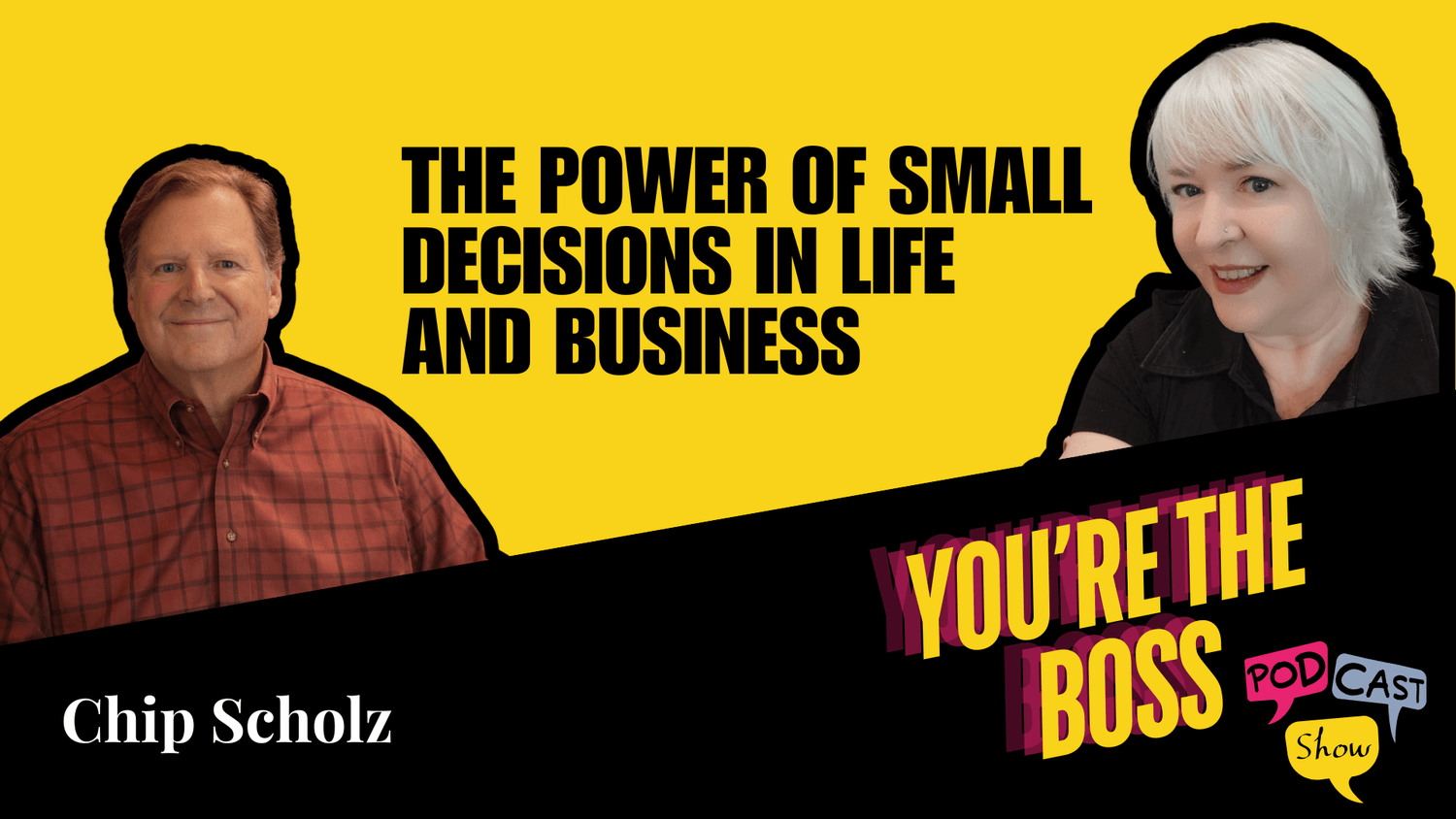
The Power Of Small Decisions In Life And Business
Click the image above to watch
Ange Dove (00:01)
Welcome to You're the Boss Podcast. I'm gonna start that again. Hold on. I'll cut that out. Okay. Welcome to Your The Boss Podcast Show. And today I have a very interesting guest with me, and that is Chip Scholz. And he is an executive coach, author, storyteller, and someone who spent a lifetime asking a simple but profound question. How do people become who they become?
Now, this is a question right speaks to my heart. So I'm very excited to speak to Chip today to find out about that. So through conversations with leaders, families, business owners, and everyday people, Chip has discovered that the moments that shape our lives rarely arrive with fanfare. More often they are small, they're found in small decisions, unexpected detours, difficult conversations, and the quiet moments that change us before we even realize it.
So, whether he's talking about leadership, family, purpose, legacy, or what a wood shop can teach us about life, we will get into that. Chip has a gift for making big ideas feel personal, practical, and deeply human. He's the author of Small Decisions, Big Shifts, and Every Dog Has Its Day. And today we're going to explore what it really means to live and lead with intention. So
Chip Scholz (01:08)
Mm.
Ange Dove (01:29)
Chip, welcome to the show.
Chip Scholz (01:32)
Angie, I am so thrilled to be here. It's not every day I get to talk to Singapore.
Ange Dove (01:35)
Yeah, that's great. Yeah. This is what I love so much about doing this show is I get to speak to people from around the world. And I just, you know, it it's the highlight of my week actually when I get to do these podcasts. So I'm so excited to talk to you today. So so just let me know, just your background first of all. What is what is it that you do now? How and what were the events that led up to what you do?
Chip Scholz (01:52)
Yeah.
Chip Scholz (02:01)
Yeah, I've been an executive coach for about 27 years and God, you know, that's half a lifetime for most people and it's a whole lifetime for other people. I can't even believe that I've been doing something for 27 years. I'm not one of those people that, you know, usually I guess stuck with things about three years was about the most before. But I ended up getting into this because I got laid off and may have 98 from a job as a lobbyist.
And I was lobbying on the West Coast for BFI, a trash company. I think BFI was in Singapore as well, anyway, that was long time ago. And I had the chance to reinvent myself. I had the chance to change everything. And instead of staying in LA, we'd only been there for 13 years, which is a long time too, but...
Ange Dove (02:31)
Okay.
Ange Dove (02:37)
Okay.
Chip Scholz (02:59)
We'd been there for 13 years and it gave us the opportunity to do something different. And so, you I got laid off, I called my wife and I said, I just got the package. My wife said, good, what does that mean? And, and you know, what, what do you want to do? And I said, you know, I really want to do something on my own. I don't want to do, I don't want to work for anybody else anymore. And,
Ange Dove (03:19)
Okay.
Chip Scholz (03:27)
And so I also knew that I didn't want to do it in LA.
Ange Dove (03:32)
Right. Okay. So where were you originally from?
Chip Scholz (03:35)
I'm originally from Chicago. Yeah, I grew up in Chicago, got old enough to know better and left, moved to Atlanta and Charlotte and Atlanta and Tampa and then LA.
Ange Dove (03:38)
Okay, okay. So
Ange Dove (03:44)
okay.
so either both both sides of the coast, right? so yeah, I'm intrigued about the the idea that okay, so the getting laid off was the catalyst then for you to make that major change and decide, okay, I'm gonna do something completely different. So at the time that you did that, what were you thinking in terms of what was there fear or was it just determination and I'm gonna go for it? Or what was the thinking at the time?
Chip Scholz (03:51)
That's right.
Chip Scholz (04:16)
Well, I, you know, it's hard to go back and think about what I was thinking at the time, but I surmised that when I got laid off, I was pretty well known in the community. I'd done all kinds of charitable things and I was the face of BFI in the communities that we serve. So we were in the South Bay area of LA. And if you know anything about LA, LA is not
Ange Dove (04:32)
Right.
Chip Scholz (04:45)
one city. There's 91 cities in LA County. so, yeah, and so I have to live in Palos Verdes and I hung out in the beach cities, Redondo Beach, Hermosa Beach, El Segundo, Torrance, and you know, so I was a South Bay guy. And I knew a lot of people. I mean, I knew a lot of people and elected officials and just people in the community.
Ange Dove (04:49)
really? Okay.
Ange Dove (05:11)
Right.
Chip Scholz (05:15)
It would have been awfully tough to pivot there. And I think that was the one I was thinking. I think it was very difficult to pivot. It was an expensive place to live. And one thing about California is you could leave, but you can't come back. know, once you have left and torn off the band-aid of high real estate prices, you're not going back. The house we lived in,
Ange Dove (05:40)
Okay. All right. Okay.
Chip Scholz (05:44)
We sold for 675,000, which was a lot at that time. And today it's 2.4 million.
Ange Dove (05:47)
Yeah. Mm-hmm.
Yeah, yeah. Yeah. The prices in Singapore are I think exactly the same. They've just gone up crazy, crazy amount. Yeah. Yeah.
Chip Scholz (05:59)
Yeah, yeah, yeah. So, you know, once you leave, if you're in that cycle, you can stay in that cycle. getting out is difficult. But it was was it was just, you know, we I had always liked the Carolinas. There were things that that my wife and I were looking for. wanted to make sure that we could play golf most of the year. We want to do, you know, we went to the movies quite a bit. We like to go out and eat and, you know, we could do that all here.
Ange Dove (06:04)
Yeah.
If you leave. Yeah. Yeah, it's definitely.
Ange Dove (06:22)
Okay.
Ange Dove (06:29)
Right. So how did you then go about rebuilding your brand in South Carolina South Carolina, was it, you said? Or North, North Carolina. So how did you go about building your brand there and doing something completely different? What was the process?
Chip Scholz (06:37)
North Carolina.
Chip Scholz (06:46)
God, I made a lot of mistakes and I was a horrible failure at it for about five years. just, you know, I had some good years and some bad years, but overall, you know, what I found is that the more performative I got, the more that I faked it, the less successful I was. You know, and you always hear, fake it till you make it, right?
Ange Dove (07:07)
Mm.
Right. Okay.
Yeah, yeah.
Chip Scholz (07:16)
I think that is okay as far as it goes, but if you really want to build a brand and in coaching and in something that's a personal service, the brand has to include integrity, authenticity, all of that kind of stuff. And if you're faking it, you're not very authentic and you don't have lot of integrity in that.
Ange Dove (07:42)
Yeah.
Chip Scholz (07:43)
you know, that leads to being performative rather than useful.
Ange Dove (07:48)
Yes. Yeah. And and trust is such a big thing in doing business with people. So you've got to gain the trust for sure. That's the first thing that has to come, right? Is the trust. So yeah. so so how did you go about building your brand? You said you you just wanted to be authentic and I guess it was in North Carolina it's easier to do it that way than in Los Angeles, I'm guessing.
Chip Scholz (08:11)
you could be that way in LA. was just a total reframe when we came here and that was the benefit of it. So, if I look at the first five years, I was just still trying to figure it all out. I was figuring out who I was selling to, what I was selling, how I was doing, because I'd never been a seller-doer before. I'd always been in sales and then I handed it off to somebody that did it.
Ange Dove (08:30)
Mm. Mm.
Ange Dove (08:35)
Yeah.
Chip Scholz (08:40)
And now I was a seller-doer and all of a sudden I had to be as good as I could. So I get the referrals and that kind of thing. so I got really lucky. So I gave a lot of speeches around Charlotte. And one of the speeches I gave was to a group, the...
Ange Dove (08:40)
Right.
Ange Dove (08:51)
Yeah.
Chip Scholz (09:06)
Charlotte Rotary Club, or it wasn't the Charlotte, but was another Rotary Club in Charlotte.
Ange Dove (09:08)
Mm. Yeah, Rachel Club. Yeah. I was in the Rachel Club at one point. Yeah. Yeah.
Chip Scholz (09:13)
Oh, we're sorry. Yeah, I've been I've been in rotary clubs too, but the one of the guys in the rotary club came up to me afterwards and introduced himself as the head of the Southeastern Warehouse Association. And he said, hey, you're really good. I would I would love to have you come and speak at our conference. So I did, and I got to know him. I took him to lunch. I created the relationship and we got to know each other.
And he referred me to a couple of different people that I ended up doing some business with. And then I gave the talk that was in November, I think of 2005. there are a couple of significant parts of it. First of all, I had 70 business owners that were in room for two hours. And we had a great time in that discussion. didn't speak to them for two hours. It was a pretty interactive session.
The second thing is the head of the International Warehouse Logistics Association was there. And he came up to me afterwards and he said, hey, we really like you come have you come and speak at our conference in Vegas the following March. Yeah. And in the meantime, they fired the head of the IWLA, the executive director. I had gotten to know the president, the volunteer president.
Ange Dove (10:13)
Mm. Mm.
Chip Scholz (10:38)
and we hit it off pretty well. And they asked me to do all the assessment work for the candidates. And so I did. And the person that I recommended, they picked. And at the conference, they...
They asked me to come and tell them how to work with the new guy.
Ange Dove (11:01)
Okay.
Chip Scholz (11:02)
So here I'm sitting in a boardroom with 10 different companies and the guy that I picked and I had the chance to show my stuff. And you know, every one of those people became my customers. They were all clients.
Ange Dove (11:22)
See, that's interesting because it's it's that all sprung from one talk that you gave, right? And then it just building relationships from there with as you meet different people, becoming known, right? And then you get the opportunities and it's like I always talk about if you're invisible, the opportunities will just pass you by. Right. You have to get out there and be known, right?
Chip Scholz (11:33)
Yeah, yeah, yeah.
Chip Scholz (11:45)
Okay, so let me tell you a couple lessons I learned from that. One is that I was always a pretty good networker and those organizations gave me areas to network with. Second of all, I really didn't know that much about family businesses. I had always worked for big companies and publicly held corporations, I hadn't worked for a family business.
Ange Dove (11:48)
Mm, mm.
Ange Dove (12:06)
Yeah.
Chip Scholz (12:10)
And all of a sudden I learned all about family businesses because in the warehousing and logistics space, they're almost all family businesses. So, so I learned about that. Third thing is that it was a target rich environment every time I went to one of those meetings. So, so I had the opportunity to network with a whole group of people. And by the way,
Ange Dove (12:10)
Very different.
Chip Scholz (12:37)
the new executive director that I helped hire called me a couple times after the meeting and said, hey, what do you think about this? And I coach him through it. And after about four or five times of this, I said, hey, Joel, I do this for a living. And he said, I was kind of wondering about that. And so he hired me, he wrote a check out of his own pocket and he hired me to be his coach. So he became my biggest fan.
Ange Dove (13:02)
Okay. Nice.
Chip Scholz (13:06)
I ended up on the board of the IWLA as a partner member. At the time, they were running these regional meetings. So they ran like 10 regional meetings a year, which meant that he invited me to all 10 of those regional meetings to have about 15 minutes to speak.
Ange Dove (13:27)
Nice opportunity, right?
Chip Scholz (13:27)
And I did writing for the newsletter and all that kind of stuff. So here's the marketing strategy is, and I came to it kind of by happenstance more than, know, think, well, probably pretty intentionally as well. But it was to burrow my way into an organization. I became a member. I did all of the stuff that I had to do.
Ange Dove (13:32)
Right.
Chip Scholz (13:57)
And it got to the point where I haven't had to market in years.
Ange Dove (14:04)
That is really good. You know you've succeeded when you don't have to do any marketing. So it's just everyone coming to you. It's just word of mouth. They hear about you and they come to you. Yeah. That's that's fantastic. Yeah.
Chip Scholz (14:11)
Yeah, yeah, yeah, yeah, yeah. And it's kind of a wild garden with the IWA and the SWA, because everybody knows each other and, you know, so.
Ange Dove (14:19)
Yeah.
Hmm. Hmm. Hmm. Mm. So you got communities like that then that will just feed off what you're doing, give you, just refer things to you, and then you build from there, right? Really, really good. Really good. Really good. So so tell me, because I'm intrigued about this, tell me what you mean by what you said, what I said earlier about how do people become
Chip Scholz (14:36)
That's right.
Chip Scholz (14:48)
Becoming who you become.
Ange Dove (14:50)
who they become. So tell me what that's all about.
Chip Scholz (14:55)
I wrote about it in Small Decisions Big Shifts. didn't, yeah, I really didn't talk about it that much, but you know, the more that I've thought about it, I kind of want to write a 2.0 at this point. But we come to it by the small decisions we make every day. You know, it's not the big things. It's not deciding to move to North Carolina. I mean, that was a big decision, but there were about
Ange Dove (14:56)
Your book, yeah.
Ange Dove (15:08)
Right.
Ange Dove (15:14)
Mm-hmm.
Ange Dove (15:20)
Mm.
Chip Scholz (15:24)
250,000 small decisions you had to make. So we moved here in a 19-foot travel trailer with five cats, three dogs, or two dogs and three humans.
Ange Dove (15:40)
Okay.
Chip Scholz (15:41)
That's a whole story in itself. But, you know, there, were so many decisions we had to make, like we couldn't, we, found out we couldn't transport the cats. We wanted to drive across country and take about a month and a half to do it. Cause nobody ever does that. And we wanted to do that. we were going to have to find something to do with cats. And we found out that transporting them and boarding them was going to be outrageously expensive. And, and we were going to travel with the dogs, but
Ange Dove (15:44)
Yeah.
Ange Dove (15:55)
Mm-hmm. Mm-hmm.
Ange Dove (16:07)
Right.
Chip Scholz (16:11)
Anyway, so we made the decision to buy a travel trailer.
Ange Dove (16:16)
Okay. Okay.
Chip Scholz (16:17)
When we picked up the travel trailer and drove it home, it was about 30 miles from home across LA traffic, the travel trailer liked to kill us because the car that we had or the truck that we had wasn't quite suitable for pulling a travel trailer. We thought it'd be fine, but it was not, which led to another, you know, having to buy another truck. yeah, there are just a thousand and one small decisions that you have to make. And that's how we become who we've become.
Ange Dove (16:38)
my god. Okay.
Ange Dove (16:43)
Yeah.
Chip Scholz (16:46)
is not the big pronouncements that I'm going to do this, but it's the small decisions that lead you to that. And I talk about courage quite a bit because I think there's a quiet courage of showing up. And the quiet courage of showing up is the decision every day to wake up and go to work.
Ange Dove (16:52)
Mm, mm.
Mm.
Ange Dove (17:11)
Yeah. Or keep the business going or whatever, right? Yeah. Yeah.
Chip Scholz (17:13)
you know, or keep the business going or, you know, doing what you're doing or, you know, just the quiet decision to change what you're doing because what you've been doing doesn't work anymore.
Ange Dove (17:24)
Mm, mm.
Yeah. Yeah. And I think a lot of people are going through that at the moment. We're living in very different times, right? Where people are I think a lot more people today are considering should I leave corporate? Should I start up by myself? Would I have more? I was speaking to a lady on a podcast a couple of weeks ago and she framed it really interestingly where she said, we think that we're we're safe in corporate.
But actually corporate is your one customer, if you like, your one client. Whereas if you're on a business, you've got multiple clients. So if if any client leaves, you've still got some income coming coming in and you just need to replace that one client. Whereas if it's your your company that's employed you and they decide to let you go, that's it, your income's gone. Right? So then you look at it from that frame.
It's actually more risky to be employed than it is to run your own business. But of course there's a lot of other things that get layered on that with running a business. But I thought that was an interesting perspective. Don't know what your thoughts are on that.
Chip Scholz (18:33)
That is, well, so that's been my premise for business is, yeah, I've had a couple of big clients. I've got one now that's about more than half of my business. And that's okay, because I'm getting towards the end of my career. I'm not as worried about that. But there have always been a client that
that takes up a fair amount of my time, but I've always had multiple clients. At one point I had, the high point, had 43 coaching clients and I was running mastermind groups and I was doing leadership academies and I did a lot of assessment work and all that kind of stuff. So I wasn't stuck with any one. And yes, it would have been painful to lose one of the big ones.
Ange Dove (19:15)
Right.
Ange Dove (19:32)
Mm, mm.
Chip Scholz (19:32)
But I don't think I had more than 15 out of the 40 that were coaching clients at any one time. And hey, people go away, things go away. Here's the other thing though that I always...
Ange Dove (19:40)
Yeah.
Ange Dove (19:47)
Well, things always change, that's the thing, I think. People have to realise that if they're running a business, nothing's gonna stay the same. You've got to be prepared for change 'cause it's gonna happen.
Chip Scholz (19:50)
They do.
Chip Scholz (19:59)
Hey, my favorite saying is Semper Gumby. Have you ever heard? My favorite saying is Semper Gumby. So have you ever heard of Gumby?
Ange Dove (20:03)
What's that? Hello.
Ange Dove (20:09)
No What's this?
Chip Scholz (20:11)
Okay, so look it up on the web after we're done. But Gumby was a claymation character back in the 50s and 60s. And Art Clokey came up with him. And I say Semper Gumby because Gumby was always flexible. Semper is always, and Gumby is flexible. So that's one thing that has carried me in good stead, is always flexible.
Ange Dove (20:14)
Okay.
Ange Dove (20:19)
Okay. Right.
Ange Dove (20:29)
huh.
Ange Dove (20:32)
Okay. Okay.
Ange Dove (20:37)
Yeah. You have to be prepared for change. Like they say sometimes, I don't know if you've seen those memes and stuff on Facebook and stuff like that, where people's idea of running a business is it's gonna go up like this, right? Where actually it's it doesn't just go up and down, up and down, it goes backwards. So you've got to be prepared for you've gotta have a mindset, I think, to be able to cope with the uncertainty sometimes of what can happen, right?
Chip Scholz (21:06)
And not everybody has that temperament.
Ange Dove (21:07)
So is that is that Yeah, yeah. So so what would you say would make a good like characteristics for a person that could be a good business owner and those that should probably avoid it?
Chip Scholz (21:23)
That's a great question. I have a bunch of colleagues that are the best coaches they could ever be. And they can't sell worth a darn.
And so you have to be a good salesperson. And that's a learned trade. And I know so many people said, well, I just can't sell. And no, I'm just not comfortable doing it. Well, yeah, don't get in your own business.
Ange Dove (21:41)
Yeah. Yeah.
Mm.
Ange Dove (21:52)
But as you say, it's a learned you can learn it though, right? Yeah. Yeah. Yeah. Yeah. I think this is very much a mindset thing, I think, of someone's talking about this today actually of how if your impression of a salesperson is that they're liars, they're sleazy, then you're gonna have that block.
Chip Scholz (21:53)
because
Yeah, yeah, but if you're afraid of it, are you ever going to do it?
Ange Dove (22:19)
to sell, right? But if you look at it from the lens of you're serving people, all you're doing is interesting introducing a service to them that you think would benefit them. And if they have the same opinion, they'll buy, right? You're not forcing them to to do anything. So I think if you come with that lens, you know, I don't look at having a sales conversation with anyone as sales. It's just a conversation and hey, I've got this. I think this will help you and here's why. And up to them whether they choose it.
Chip Scholz (22:42)
And if you start with, okay, so where does it hurt? What keeps you up at night? My favorite line to open a sales conversation is, okay, so why did you see me? There has to be some reason that you took this meeting.
Ange Dove (22:53)
Yeah, yeah, yes.
Ange Dove (23:05)
Yes. Yes. And that's towards the end of the conversation as well. Like, well, you said you wanted some help, so what's stopping you, right? You've told me this, this, this, this, this. So now tell me why you you haven't made a decision, right? That's another thing, right? So yeah, so it's that's something that 'cause I used to be the same. I used to say I can't sell. I can't sell. There's no way I used to say a lot of things I couldn't do actually.
Then as you run a business, you learn you have to actually do it or you die. So I was like, one of my big things was I couldn't be on camera. I would never have been on camera like five years ago. I I just could not do this at all. thank you. But honestly, it was a struggle. Like someone would put the camera on and then my brain would empty and I just I've no idea what I was supposed to say, right? I had
Chip Scholz (23:37)
That's right, that's right.
Chip Scholz (23:50)
Richard looks so good.
Ange Dove (24:03)
terrible like self-image. I just and also it's a case of this wasn't my generation. We didn't have cameras, right? We didn't grow up around cameras, like moving moving cinematic things, right? Whereas my children's generation, they think nothing of just getting their phone and filling themselves talking and it's completely natural. It was never natural to me. It was like moving images of a movie stars, right? It's not
So I I had a real struggle, a real struggle with this. But I knew I had to get over it to do what I'm doing. And so one one of the reasons I created my YouTube channel was I'm gonna I'm gonna conquer this, right? And my videos were terrible. Right. But you know, it comes with practice. They've got better, they can still improve, but they're I'm I'm happy with what I'm doing.
Chip Scholz (24:52)
But they've gotten better. Yeah.
Ange Dove (25:00)
Right. And I'm not trying to be someone I'm not. So I'm just okay with it now being this is and and life's too short. That's what I feel. Life's too short to be worrying about all of this kind of stuff now. Just get on and do it.
Chip Scholz (25:15)
Well, you know, I talk a lot about being performative or being useful and you get over being performative. I think it's partly an age thing, you know, or an experience thing, let's put it that way.
Ange Dove (25:26)
Yeah.
Yeah. I think age is you you get to be I think less patient with people as well. It's like you're just I don't know, less less willing to please. I would say for myself anyway, less willing to please. It's more no, this is what I'm gonna do now, whether you think this is a good idea or not, I've decided that I'm gonna do this, right? Whereas before I'd have listened to someone and just not done it, right?
Chip Scholz (25:57)
Yeah. Yeah.
Ange Dove (25:58)
So I I think I'm more trusting of my own my own opinions today. So that's something that has has developed for sure. Okay.
Chip Scholz (26:04)
Yeah.
Chip Scholz (26:07)
Well, listening to somebody caused me to finance my business at the beginning with credit cards and that led to a whole mountain of debt that I had to pile myself under. So, you know, listening to others is not always the best thing.
Ange Dove (26:23)
That's no fun. Yeah, sometimes you gotta trust your gut, right? So so you mentioned you mentioned your book, like small decisions, big shifts, where this whole concept came from. So what else is cover what else do you cover in that book and what is it now you're thinking that you want to do a 2.0 version of it?
Chip Scholz (26:29)
That's right, that's right.
Chip Scholz (26:47)
That's a whole lot of questions in one question. Do you mind if I tell a quick story? Okay. I wrote a book with seven other people in 2009 called Selling for Geniuses. You get that because you're so tired of being called dummies. I don't want to sell for dummies. I want to sell for geniuses. I'm a pretty smart person. That's what we wrote.
Ange Dove (26:57)
Yeah, sure. Yeah.
Ange Dove (27:04)
Right.
Ange Dove (27:13)
Yes. Yeah. Yeah.
Chip Scholz (27:16)
And it was a credibility piece and you know, say, hey, I have a book wrote another one in 2011 and then in 2012 I had a stroke. And I wasn't able cognitively to do the things that I needed to do for a while. But I decided I decided I had to write my book. You know, it had to be the book that I wanted to write. And so I started it and I started getting a manuscript and I worked with a ghostwriter for a little while and
Ange Dove (27:26)
okay.
Ange Dove (27:32)
Right.
Chip Scholz (27:45)
I got about a hundred pages and I just didn't like it. So I stuck it in a drawer and it sat in a drawer for about five years. and so my kids, I've got three girls, I've got three daughters and my kids gave me Storyworth for Father's Day. Storyworth is a platform that sends you a question a week for a year. And then they, they print a book of all these stories that you've written. Yeah. So, you know,
Ange Dove (28:06)
Mm-hmm.
Ange Dove (28:12)
okay. Well that's interesting. Okay.
Chip Scholz (28:15)
Yeah, quite questions like, you know, what was your dad like? What was your mom like? Who did you take to prom and that kind of stuff? And so over the course of a year, I wrote 60 stories. wrote it ended up the book ended up being 411 pages. And it got me back into writing. So I said, you know, I'm going to finish this damn thing. And I pulled it out of the drawer and I dust off the manuscript and I cut a bunch of it and,
Ange Dove (28:20)
Mm.
Ange Dove (28:24)
Yeah.
Ange Dove (28:33)
Right.
Chip Scholz (28:43)
put use a little bit of it and started to build that. And so that book became Small Decisions, Big Shifts. The premise behind it is my coaching philosophy. And the coaching philosophy is the five Cs. And the five Cs are context, clarity, conditioning, choice, and character. Context, you've got to know where you are. Clarity is you've got to know what you want. Conditioning,
Ange Dove (28:50)
Right.
Ange Dove (29:11)
Really important.
Chip Scholz (29:12)
Yeah, conditioning is you got to get your mind right, like you got to get over, you got to get over being on camera. Choice is about the behaviors because you can decide to do something, but if you never do it, it won't do you any good. So that's the choice. And then character is about personal accountability. So what I describe is not
Ange Dove (29:15)
Right.
Chip Scholz (29:38)
leadership so much and you can use it in the public setting as well, but it's self leadership is, know, how do you lead yourself because it's so important to be able to lead yourself to be able to lead others. And yeah, and so that was the book I really had to write. And what I do is just, you know, I would hammer the small decisions part a lot more.
Ange Dove (29:46)
Mm. Mm.
Ange Dove (29:51)
To lead others, yeah. Yeah.
Chip Scholz (30:07)
Because I've learned I've learned a lot about that in the last you know in the last six eight months
Ange Dove (30:07)
Okay.
Ange Dove (30:13)
Okay. Okay. So so what is it about the small decisions that you think is is so important? 'Cause like for me, like a long time ago, I was kind of like a boho, don't plan for anything. I just everything I did I fell into, including my business actually, when I started my copywriting business. There was no intention behind that whatsoever. I just fell into it. There was a need and then I could fill it and then it was popular. So
So that there was that. So I always had the feeling of, well, there's no point planning because you don't know what's gonna happen, right? And then as you say, little things can happen that can either derail you, I guess, or shape you. So what is it exactly about the the little things that is important in in your life and in your brand and your business?
Chip Scholz (31:04)
Well, I talked a little bit about the quiet magic or the quiet courage of showing up and it's that decision every day for you to sit at your desk and write. It's the decision to pick up the phone and call somebody. It's the decision to maybe build a website or maybe work on your pitch or maybe work on whatever.
Ange Dove (31:17)
Yeah.
Ange Dove (31:30)
Yeah.
Chip Scholz (31:34)
There were a couple of things that were pretty pivotal to me. One is that I discovered and I haven't done anything with it, but it helped me. I called the five by five plan. And so what I would do is I'd meet with somebody and at the end of the meeting, I'd say, who are the five people that I need to know in the business or whatever? And can I have their phone numbers and do you mind if I call them?
Ange Dove (32:03)
Nice, nice.
Chip Scholz (32:03)
And so then I had five names and I would go to those five people and I'd ask who are the five people? Now I had 25 and it just starts to billow exponentially.
Ange Dove (32:13)
Wow.
Ange Dove (32:17)
And that's the thing, is that's such a simple thing to do, right? That most people wouldn't think about. But it's just that one decision just to ask that question, right? And then you end up getting, as you say, five from one person five times the opportunity, right? Yeah.
Chip Scholz (32:35)
That's right. That's right. The other thing is, and I didn't come up with it, but the four point plan and the four point plan is you've got to have four points every day and you get a point for making a contact, two points for making an appointment, three points for going on the appointment and four points for closing a deal.
Ange Dove (32:47)
Okay.
Ange Dove (32:52)
Hmm.
Ange Dove (32:59)
Okay, nice. Okay. Yeah.
Chip Scholz (33:00)
Okay, and the whole point is it's four points every day, not 20 points on Friday.
Ange Dove (33:05)
Yeah.
Right, okay. So consistency again is the the key, right? Yeah. Yeah. Showing up, right. Yeah.
Chip Scholz (33:11)
Okay. Well, it's discipline. Yeah, it's discipline. It's the discipline of doing it. And there were times when I was talking to the West Coast from here, it's three hours later, or three hours earlier. And it'd be four o'clock out there and I'd still be sitting on the phone at seven o'clock back here trying to get my extra luck by last point. So, it was just the...
Ange Dove (33:23)
Yeah.
Ange Dove (33:30)
Yeah.
Uh-huh.
Chip Scholz (33:38)
the small decision to do that every day.
Ange Dove (33:40)
Yeah.
Ange Dove (33:44)
Heard another one that I've come across in reading recently quite a few times, where is this idea of not breaking the chain? It's a similar kind of thing, right? You've got this target of you've got to hit your points every day, right? So it's the same kind of thing as if you don't, you've broken the chain. So they talk about putting a calendar up and you put a cross on each day, and then you're determined then not to break the chain because you can physically see.
Chip Scholz (33:52)
Mmm.
Ange Dove (34:11)
That you've got crosses there, and then if it doesn't happen on one day, you've got that big empty gap, right? So I think that's that's a similar kind of thing, right? Where you you have your target that you have to hit for yourself, right? For your to to just keep moving along, right? And getting
Chip Scholz (34:17)
Yep.
Chip Scholz (34:29)
Yeah, and some people have routines that they follow. Some people feel really good about getting dressed as if they're going to the office. It's a whole different world these days with networking, but I don't think people are any different. It's just how can you find it? look at, since COVID's hit,
Ange Dove (34:33)
Mm, mm.
Ange Dove (34:51)
Hmm. Yeah.
Chip Scholz (34:58)
we had a little bit of a wobble and networking, but there are still conferences. And so, you know, the big thing is, okay, burrow into a business, you know, burrow into an industry and go to the conferences and meet everybody that you could possibly meet at these conferences and know that you're not going to make any business while you're at the conference, but it's all the things you're going to follow up with when you get home.
Ange Dove (35:06)
Mm. Mm.
Ange Dove (35:12)
Yeah.
Ange Dove (35:26)
Yeah. So as you say, the little things that have to be done afterwards. Yeah. I like that. I like that. So th the other book that you wrote, is that the one that came from the question and answer from that platform you were talking about? Your every every dog has its day. It's not. Right. So that's a different book.
Chip Scholz (35:28)
Yeah, that's right. That's right.
Chip Scholz (35:41)
No, no, is nothing. No, no. So I was so energized that I wrote the next book, which was Small Decisions, Big Shifts. And then I sent that to the publisher and I sat down and like in a month and a half, I wrote Every Dog Has Its Day. And that is Reflections on Life, Love and the Lave. So I'm a woodworker and are a woodturner.
Ange Dove (35:58)
Okay. Okay.
Ange Dove (36:06)
So I was gonna ask about where this comes in, right? So how does that come into your life?
Chip Scholz (36:09)
Yeah, yeah. Well, and you can see behind me, these are all things that I've made.
Ange Dove (36:16)
lovely. okay. And this is all made of wood. They're all wood, yeah? Nice, nice.
Chip Scholz (36:20)
Yeah. Yeah. Yeah. Yeah. And, and so, you know, I, after the stroke, I, my wife and I bought a cabin, up in the mountains and, I was, I was started to do some woodworking and my wife bought me a lathe for Christmas and I just fell in love with the lathe. you know, maybe it's something. Yeah. Yeah. I think it was, I think it was 20, 2014.
Ange Dove (36:44)
this was the first time the first time you've done it. Okay.
Chip Scholz (36:50)
think 2014 is when I started. And so, you know, it was just, it was magic and it was funny that she bought a small lathe. I guess lathes are kind of like boats, you know, you can never have a big enough one. So I've, you know, I've been through a number of different lathes at this point and I've got, my wife has told me that's it, I'm not getting any bigger lathes, but you know.
Ange Dove (36:51)
Okay.
Ange Dove (37:15)
It's like me and my husband with his guitars. He's got so many guitars outside in the living room just lined up. Yeah. Both both acoustic and electric.
Chip Scholz (37:21)
does he really electric or or acoustic? Okay. Okay. All right. Yeah. Yeah. So I just, it was something I just fell in love with. now teach woodturning and I'm president of the North Carolina woodturners association and you know, so it's, yeah, it's, it's just, it's become something. So, so in every dog has a stay, I tell the story about my mother-in-law.
And my mother-in-law was a dear woman. She died 12 days shy of 98. She died in my easy chair in my wife's arms. Yeah, yeah, yeah. And there's a whole story that goes along with that. she was a craftsperson. She did theorem painting and she did
Ange Dove (37:56)
okay.
Ange Dove (38:01)
look like aww
Ange Dove (38:13)
okay.
Chip Scholz (38:19)
Yeah, she did all this kind of stuff and she taught it and she always wanted me to be useful. And so, you know, she always wanted me to have a hobby because before the stroke, I worked unbelievable hours. I traveled 200 nights a year. I was just, you crazy. And, you know, hey, my business results showed it. I was billing over a mil every year as a sole
Ange Dove (38:22)
Right.
Ange Dove (38:27)
Right.
Ange Dove (38:36)
Mmm, mmm, mm.
Ange Dove (38:47)
Mm. Mm-hmm.
Chip Scholz (38:48)
proprietor and you know, the stroke changed a lot of that and so having that hobby, you know, one of the things that I loved about her is that I would finish a bowl or I'd finish a piece and I'd come up and I'd hand it to her and she would inspect it and she'd turn it over and she'd say, well, you could have done this a little bit better and boy, this is really feels good and all that kind of stuff. And my wife now does that.
for, you since Maxine has passed, but she was an amazing woman. And I tell that story in Every Dog Has Its Day.
Ange Dove (39:20)
Fast okay.
Ange Dove (39:25)
Okay. Nice, nice. So, did did having the stroke then I mean it must have changed your perspective on a lot of things in life, I'm guessing, yeah? Made you slow down or?
Chip Scholz (39:38)
Yeah, yeah. Yes. Well, yes, yes and no. I charge more. So I did. I did less but charge more. I lost 110 pounds. We're talking about videos earlier and old videos come back to haunt you. I gave a speech in 2009 that was videotaped and I weighed about 350 pounds at that time. Yes. And, you know.
Ange Dove (39:45)
Okay, interesting. Okay. Good.
Okay.
Ange Dove (40:03)
Wow. Okay.
Chip Scholz (40:07)
I don't anymore and it just, every time I look at that, go, my God, I actually walked around like that? my God.
Ange Dove (40:08)
Yeah.
Ange Dove (40:15)
But it's something you can't see at the time, right? You you can't see it, yeah. Yeah.
Chip Scholz (40:17)
No, no, no, no. And so, you I lost a lot of weight. I started washing my health. My parents died really early. So my dad was 51. My mom was 56 when they passed. And so I never thought I was going to outlive them. And my goodness, I have outlived them and, you know, live a good life.
Ange Dove (40:30)
Right.
Ange Dove (40:34)
okay.
Ange Dove (40:39)
Hmm. Yeah.
Ange Dove (40:47)
Okay. So a more balanced life I guess now. So you've got the craft and you've got the work. Right? Yeah.
Chip Scholz (40:48)
But it's, yes, yeah, well it's.
Yeah, yeah, yeah. And I don't ever intend to retire. Yeah, I'm just going to keep doing what I'm doing until nobody wants to do it with me anymore.
Ange Dove (40:58)
Yeah. Yeah, me neither. Yeah. Yeah. Yeah.
that's so cool. So where where can we send people to to learn out learn more about you? So I know there's your website that you have for your executive coaching, right? And then your books. Where can we and people s find those?
Chip Scholz (41:20)
Right, I'm schoelsandassociates.com. can email me at chip at schoelsandassociates.com. I'm sure you're going to put that in the show notes. And then the books are on Amazon, but also the audiobooks. So a little dirty secret about audiobooks. It's read in digital voice, but it's read in my voice. So I...
Ange Dove (41:46)
Okay. Great.
Chip Scholz (41:47)
I went into a studio, recorded about 20 minutes of speaking, and they've extrapolated that out with AI. I think it's fascinating. I really do.
Ange Dove (41:52)
Hmm.
Ange Dove (41:57)
That's good. Well I'm hoping it's i it's improved because I tried there's there's an app called Eleven Labs and there's another one, Hey Gen, where I tried to do similar kind of thing where I record my voice and they would then do it. But they always gave me an Australian accent. And I'm not Australian. Yeah. So I haven't tried recently. So but I know like AI just just improves in leaps and bounds, right? So I'm
Chip Scholz (42:14)
really?
Ange Dove (42:26)
I guess if I went back and tried maybe now, maybe I'd get a more accurate version. But they always gave me an Australian accent.
Chip Scholz (42:33)
Yeah, my publisher has a program that they use and I can't remember what it's called, but they do such a great job. even though if you know me and you have been around me a lot, you'll probably understand that it's not quite exactly right, but it's really damn good. Well, yeah, and I didn't have to spend a week in the studio.
Ange Dove (42:52)
Yeah. Nobody else would know. Yeah. It's amazing. It's amazing.
Ange Dove (43:00)
Yeah. Yeah, didn't have to read the whole thing for yourself, yeah. that's that's amazing. Okay, 'cause I was gonna ask you, did you actually record it yourself? But so you just recorded a little bit and then it f filled in the blanks, right? Yeah.
Chip Scholz (43:02)
You know? That's right. That's right.
Yes.
Yeah, yeah. Yes, that's right. That's right. Yeah, and and so those that's on audiobooks.com and Spotify and you know a lot of different audiobook platforms.
Ange Dove (43:22)
Hmm. Okay. Interesting. So have you got another book in you?
Chip Scholz (43:28)
I do, I do, and it's coming out in October of this year. It's called Handoffs. It is the story of a family business since I've worked with family businesses for the better part of 20 plus years. And they go through a crisis and I use the same framework from small decisions, big shifts to get them out of a crisis. So the five C's comes in as a part of that. And I'm working.
Ange Dove (43:32)
Mm-hmm. Okay.
Okay.
Ange Dove (43:42)
Yeah.
Ange Dove (43:52)
Okay. Okay. So is this a true story or is it conceptual?
Chip Scholz (43:59)
No, you know, and it's funny because I've shown it to a bunch of people who have written endorsements for me and they all said the same thing. They said, did you write that about my family?
Ange Dove (44:11)
Okay.
Chip Scholz (44:12)
So I knew I knew I was pretty close when when they start saying that. Because because seriously, it's it's an 82 year old guy that just hasn't let go. Just still runs the company with an iron fist. Yeah, his 54 year old son.
Ange Dove (44:15)
Okay.
Ange Dove (44:26)
yeah, I get that a lot here. Yes, yes. They won't they won't modernize. Yeah.
Chip Scholz (44:35)
And it, you know, so that's every family business there is. And so that's the one for October and then I'm working on one for 27 too, so.
Ange Dove (44:41)
Yeah. Yeah.
Ange Dove (44:49)
Okay, what's that about?
Chip Scholz (44:51)
Well, that one is called Dancing in the Eye. And it's a story. It's kind of like a parable story that talks about these people who are the keepers of the light. And so I'm using an actual lighthouse, but the keepers are fiction. each one of the keepers has a lesson that they learn along the way.
Ange Dove (45:05)
Mm, mm-hmm.
Ange Dove (45:20)
Okay, interesting, interesting. So what's your pro what's your process for writing then? How do you go about starting a book and finishing it would be the maybe the more important question. I think a lot of people start but they don't necessarily finish.
Chip Scholz (45:22)
Yeah, yeah.
Chip Scholz (45:35)
So, yeah, the process, the place that Dancing in the Storm came from is there was a song by Brandy Carlisle called The Eye. And the refrain is, can dance in a hurricane, but only when you're standing in the eye. And I just thought that was brilliant and said, you know, I've got to write this about it.
Ange Dove (45:51)
Right.
Chip Scholz (46:04)
And so I just start with an idea and start doing the research on, you know, lighthouses and the US Lighthouse Service and the way that lighthouses became what they became and, you know, what's happened to them since they've all automated and that kind of thing. And then, you know, it's starting to imagine the characters and imagine who they are. So the one of the keepers.
Ange Dove (46:20)
Mm.
Ange Dove (46:25)
Okay.
Chip Scholz (46:31)
the keepers that kind of start the story are Will and Cora, who had been in the lighthouse service for most of their career. And they were at this lighthouse when a hurricane hit and they loved to dance. And they took the opportunity to dance in the eye and then just got so caught up in the dance that they got swept away. And so they stay in the keepers house.
Ange Dove (46:42)
Mm.
Ange Dove (46:51)
Cool. Okay.
Chip Scholz (46:59)
even as eminences. so it's then, okay, so how does that inform the rest of the people there? So I'm still kind of working on the mechanism, but I think I've found an author, a woman author named Elliot, who's gonna be the last keeper, who uncovers all the past and uncovers what the story's worth.
Ange Dove (46:59)
huh.
Ange Dove (47:27)
Okay, all right. So this will be released in 2027. Yeah. Yeah. Yeah. Yeah. Okay. All right. So thank you so much for your time today. It's been a fascinating conversation with you. So we'll send people to, we'll put the links wherever you happen to be listening or watching this podcast. And then do go and visit Chip and contact him. Thank you, Chip.
Chip Scholz (47:32)
Yes, God willing, and the creek don't rise.
Chip Scholz (47:55)
Angie, it has been an absolute pleasure. It really has been. Your delight.
Ange Dove (47:58)
Thank you. Thank you.
Don't leave without your free gifts

Check out my page of freebies designed to help you make progress towards your goals.
From free training on making $10,000 months to how to create your brand message to access to the resources I use in my business that may help you too!
I've got some
gifts for you!
Check out my page of freebies designed to help you make progress towards your goals.
From free training on making $10,000 months to how to create your brand message to access to the resources I use in my business that may help you too!
About me

Hi there 👋 My name is Ange Dove, professional copywriter and messaging strategist. I help Gen X professionals find the words to express who they have become, and to build a career or business that owns it.

GET YOUR UNCHAINED AUDIT
Let’s have coffee online for 60 minutes on Zoom, where we'll look at your profile, your message, and your next chapter together and give you the roadmap to take your next steps.

GET THE NEWSLETTER
Straight-talking insights for experienced professionals who want to turn what they know into income, options and greater freedom over what comes next.


