Call: +65 6012 3433 | Whatsapp +65 87792453

Managing Stress Like Your Business Depends On It
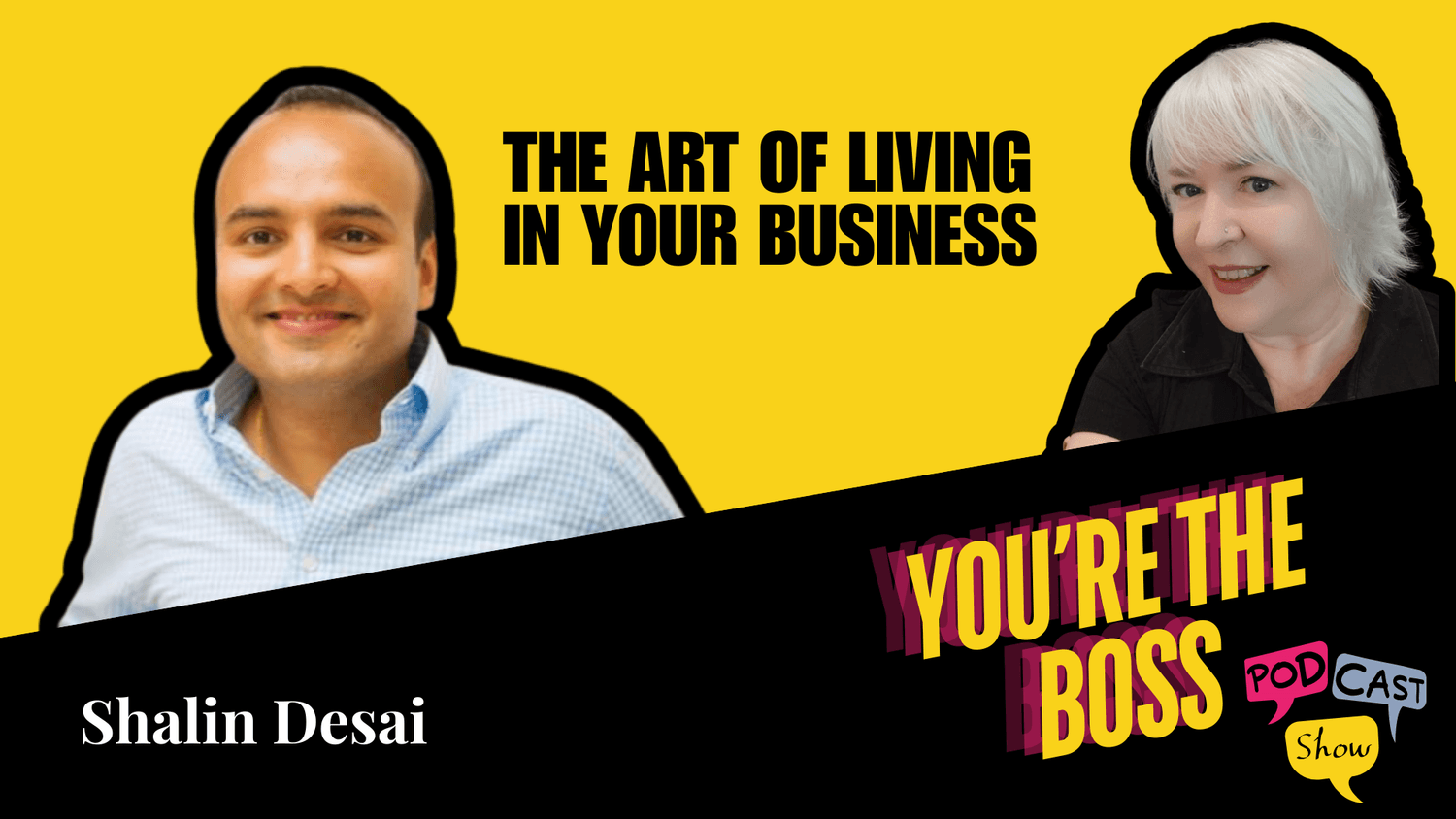
Click the image above to watch
Ange Dove (00:01)
Welcome to You're the Boss podcast show. And today I have a very special guest with me and that is Shalin Desai. Shalin welcome to the show. Yeah, welcome. So just tell us a little bit about yourself and what we should know to give context to today's talk.
Shalin Desai (00:10)
Thank you, Angie. Thanks for having me.
Shalin Desai (00:19)
Sure. So I'm an engineer by education, profession, and I am also a director of programs, director of programs for the Art of Living Foundation. Art of Living is one of the world's largest volunteer based organizations with presence in 186 countries. And, you know, the founder of Art of Living is Gurudev Sri Sri Ravishankar. He's a world renowned humanitarian and peacemaker.
And his mission is to create a stress free and a violence free society. And the programs that Art of Living teaches, it has touched the lives of about 800 million people globally. So it's a huge organization. part of it, I look after, I conduct lot of programs in the US. I've traveled and taught programs in 63 cities around the country in the US. So I travel quite a bit. And I'm also chief revenue officer, CRO with the.
Sri Sri Tattwa, it's wellness and I'm with the best friend.
Ange Dove (01:20)
Are they connected or separate?
Shalin Desai (01:22)
Yes, yes, yes, it's associated with the art of living and the whole same umbrella and all the profits and all the kind of all the profits go to support the service projects that art of living runs. Yeah.
Ange Dove (01:34)
Okay, okay, all right. Okay, so definitely work that's needed in today's world, for sure, right, what we're going through today. So tell us a little bit about your journey into doing that, because you mentioned you started as an engineer, so that's quite a difference, right, from engineering to what you're doing now. How did that
Shalin Desai (01:54)
Yes. In fact, I started this in the age of 16. My mom got me into the art of living. She had done the program and she really liked it and she didn't stop there. She made me and my brother also take the program. And at the age of 16, you can't care less about the breathing exercises in the meditation. So I up going for the course. But when I did the course, I absolutely loved it. I found out that
Ange Dove (02:13)
You
Shalin Desai (02:22)
I didn't have to, my focus improved, my concentration improved. I didn't have to study that many hours and I was getting even better grades. So I'm like, this is not bad. know, just practice this for 20, 25 minutes every day and your entire day, have a lot more time during the day. I'm like, this is smart way of doing things. And then I started working. I have my master's in engineering from Buffalo, New York. And I started working and I saw that this...
The skills, the tools that I've learned really came handy in my handling the stress at work, handling the different situations that come at you. And most importantly, even the people management. Because I believe in any field for you to strive, for you to succeed, is being able to manage the people is a very, very important skill set. Manage your own mind and managing the people's minds is such an important skill set.
Ange Dove (03:02)
you
Shalin Desai (03:18)
And I remember, it's a bit funny, I remember initially in my first one or two years of my job, of my career, you every year we would get these performance reviews and we had an online system that I would get the performance reviews and in that one year my boss wrote me in my performance review that, Shalin is the only guy I see smiling on a Monday morning. And I didn't realize it was that big of a deal, but I think...
Ange Dove (03:18)
Right.
Shalin Desai (03:45)
at work or wherever we are, we appreciate having happy people around us. We appreciate people who are light, who are more enthusiastic compared to people who are dull and people who have, you know, whose energy is not high. So this, it helped. then I became an instructor with the Art of Living for teaching the Art of Living programs. And it was very clear to me, Angie, that I don't want to just keep this to myself. I want to share this knowledge with more people.
Ange Dove (03:50)
Yes, yeah, makes a difference.
Ange Dove (04:06)
Right.
Shalin Desai (04:15)
And my biggest inspiration in my life is the founder of Art of Living, Gurudev Shri Sri Ravishankar. Like he tirelessly works to uplift the humanity. And I'm like, you know what, even if I can do a small part of that, even that's a big thing. So I became an instructor, I started teaching programs and then it just took, for me, it just took off. I travel quite a bit and now my schedule gets booked out a year in advance and I enjoy every bit of what I do.
Ange Dove (04:15)
Alright.
Ange Dove (04:44)
Okay, so you're no longer working in engineering.
Shalin Desai (04:48)
I do, I have to have a side gig that I keep doing at the same time, but my main focus is this. Yeah.
Ange Dove (04:52)
Okay, all right. So it's the other way around than usual. it's okay. That's nice. So I'm quite intrigued about you said that as a teenager, you did your first course with art of living, right? And then you saw actually an immediate difference. Is that true to say?
Shalin Desai (05:06)
Mm-hmm.
Shalin Desai (05:13)
Absolutely, yes.
Ange Dove (05:16)
Okay, so if I was to apply this now to a business owner or someone leaving corporate and starting the business, for example, and there's all the stress that goes with that and the can I do it, you know, all the doubts that might come and the feelings are maybe a fear of insecurity, you haven't got that paycheck every month to month.
Shalin Desai (05:38)
Thank you.
Ange Dove (05:39)
what advice would you give to people in terms of changing their mindset around that worrying in general?
Shalin Desai (05:48)
No, I mean, that's a very good question and something that comes up often actually. So I do work with lot of business leaders, lot of corporates, that I go and travel and teach these workshops, these courses. And nowadays, I've seen that, at least in corporate America, I'm sure it's that globally also, corporate America, there's a huge focus on mental health, huge focus.
Ange Dove (06:11)
Yes. Yes.
Shalin Desai (06:12)
And they want their employees to be, they just found simple, you know, they found that when employees are more present, they're more happy, they're more aware, naturally their productivity goes up and companies do well. It's simple, simple, a simple map. And so we found that a lot of this HR in different companies, they want us to come and conduct this program for their employees. And that's what I've found to be super effective and super helpful.
Ange Dove (06:24)
Mm. Mm.
Shalin Desai (06:40)
I'll just share an example. was teaching this course at one of the largest consulting firms globally, one the largest consulting firms. And the HR had set up a course for their employee. There is a small cohort of employees who had come for the program. Every single person was either Harvard, Stanford, MIT, or Wharton graduate. Every single person, super high achievers. And you know,
Ange Dove (07:06)
Right.
Shalin Desai (07:07)
During the program, they had a of questions, they challenged a lot of things and all. But on the last day, when they were sharing their experiences, they were sharing that, you know, our employer gives everything best, you know, we get the best salaries, we always travel first class, you know, we have to stay in the nice hotels. This is the first time we got the best training. Training to, you know, deal with your own mind, deal with your own...
how to handle your emotions, how to handle the pressure. And as a business leader, as an entrepreneur, it's every day. know, when you're working for someone, you start your day at eight o'clock, you're done at five o'clock, you're done. But as an entrepreneur, your work keeps going on around the clock. There are no business hours, there are no weekends, and you're constantly striving. And when you're doing that, how not to get burnt out? How?
Shalin Desai (08:03)
to stay positive, how to keep your energy levels higher. Because at the end of the day, what is stress? Stress is like too much to do and too little energy. And you cannot bring down what you have to do. The amount of things on your total list will keep increasing. That's a hard fact of life. But what you can do is you can increase the energy levels. And by the help of the breath work, the...
Ange Dove (08:16)
Right.
Ange Dove (08:23)
Right. Uh-huh.
Ange Dove (08:28)
Okay.
Shalin Desai (08:32)
In the Art of Living course, we teach this very powerful breathing exercise called the sky breathing. It stands a Sanskrit word, su darshan kriya. It stands for, we call it the sky breathing. And sky, sky breathing. And it's, found that this is very helpful for people to maintain their energy levels, to bring down the stress. And it says,
I believe it just makes you not, believe I've known this, it makes it just way more efficient.
Ange Dove (09:04)
Okay, so this is just by changing the way you like exercises in how to breathe, right? And that will change your energy level, changes your mindset, I suppose, as well, Yeah.
Shalin Desai (09:10)
Yes, yes, exactly.
Shalin Desai (09:19)
It does, it does. You know, there's a connection between breath and emotions. So is my voice coming clearly? No, is my voice coming clearly? Okay, so there's a connection between breath and emotions. You know, how's your breath? Have you observed how's the breath when you're happy?
Ange Dove (09:26)
Okay.
Ange Dove (09:30)
Yeah, yes, I can hear you.
Ange Dove (09:45)
I know, some free and easy, I suppose.
Shalin Desai (09:48)
Exactly. It's very light, very effortless. And how's your breath when you have some frustration? It's like if you've observed it's like a long sigh. Right? Yeah. And when you're angry, when you're angry, the breath is much faster, much quicker. And it's slightly more, slightly hard breath. So there's a connection between breath and emotions.
Ange Dove (09:52)
Yeah.
Ange Dove (09:59)
like shallow kind of like as well. Yeah, you don't breathe deeply, right?
Ange Dove (10:09)
Right. Yeah.
Shalin Desai (10:16)
For every emotion, there's a corresponding breathing pattern. And the interesting thing is that the reverse is also true. With the help of the breath, you can actually much better manage your emotions.
Ange Dove (10:20)
Okay.
Shalin Desai (10:30)
So imagine you have you're running a business and when you run a business, course, things don't go as planned. Things go in the wrong direction. And if there was a way to maintain your calm, maintain your cool and having that balance centered state of mind, that's exactly what this breathwork does for you.
Ange Dove (10:39)
Mm. Mm. Mm-hmm.
Ange Dove (10:53)
Okay, nice. So it's definitely important, right, for people to be able to change their state if they're noticing that they're getting stressed. What other things would you recommend in terms of if someone is stressed, other than breathing, what other techniques are there that would help them to manage and become more productive in the day?
Shalin Desai (10:57)
Yes.
Shalin Desai (11:05)
Exactly.
Ange Dove (11:20)
Now your voice has gone.
Shalin Desai (11:22)
because my voice is not.
Ange Dove (11:25)
Yeah.
Shalin Desai (11:27)
Okay, let me try something else. So I'm saying that there are many things you can do to reduce your stress, but the easiest is the breath. If you're breathing the whole time, it depends on the time, but some breath work, some meditation, and what I've seen breathing exercise and meditation does for you is that it also increases your intuitive abilities.
Ange Dove (11:29)
Yeah, that's better. I can hear you now. Yeah.
Ange Dove (11:40)
Okay. All right.
Ange Dove (11:55)
Okay.
Shalin Desai (11:55)
it increases your ability to have that intuitive thought. And that is so important because, you know, I was listening to Gurudev's talk once he was addressing all the scientists at one of the top research institutes in the world. And one of the scientists asked him a question that Gurudev, what do we do? You know, sometimes we work on certain experiments. They last for five or 10 years.
Ange Dove (12:11)
night.
Shalin Desai (12:20)
And after 10 years, we find out that it did not work. It did not get us the results that we wanted to get. And then we feel so dejected. We feel so, no, what do we do? How do we make sure that we're doing the right thing? And his response to them was, to all the scientists was, meditate every day. He says that when you meditate every day, your intuitive abilities improve. And when intuition is higher, you know exactly which.
what to invest your time and money behind and what not to invest your time and money behind. And exactly, and that's what I've seen with so many business leaders. I've also been started doing something called intuitive scanning, where I can tell people, connect with them. can tell things about them intuitively about their past, about their future. And it's super accurate. And we found that it's very helpful for people because you have that
Ange Dove (12:51)
so you just instinctively know.
Ange Dove (13:03)
Right.
Shalin Desai (13:15)
You get to know what may be in store for you in the future. Certain things that may have happened in the past, what you can learn from that and so on. so meditation and the sky breathing, it improves your intuitive abilities. And naturally as a business leader, that is so important to develop that faculty of your consciousness, the intuitive faculty of your consciousness.
Ange Dove (13:41)
Okay, interesting. And then so you mentioned meditation there as well. So for someone who's never meditated before, and maybe they have the idea that it's emptying your mind and you shouldn't be thinking of anything. What is meditation actually?
Shalin Desai (13:58)
So meditation I think, not anything, meditation is like this simple art. Is it coming clearly now or is it my voice?
Ange Dove (14:06)
In and out, actually.
Shalin Desai (14:08)
If we try something, can I just pause for a second?
Ange Dove (14:10)
Okay. Yeah. I'll just cut it out later.
Shalin Desai (14:38)
Let me know if you can hear me better now. Is it better? Yes. So meditation is this delicate art of doing nothing. You know, how often can somebody just sit and do nothing? And I'm not talking about people sitting and just watching YouTube or watching Instagram or watching Netflix. Not that kind of doing nothing, but really, really doing nothing. Just being there for 20 minutes when there is no
Ange Dove (14:41)
Yeah, I can hear you. Yeah. Yeah.
Ange Dove (14:50)
Okay.
Ange Dove (15:06)
Okay.
Shalin Desai (15:08)
Your mind is not working on your to-do list. It's not working on what needs to be done. It's not fixing anything. You are just being. And that is like such a powerful thing. It's like resetting yourself. know, resetting yourself so that you can come out of it much fresh. that is the, this is the need of the hour right now because see, we take shower every day. That is the bodily hygiene.
Ange Dove (15:16)
Right.
Ange Dove (15:21)
Okay.
Ange Dove (15:26)
Mm.
Shalin Desai (15:35)
We brush our teeth every day, that is dental hygiene. And this breath work and the meditation is the mental hygiene. And this is so important to life. Exactly, exactly. You know, this, the way our life moves now, it's so fast paced. It is so important to attend to your mind, attend to your mental health, because even though
Ange Dove (15:43)
Nice. Okay. So everyone should take time. Okay. Yeah.
Ange Dove (15:54)
Mmm.
Shalin Desai (16:02)
We may be lot more comfortable in the material world nowadays compared to what it was 100 years ago. But our minds, they're a different story. They become so complicated, so complicated. And if there's a way to unwind all that and just make it simple, that's what meditation does.
Ange Dove (16:12)
Yeah.
Ange Dove (16:24)
So how long should one meditate every day? What would you recommend?
Shalin Desai (16:29)
About, I meditate 20 minutes and I do it twice a day. love it. So I do it twice a day and you can, people can get started. You can go to YouTube and type art of living meditations. And there are a bunch of meditations. You can just try, start something out there. And then eventually you can even take one of the courses where you can learn the actual sky breathing. Sky breathing is the coolest thing. You you learn it and it just,
Ange Dove (16:32)
Okay.
Shalin Desai (16:59)
mind effortlessly becomes empty and focused. You can even do a three day course and do a London sky breathing. But to start with, you can go to YouTube and learn some meditation, do some meditations.
Ange Dove (17:10)
Right. And then other courses that you offer, are they online or do they have to find a center near them?
Shalin Desai (17:17)
So both we have online as well as in person courses. So in the US where I live we have courses in every state, in every city. And we also offer online courses and in the Far East, in East Asia, we have a lot of centers that are also in Singapore, China, Malaysia, everywhere we have programs. And if people want to take it online, they can also do it online.
Ange Dove (17:26)
Right. Right.
Ange Dove (17:41)
Okay, so just backtracking a little bit, how did art of living start and when did it start? Because for it to now be sort of global and all over, you've got centres all over the world, how did it start?
Shalin Desai (17:54)
Yeah. So it was started by Gurudev in 1981. And at that time, you know, he started a small school, you know, there was a school and then the school was shut down and the kids had no place to go. So he kind of got them at his own house and started providing them education and all that. And then he also started traveling and teaching the programs. And then
Ange Dove (18:13)
Mm.
Shalin Desai (18:20)
He went for this 10-day silence course. Gurudeva went for this 10-day silence period. And this breathing exercise, the sky breathing came to him. And then he would tell people back in the day that, you know, the world is waiting for something like this. And he would tell people like, know, people are waiting for to receive something like this. And at that time, not everyone believed him because, you know, it was the program were just taught in...
Ange Dove (18:29)
Okay.
Shalin Desai (18:48)
a small town in southern part of India. And then slowly and slowly more and more people without doing any marketing or anything like that, somebody would do the program, they would love it, they would recommend their friends and family to it. It just started spreading globally. And now it's, as I mentioned, one of the world's largest volunteer based organizations in 186 countries. And it's phenomenal no matter where you go, what part of the world.
You know, I have I've had the opportunity of traveling with Gurudev quite a bit. I've traveled with him to Latin America. I've traveled with him to Europe and regardless of what part of the world you go, what language people speak, you know, they all connect with what we have with this knowledge and I always tell people it's it's the language of the heart.
Ange Dove (19:38)
that's nice. Yeah, I like that. So as he was opening up new centres with these run by past students, is that how it grew?
Shalin Desai (19:39)
Yeah.
Shalin Desai (19:48)
Yes, yes. So students were taken the program and then students who end up going like for like me, you know, I'd taken the program and then I wanted to become an instructor. I went for this teacher's training course, a 15 day program, and then I became an instructor and started teaching. And then it just it kind of happened very organically. There's no plan happened organically where
people would take the program, then some people would become instructors, and the group would come together and like, know, let's open a new center here. And then you go to some other part of the country, and they're like, you know, we want to do program here, course here, and then a new place starts. It just spreads organically. And the programs have, they're such huge impact. many years ago, this was maybe 15 years ago,
and go to this very tiny town, very tiny place in Illinois, in state of Illinois in the US. A very tiny town. And on the last day of the course, this guy, his name was Mike. His name was Mike and he came to me and he gave me a letter. And he's like, I want you to read this letter. So I started reading the letter and it sounded like a suicide note. So I'm like, what is this? What is this?
So this guy is like, know, Shalin, I had lost all my hope in my life. I had no purpose to live my life and I was going to take my life away. And I had even written a suicide note. And he's like, you know, went to a Starbucks, a coffee shop and I saw the art of living course flyer and I told myself, you know what? I'm going to do the art of living course. After the course, if I don't see any hope, I was going to take my life away today.
And he's like, now you can take this letter and tear it away. have a new purpose in my life.
Shalin Desai (21:44)
And so many such stories of impact power, huge impact in people's lives. Because at the end of the day, Angie, what we all want is happiness. We all strive for happiness, whether it's relationship, it's money, you're running your business. At the end of the day, you do what makes you happy. And we are so used to getting into this happiness.
Ange Dove (21:58)
Mm. Yeah.
Ange Dove (22:11)
Mm.
Shalin Desai (22:13)
a habit of postponing the happiness. It's like, you when you're in high school, mind is like, you know, once I get into a good college, I'll be happy. You get into a good college and the next thing is, you know, once I find this perfect, I find a job, I'll be happy. You find a job and the next thing is like, once I find a perfect life partner, I'll be happy. And then the kids come and the whole cycle starts with the kids. So you're constantly postponing our happiness.
Ange Dove (22:17)
Right.
Shalin Desai (22:42)
Constantly postponing happiness, right? Making your bed the whole night and having no time to sleep?
Ange Dove (22:43)
Yeah.
Ange Dove (22:49)
Yeah, I've also I've also heard people saying that they have these goals like when I achieve this, I'm going to be happy as you say, right? When I achieve this, I'll get what I want. And then they they achieve it. And then they don't feel the happiness they thought they were going to feel. And actually, the opposite happens, they fall into depression because either now they haven't got a purpose because they've met that goal. There's no purpose anymore.
Shalin Desai (23:17)
Exactly.
Ange Dove (23:18)
What do they do? So what would you advise people if they're in that situation?
Shalin Desai (23:24)
You know, what is this actually beautiful question, very nice question. We have been as a society, we have been kind of cultured to think that life is a pursuit of happiness. It's like you have to keep pursuing happiness, keep pursuing happiness. But there's a twist, there's a different way to look at it. It's when you do this breathing, when you do the meditation, you're happy from within.
So then you don't live your life pursuing happiness, you live your life as an expression of happiness. It's so beautiful, like every action you take, it's an expression of happiness.
Ange Dove (23:57)
nice I like that yeah
nice. So as you create your own happiness from within.
Shalin Desai (24:05)
Okay.
Exactly, when you're happy from within, regardless of what you do, you're happy. Otherwise, what happens, you have a goal, you get to a goal and then that's it. What next? And it's very interesting how the mind works because what we know people look for happiness in change, either they buy a new house, they get a new car, then new job or new partner and you're my partner. They think, you know, once I get something else, I'll be happy. And why change?
gives you happiness is that when you're working on that change, the mind has let go of the old stuff, hasn't gotten used to the new stuff completely. And it comes in touch with that inner, that vacuum in between. And that inner vacuum and that inner space. And that's where the happiness is. So that's why change gives you happiness. It's not like you're getting the next thing, you're happy. You're moving on, you let go of the old thing, you've not gotten used to new thing.
and that empty space within gives you happiness. And the moment you get used to the new thing, we mentioned, the happiness doesn't last very long because then its mind is like what next?
Ange Dove (25:16)
Yeah. Yeah, you're always trying to pursue the next thing and the next thing and next. Yeah. And then so for someone running a business, again, we go back to the business side of things. So we've talked about like quietening the mind, I suppose, in terms of the meditation and then the intuition. I like the intuition part because that I think business owners
Shalin Desai (25:20)
Yeah.
Ange Dove (25:45)
kind of rely on that quite a lot. If you intuitively know you're supposed to be doing something or you don't know why you're choosing something, but it just feels right. Can you kind of explain a little bit more about intuition and how it works?
Shalin Desai (26:02)
Yes, so intuition is not just like our mind has limited capacity. It can travel to certain places and it can only fathom what it knows. Intellectually what you know, your mind can fathom that. But there's something beyond that. There's this different faculty that you have.
the intuitive faculty and that is in one of the layers of your consciousness. When you reach that, you tap into that layer of your consciousness, that state of your consciousness, naturally the intuitive abilities start developing. And this intuitive ability start developing more. The more you're quiet, the more not just quiet is not talking much, but when the mind is quiet, when the mind is more centered, when the mind is more balanced,
naturally these intuitive abilities start developing in you. Somebody who's very stressed, somebody who's under all the time running, running, will never be able to have these intuitive abilities. And this is the biggest pitfalls as said in business leaders. This perception that I have to be super busy, I have to keep working, I have to keep running, I have to be workaholic to get more things. That's not true. In fact,
smart people, they don't have to work that many hours. There's a smarter way of doing things. You don't have to all the time work hard. You can work smart and get even better results. And working is... Yeah.
Ange Dove (27:27)
I love that. Yeah, I think you're right. We have this perception of busyness, right? Where, but it's not, you're not productive. You're just busy, probably not focusing on the right things, spending too much time on things that you should be either delegating or not doing at all, because it's not going to serve the business. So I think that that's an excellent, excellent observation.
Shalin Desai (27:34)
Exactly.
Ange Dove (27:54)
You know, we need to, there's a phrase, you just got to slow down and smell the roses, right? Or smell the coffee, right? Just be aware of your surroundings and just, you know, this happened to me during the pandemic. Where, you're obviously thrown into a completely different environment at that point, right? Where we were doing things we wouldn't normally do, you know, we couldn't do the things we would normally do. So we were kind of forced in a way to slow down.
Shalin Desai (28:01)
It actually exists.
Shalin Desai (28:11)
No.
Shalin Desai (28:16)
Yeah.
Ange Dove (28:23)
right? And I remember standing in my kitchen one day, one morning, and thinking, I don't actually have to be working every hour of the day. And that realization was like boom. So that completely changed my perspective of being, you know, because we get so consumed.
Shalin Desai (28:36.556)
Yeah.
Ange Dove (28:52)
with everyday life and it becomes a pattern, right? It's a ritual in a way, right? And you just get so consumed with what you've got to do that you're not conscious anymore of what you're doing. You're not thinking about what you're doing or why you're doing it. So I think people need to take a step back and re-evaluate. And I think the pandemic helped with that.
Shalin Desai (29:04)
We are.
Ange Dove (29:16)
I think for sure. So then if you're doing the things that you're teaching in the art of living, that's kind of having the same effect, It's making people slow down, step back, look at things differently, right?
Shalin Desai (29:16)
Yes.
Shalin Desai (29:27)
Exactly, exactly. See it's so important because I mean nowadays when I teach the programs I realized like so many people would come and talk about insomnia not able to sleep properly in the night and sleep
It's something so basic, but it's kind of for many people it's become a good night's sleep has become a luxury. It doesn't happen that easily. And it was not like that before. And what happens you don't get good, don't get a good night's sleep. You don't wake up fresh. And then you keep pushing, keep pushing yourself, keep pushing yourself. And at some point of time, your body says, you know what? I cannot take it anymore. And then you end up having blood pressure, sugar.
Ange Dove (29:53)
Mm. Yeah.
Shalin Desai (30:12)
anxiety, depression, heart issues, whatnot. Because your body can only take it for so long, for so many years, at some point of time it's going to give in. And I've had so many of my participants who have shared that they would be taking this insomnia medication so they're not able to sleep well and now they're able to sleep like a baby. And so when the mind is more calm and fresh, you know...
Ange Dove (30:14)
Hmm.
Ange Dove (30:18)
Mm.
Ange Dove (30:22)
Right. Yeah.
Ange Dove (30:38)
Mmm. Without medication.
Shalin Desai (30:41)
Yeah, if you had a good night's sleep, you have a great day. Otherwise, you wake up groggy and the day keeps going like that.
Ange Dove (30:45)
Hmm
Ange Dove (30:50)
Yeah, and I think with the way we're living today as well with all the electronic devices around us as well and the first thing we do in the morning is look at it for last thing at night you're looking at your phone. It's not a natural state to be in. yeah, and sleep is, as you say, really important. It's the way to restore the body. You we need the sleep.
Shalin Desai (31:00)
Exactly, yeah.
Yeah.
Shalin Desai (31:13)
Yeah.
Ange Dove (31:14)
But it is so hard to get a good night's sleep these days, for sure. So you've definitely got to change the way you're living in order to ensure that you, as you say, it's a basic, it should be the most easiest thing. And it's very elusive to get a good night's sleep, right? Okay, so.
Shalin Desai (31:23)
Yeah.
Shalin Desai (31:28)
Exalting.
Ange Dove (31:36)
Shalin, thank you so much for coming on the show today. It's been really enlightening, the things that you have been teaching us today. So where can we send listeners and viewers to find out more so that they can actually benefit from the things that Art of Living is teaching?
Shalin Desai (31:57)
Sure, they can go to our website. It's the art of living this beautiful name like exactly what it is art of living dot org dot org. So they can go to the website and regardless of what part of the world you're in, you can go and you can you'll be able to find programs here you will get more information about it.
Ange Dove (32:03)
Mm-hmm.
Ange Dove (32:08)
Okay.
Ange Dove (32:17)
Right. So I will put the link to wherever people are listening and watching this around this, you will find the link to the art of living dog. Right. And then I'll put that I'll put that link there so we can send send things. So, Charlotte, is there anything that we should have covered today that we haven't that you think might be useful?
Shalin Desai (32:41)
I really like the questions you asked, they were very good. So it is, I think we've covered everything. Yeah, we've covered most of the things. would, it's good that we've covered them.
Ange Dove (32:49)
Go ahead. Yeah.
Ange Dove (32:54)
Okay, so the key then is to learn how to breathe properly and to meditate on a daily basis to clear your mind. Yeah, okay, love that, love that. Okay, Charlene, thank you so much for joining us today.
Shalin Desai (33:00)
Mm-hmm.
Yes.
Shalin Desai (33:11)
Thank you, Andy. Thank you for having me.
Ange Dove (33:13)
You're welcome.
Don't leave without your free gifts
Check out my page of freebies designed to help you make progress towards your goals.
From free training on making $10,000 months to how to create your brand message to access to the resources I use in my business that may help you too!
I've got some
gifts for you!
Check out my page of freebies designed to help you make progress towards your goals.
From free training on making $10,000 months to how to create your brand message to access to the resources I use in my business that may help you too!
About me

Hi there 👋 My name is Ange Dove, professional copywriter and messaging strategist. I help Gen X professionals find the words to express who they have become, and to build a career or business that owns it.

GET YOUR UNCHAINED AUDIT
Let’s have coffee online for 60 minutes on Zoom, where we'll look at your profile, your message, and your next chapter together and give you the roadmap to take your next steps.

GET THE NEWSLETTER
Straight-talking insights for experienced professionals who want to turn what they know into income, options and greater freedom over what comes next.


