Call: +65 6012 3433 | Whatsapp +65 87792453
How to Get Found in a Rapidly Changing World
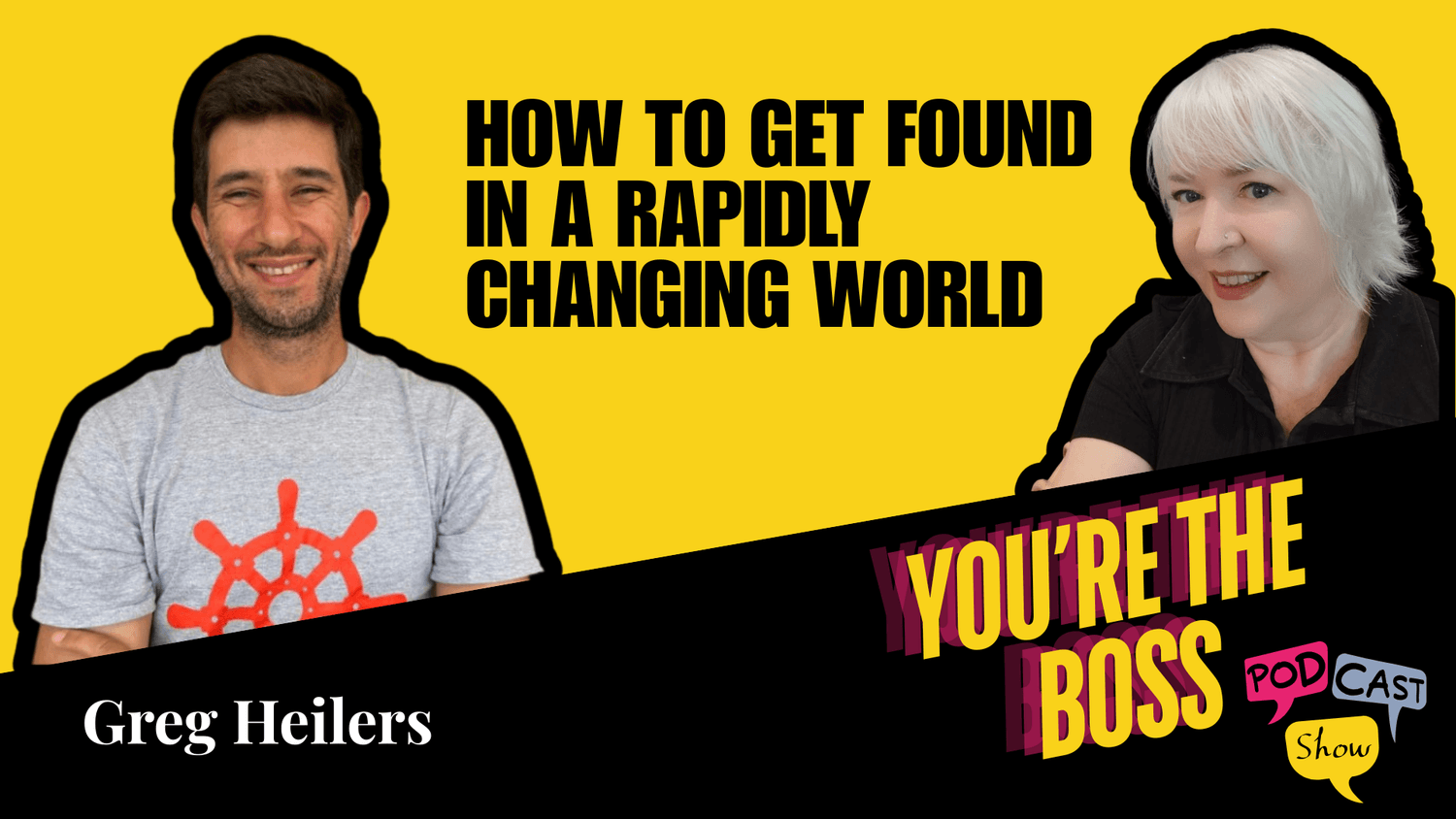
Click the image above to watch
Ange Dove (00:00.652)
show. This week I have Greg Hylers with me and he is the founder of Jolly SEO, Jolly SEO, yeah. The founder of Jolly SEO and we're going to be talking today about SEO and how that's changing in the AI times and we're also going to be chatting with Greg about general business and how he started his business.
So Greg, welcome to the show.
And thanks so much for having me.
You're welcome. Now, just a word of warning, Greg is calling in from China. And it says that app not focused now. OK. He's calling in from China. So we've got a bit of tech issues in terms of the internet's network. So he may be coming in and out. And we don't know whether, once we have this recorded and downloaded, whether
files will be okay. Usually when you record it doesn't look so good but it usually looks good afterwards when we've downloaded so I'm hoping that's the case but if it's not the case then that's the reason why is that we're having issues with network problems at the moment. All right so Greg just introduce yourself first of all.
Greg Heilers (01:19.63)
Sure. My name's Greg Hylers. In this context, I like many of us. I started a small business. I have a co-founder named Morgan Taylor. We are friends since high school. half our lives or more at this point. And we've been learning as we go. And so at this point, we have a crew of about 30 of us that serve clients.
In a particular subset of SEO, which is called offsite, meaning we do outreach to other websites to get them to endorse your website.
Okay, so how long have you been running that business now?
This is going on nine years with a pivot after the first three years and then an errant side quest for a couple of years in the middle there that we shut down as well. OK.
When was that?
Greg Heilers (02:26.662)
It was as our current version of this company was taking off in 2019 and 2020. like many agency owners, had the great idea to start a software as a service as a down sell. Yeah. And that sucked up about two years and a couple hundred thousand dollars of our lives. And then we thought, why don't we just do what we know how to do instead of what we don't? So.
we shut that down and we just kept doing what we know how to do.
Actually, that's interesting because I had the same. did exactly the same. I started a copywriting agency and then we became a full marketing agency, got people in-house to do web design, graphic design, all this kind of stuff. And then eventually I just realized, OK, now we're the same as every other agency. There's no differentiator. Right. So then pulled it back to just being copywriting again. So, OK, we're just known for copywriting and that's it. So that's what we
Well, intended people are always saying, like, why didn't you just do X or Y? you're like, after you hear that 20 times, you're like, maybe we should make this what we're supposed to do.
Yeah, the lesson there is always trust your gut, Yeah. Usually right, right. So how did you get into the business in the first place then? What were you doing before you started your business and why did you decide that having your own business was the way to go as opposed to being employed?
Greg Heilers (04:02.294)
Right. Having a business, I either got all this white hair that's coming in from my kids or the business. So it's a great question. Why start a business? I'm answering in reverse, but at this point with like around 50 clients, I view it as security. You know, instead of getting fired from my one and only job, a client when they fire us, it doesn't feel good. It's still scary because we have overhead now. That's not just me. Yes.
At least it's not all the income gone. Yeah. But I guess why did I do it in the first place? Like every budding agency owner, I imagine kicking back on the beach and everyone else doing all the work for me with no stress in my life and massive income and crazy how that most of that just didn't happen yet. You know, joking aside, I I live in China, which you previewed and
When I first got here, I needed to use English as a skill, started editing translated stuff, and then realized that writers get paid better and had a more flexible schedule and thought that I was an amazing writer. But unlike you, Ange, I didn't actually have great writing skill. I was a SEO content mill writer, if you remember those days, but didn't know it. just...
Yes, yes.
thought that people loved my writing, I didn't realize what the purpose was. So that was my first steps into SEO. I totally ignorant, didn't realize what the purpose of the content was, and slowly baby stepped. Our first version of this company piggybacking off of that freelance work was as a content agency. And you know the trend in SEO. It wasn't long before that wasn't very valuable.
Ange Dove (05:56.514)
Right, okay. So, okay, this is one of things that interests me, actually running a business and what people sometimes don't think about when they first start is the fact that you have to keep pivoting, right? You have to keep moving with the times and especially digital age. There are so many changes, they happen so fast that you do have to keep changing, right?
I every industry, know that sometimes it feels like what's happening to me is so unique and special. I try to keep perspective. Every client I talk with is dealing with a problem that they need to deal with or it threatens. It's not always existential that extreme, but
enough of these problems pile up unaddressed and it becomes that much. yeah, absolutely. If we hadn't changed with the times and if we weren't changing right now, we're in an evolutionary bottleneck in the SEO industry. We won't exist in the next couple of years. And once we make it through this one, you know the deal. In three or four years or maybe not that long, if we're not that lucky, we better adapt again.
Yeah, I think everyone's adapting now because AI is just changing so fast. So we'll talk about that because that's really important. people are thinking about, I think a lot of people are thinking, will I have a job in the future? Because they're talking so much about how AI is going to take all the jobs. Will I have a job? And if they start their own business, that would be a solution.
you've still got the same issue there. Even if you start a business, you still got to keep moving, right, with that. But when you started your business, I'm just interested in how you started and did you always know that you wanted to run a business or did you get into it by accident? Did you have anybody that was running a business that inspired you or was it completely, you know, there was no history in your backstory?
Ange Dove (08:17.364)
of anybody in your family running a business.
Zero that I'm aware of. mean, my family came to the United States and after digging canals, got farmland. And on the other side, well, I shouldn't say zero. On the other side, there was a barber who ran his own barber shop. And before that, his wife's father was a cobbler. So pretty typical immigrant.
businesses to run in the United States history anyhow was it is a business. Yeah, but it's it's a business that one person can execute. Yeah. So that's why I guess I shook my head. No, no scaled business that I'm aware of.
Okay. Okay. So how did it start for you then? Why did you decide to take that leap? And were you employed before that? Did you have a job?
So in fact, Jolly is my first attempt at working professionally. Before this, I worked in agriculture and conservation, but not professionally even. Just very small scale projects. I spent all my 20s traveling around working in little projects here and there. Very gratifying, not making money. And then the pressure of, a kid appeared in my life. So I got to...
Greg Heilers (09:44.366)
get my you know what together. And when I was freelancing and hustling as I described, and I introduced my buddy Morgan to content writing, and he quickly picked up on the fact that what I knew I was doing the majority of work at one agency. And he said, well, what if we just pitch them on doing all of it so they don't have to manage the other 10 people since you're already doing 80 % or something like that? Why don't we just do it all? And that was a great pitch.
But I would say this to anyone who's like, I see the through line. I had my first coach try to talk me down. because we got the visions of grandeur. OK. And he said, you've known that agency for two and a half years. Don't think that a cold pitch is going to replicate that extremely warm relationship that you had off that first pitch. It's just not going to be the same.
It was years later until I understood what he was trying to tell me. So I guess maybe the listener won't be able to soak this in, but it's much easier to pitch people that you're already working with than it is a complete and total stranger. I guess the only takeaway I can offer is if you're already gainfully employed and you're thinking about opening your own business, reach out to your past or current employment before you cut ties.
Okay, because they may be able to give you work, right? Yeah, I mean, they say as well, it's easier to get business from your existing or cold clients than it is to get new clients, right? You have to invest money and time to get new clients. So it's easier to go back to the old ones and try and rekindle a relationship with them as well. That's certainly true. So how do you get business now?
We get business now, I mean, look, we're both investing time in hoping to generate awareness and authority through content. I think that people, scary as it can be, need to just take baby steps into video and audio, if you can be brave and do that. Most people like to consume video and audio these days.
Greg Heilers (12:02.022)
I still think LinkedIn is a good outreach platform. You have to work on your positioning, but a connection request with a text accompanying it, I'm still blown away how many people send them without even a message, but a message accompanying it, it goes a long way. We don't get bad response rate to that. And then the last one that I think is really valuable is engaging.
in communities that are in or adjacent to the type of work you do or the type of clients you want to serve. That's a lot of different possibilities within all that. But engaging is just commenting on other people's posts, not promotionally. And eventually working your way up to a respected enough member to make a post of value that other people see. And sooner or not, you'll find people associate your name with someone who knows something about what you offer.
Hmm.
Yeah, and then you get recommendations there. Yeah, that was how I started my business actually first, when I very first started was because when I started in Singapore, there weren't many copywriters here. And but there were a lot of design agencies, a lot of graphic design agencies. So I just contacted design agencies knowing that most of them didn't have copy in-house.
And then they were just relying on the customer to write the copy. So that's where I got my first jobs was through partnerships with them. But the issue with that, though, sometimes is you're not in control of your own cash flow as well because you have to wait for them to get paid for them to pay you. Right. And then sometimes the client is slow at paying. At least if it's your client, you're in control of how you ask for the cash.
Ange Dove (13:56.334)
And whether you're deciding, right, I'm going to burn my bridges with this client, but I want my cash now. Or, you you've set the expectations up with the client at the start. This is how I expect this to go. So your cash flow is working better.
I totally pro pros and cons to working with an agency. I say that as an agency owner, you you nailed it. Whenever we can, transparently, we structure our contract with our contractors that we appreciate all the work you're doing. You're going to get paid when the client pays. And that is a total downside. In addition to we all know agencies need to make our money, too. Yeah. Got to pay.
the support staff and hopefully the owners at the end of the day make a little money too. So yeah, I totally understand that the dynamic that has a few unsavorable aspects. I mean, I freelanced for a half a decade before and while this was taking off. I get it.
I just used to look at, because it started off like 80 % of my clients were agencies and 20 % were my own individual clients. And then when I reversed that, so it's 80 % my own clients and 20 % the agencies, that work from the agencies just became a bonus that I didn't have to do any work for. It would just come as and when. But I was getting enough work from the clients to sustain.
What's funny is, I don't know if this is useful to someone who's starting to build an agency or a business model with contractors. For my business partner and other people who haven't freelanced like you did, they struggle to understand this dynamic you just described. I try to explain to them when a contractor disappears. I try to explain like we're...
Greg Heilers (15:50.84)
We're number six on their roster right now. That's what it means. We're their bonus work. And if you don't feel like doing it, they're not going to do it. If they have a client, a direct client that's paying them well with urgent deadlines. And every time they finish the deadline to get another great paying project. Well, why are they going to prioritize us? Because we're always here ready for them when they want to return to us. It's very much akin to romantic, like side piece kind of.
dynamic. Unfortunately, that's the only way I've thought to explain it to them because they're all stuck in like an employment. Like, why don't you what I'm asking them to do? Yeah, because they're their own business. They're not our employee. We are their clients. Yeah, the dynamic.
Another thing about that is it comes down to how you're treated as well. So I always find that the clients that treat me well, they're on the top of the list when things need to be done. That's the priority, right? Those that are, can we call it nasty sometimes, right? Or they expect so much for so little, right? It's this dynamic of again, 80-20 Pareto principle rule, right? Of the 80 % of the customers.
or 20 % of customers taking up 80 % of your time. So it's how you have the relationship with a client as well will determine how quick you get served.
Ange Dove (17:23.394)
Yeah, so it's okay. we've talked about your business and how that started and pivoting and stuff. I'm just interested.
So how did that grow over time? And were there any concerns around that as you were growing it?
Yeah, of course. We, you mentioned the Pareto principle. Another one I really like is the Peter principle. And I've learned this one through trial and error. And the Peter principle is giving the most generous interpretation to people and their growth trajectories. It's a situation we've encountered time and again, where we promote or we ask someone to do
a role that's different from what they were just doing an absolutely amazing job at. Right. And maybe they even do well at the next thing. And then the example that I read was like a bookkeeper who excels and then you ask him to be an accountant and they excel and then CPA and then a financial manager and then maybe the director and then maybe the CFO. But at one stage or another.
they just fall apart and are a disaster. And you say, what happened to this person? Like, why do they suck? They used to be amazing. And it just so happens that they are amazing at the thing that you took them out of. They're not qualified for the thing that you put them into. Boy, have we made that mistake. It ruins the relationship in my experience. I don't know if there's going back from it. We've burned.
Ange Dove (18:58.082)
Yeah.
Good to.
Greg Heilers (19:09.4)
bridges unintentionally. There's one gentleman I can recall who at least face to face, genuinely no hard feelings, totally understood that we accidentally, over a period of time, raised his income and put him in a position so far outside the scope of what he could do that we didn't know how to walk back from the situation and we had to say bye. And we've made that mistake at least three times now.
I'm not the brightest, so I didn't learn the first time or the second time, but I hope I've learned the third time. And unfortunately with the other two, I think we just ruined it. I think we ruined it and I think those people don't like us. And that's the part about running a business. Sometimes people don't like you and it is my fault. It's not, oh, people don't like me because they don't understand me. It's because I screwed up.
Yeah, but also, I mean, it's understandable because unless you know psychology and stuff like that, that's really hard to actually manage people, right? And I had the same was I swear to God, this is true. I did not know that not everyone was like me. I thought everyone was the same. That was how bad I was. So the first employee I lost was an admin staff. She was the first person who worked for me.
And she was brilliant at what she did. She was really good at admin. And I could just leave her to do everything, and she was great at it. I was thinking, OK, she must be really bored. So let me give her something else to do. Let me give her more work to do, because she must be really bored. She's doing the same thing day in, day out. It's going to be really boring, because I would find it boring. But not understanding that she didn't find it boring. She liked the stability. She liked the consistency.
and just being able to do the same thing all over, you every day. And then when I had her doing sales calls for me, was the worst thing you could get anyone to do,
Greg Heilers (21:10.83)
So as the business owner, it's so funny how my head went to like, when can I stop doing the sales calls? I don't believe these people who say if you're under 10 million revenue, the founder needs to do the calls. And whenever times get hard at this company, I'm like, yeah, I don't know what I was ever thinking. There's no way I would stop doing sales calls because that is the most valuable thing I can do. They don't need me doing anything else. Yeah. If I just show up. Yeah. One thing. Yeah. Yeah.
So that was one mistake that I made was with them. And I realized, OK, different people have different personalities. And then you've got to find the people with the different personalities to fill the roles that they would naturally be good at as well. So that helped a lot when I understood that.
Yeah, it's amazing what you said. I don't think I've learned that yet. I have this wonderful, really delightful lady named Joyce on the team right now. And I told her once, I was like, you're you're sick. You know that, right? Because I asked her, are you sure you don't mind sorting out? was hundreds and hundreds of rows of financial data from an entire year. Yeah, this one niche data point.
And she's like, I love doing this stuff. And I was like, have such a hard time believing you right now. But like, I'm so glad you're here because that is not me. I'm just so grateful.
I did.
Ange Dove (22:43.182)
There are people that will do that. So I have a VA. She's based in Canada. And it's the same. She does my bookkeeping for me. And she'll weed through all of the, know, send me this receipt, this invoice, whatever. And she'll go through it. And all of this in great detail, real attention to detail. That is just not what I'm good at at all. I just would not be able to sort out all of that by myself. So having heard that.
business owner, you you partially it's delegating what is not worth the company's paying you to do. Yeah. And partially as the business owner, you get to add a little subjective decision making in terms of I just really don't want to do this thing day to day. And maybe it is worth them to pay me but maybe we could just pay someone else to do that.
Yeah, I think that's the thing. just be, have people doing what they're good at. And you don't force people to do things that they're not, because you find out. And like I did that at the beginning when I very first started hiring people, especially writers and editors, was I thought I could train them. And then I realized, no, that's not going to work. It's just heartbreaking. It's just, takes so long. And you end up paying them.
for you to train them, if you know what I mean, And when I realized that if I just hired someone that could do it and pay more, but hire someone that could do it, that changed everything. Life just became so much easier, because I had the right people doing the right things at the right time. And that became so much easier than trying to train somebody who wasn't trained in the job to do it.
Yeah, I'm very grateful for all the people who work with us. And I keep trying to explain to them what their role is to me personally, where sometimes a lot of the people have transparent views. Well, I should say a select few have transparent view in business health.
Greg Heilers (24:59.254)
Look, I'm not one of the software or AI companies that are like rocket ships straight up into the right forever kind of valuation stuff. It's a real business that's bootstrapped. And sometimes we're doing great. And sometimes it's really great. And when it gets really tight and people get a little nervous, like, I yes, true. And just remember that if personally, if I lost you, I'd be rewinding like three to four years of my life because
do your work if we're really having a frank conversation. But I don't want to go back there. I really want this to work. So trust me, I'm doing everything I can to make sure that I keep moving forward with my own life. And it's not probably, I'm not the best communicator. It's probably not the right approach, but just to try to explain like how grateful I am for your presence day to day is that's one way I've come to think of it.
Yeah, that's good to have them be appreciated for what they do. It's important, I think. Yeah. OK. So what's happening?
Greg Heilers (26:13.144)
Sorry, I had an alarm. So I hope you can get that out. Glad.
No, hear anything.
You
Ange Dove (26:25.076)
Okay, so let's move on now to SEO. That's what we're here to talk about. So just explain for anyone who doesn't know what SEO is, can you explain that first?
Okay, search is changing a lot right now. But if you think of SEO as either a triangle or at least two-sided, there's what's on your website. If you think of it as a triangle, one corner over here would be the words on your website, a lot of what you did, I imagine. The actual words on your website. The other corner up here would be the technical.
or the architecture, the organization of it, we could say. This involves like internal links, meta descriptions, schema, all these things. And then the other corner over here, which is what we specialize in is offsite. This is, as I mentioned at the beginning, other websites refer to your website and the quality of those websites is particularly what we focus on. And typically in SEO, that was a backlink.
Yes. For all of us consumers, that's the blue words with the underline that you click on to go to another website. that's SEO in a nutshell is this quote unquote, if you could achieve the trifecta of fully optimized on site content related to your optimized meaning it's all the words related to your business and service that actually matter to your business and service and nothing else, not a bunch of garbage. It's is it all organized?
Properly and properly meaning for Google crawl it and these days chat GPT to crawl it and then finally what are your endorsements offside and I Definitely could dive into the backlink side and keep going a little on the other two but that is search up until a year ago and then of course Like all of our industries AI has come in not only changing
Greg Heilers (28:34.092)
the value of the labor that we do, but also the value of the product because the way that consumers use search is changing and it's now becoming either Google AI or Google AI mode or chat GPT or and so on. So it's definitely a changing landscape, but that's brings us to today at least.
Yeah, because I know that a lot of people now are, I mean, because it's changing how I notice now when I search on Google, right, I never even look at the listings below. It's what that part.
You look at the AI mode, the AI overview.
Yeah, and I look at that and I get the information there. OK, right, I found out what I need to know. Right. So then I never look at the listings below. People could be doing paid Google Ads and they won't be seen. Right. So it's changing. Even Google Ads is changing in that sense. And then I had a client come to me and he turned up on my calendar. He booked himself in to have a meeting with me.
And I didn't recognise his name. It wasn't someone I had been chatting with on LinkedIn or anything. And when he got onto the call, I asked him, how did you find me? And he said, I asked Chatgy P.T., who was the best copywriter in Singapore, and your name came up. And I was like, yes.
Greg Heilers (30:03.982)
The win, take it.
Yeah, but he used Chagy P.T. He didn't use Google. people are searching there as well now, right? that's changing.
Yeah, it's still, ChatGBT is still in some cases a very surprisingly small minority, but in other cases, mean, larger websites are getting 50,000 plus visits a month from ChatGBT. So it just kind of depends on its significance to you in terms of scale, but you can, as a user, anytime you use ChatGBT, you can ask it to give citations for the information.
Yeah, it's showing you. Yeah. That is where if you were someone who worked in search, you'd be looking at, OK, what information is it looking at to provide this result for this question? Yeah. that is where as SEO means search engine optimization. So that is where you would go begin your optimizing work. You would either try to be more like what's being cited or just try to get into what's being cited.
Or you could try to influence what's being cited, meaning hoping that you will pick something else if you out position that. So there's different strategies for optimism, but it is definitely front of mind for any of us that want to back to the start of our conversation, have our businesses adapt to the changing landscape.
Ange Dove (31:41.452)
Yeah, yeah. So what should business owners be thinking about now in terms of SEO? What should they be doing?
So there's a lot going on. I'll start with one that seems a little far out there, but is not that far into the future in that for the past six months, I've been asking on our podcast, I've been asking SEOs, so when are we going to start writing our website content, organizing our pages for AI agent? But I was thinking of it wrong. I was thinking of AI search engine crawlers.
just like we do for Google. But I kind of missed the mark because on a podcast recording in January, a guest said, we're already there. We need to start writing our pages for AI agent shoppers. As you may have experienced, and I think when we met, and you were already showing me some out of the box solutions for AI agents that can work for you. Well, pretty soon on a personal level and certainly on a business level.
we're going to have AI agents going out there and at least doing research for us, if not actually purchasing for us. as B2B business owners, we need to be thinking in the near future, it's really coming about how to sure have a website humans can read and humans want to convert on, book a call by now, but also something that AI agents, not just the search engines, but agents can read and
take action on. So that sounds far out there in the future, but it's coming and maybe we want to get into more practical like today search engine optimization.
Ange Dove (33:27.15)
So that's sort of becoming full circle in a way, because I think when SEO first started, there was such a focus on the SEO part of the optimization part of it, and to the point where text wasn't so readable for the human. Then is Google saying, right for the human. And then Google became so smart at understanding what the context was that the exact words weren't
necessary anymore, right? That they could, if they saw one word, they'd understand another similar word would have the same meaning. So they could understand the context, they became smarter. Right? So the sounds of what you're saying now, it's becoming, we're going back to that, okay, it's got to be for the bots.
There's so many examples of this, Ange, like you've been in internet marketing long enough to have heard online reputation management. Yeah. have seen it come and go. Yeah. Right. It's back, though. There's so many things that you would say. I've been using the phrase, what's old is new again every week, if not every day lately. There's so many we could give endless examples. But as a business owner, I just explained briefly.
If a search query is important to you, who's the best copywriter in Singapore? Run that query in chat GPT or Google. Yeah. Look at all the citations and manage your reputation. If you're being trash talked by chat GPT or Google because they're citing someone, I'll give you an example for us. Right. I asked, is Jolly SEO a good link building agency? Well, part of the answer initially, not today.
was that we don't have transparent pricing on our website and which is not true. that we have a poor rating on it was a website I'd never heard of that made a profile for us because we never filled out a profile that I never knew existed that gave us a low score. And that was influencing ChaiTBT. So what did I need to do?
Ange Dove (35:39.575)
Right.
Greg Heilers (35:45.868)
Well, the reason it said our pricing wasn't transparent was because someone else wrote a listicle, very common. So we're numbered one through X. They list best X. So in our case, best link building agency. We were number 16. Thanks so much to whoever wrote that. And they said that we don't have transparent pricing. So I had to reach out to them and say, excuse me, that's not true. Could you please update the article on your website? Because our pricing is listed on our website. So that would be appreciated.
made it factually correct. In that case, they didn't respond to me. So that's still showing up there as influencing it. It's got pulled neutral because the other example and a few others I'm not going to waste our time on, I logged in, flushed out the profile, reached out to that directory owner and said, what can I do to raise it from the now neutral to positive?
In this case, it's basically extortion. They're like, well, if you write a couple free articles and put a bunch of content on your profile, then you'll have a positive. I was like, you know what? And just I'm leaving that one to be. And in that case, I go back to the other strategy I mentioned. Maybe just try to out position them because I don't want to help them out any more than we are. So online reputation management, I don't know what we're calling it. Chat GPT reputation management.
Whatever you want to call it, but that's another one. There's a lot of the old playbooks are getting dusted off and they're totally relevant today.
Yeah, I mean, think people understand, most people understand that you've got to be careful with what comes out of chatGPT because it's not always factually correct anyway. Like I wrote an article once where for a client and they wanted sources cited. So I asked it to give me the sources of what it was doing. And so on the first run through and I said, can you give me provide the sources for this? And then they made up some sources.
Ange Dove (37:46.318)
was just completely made up when I went to check it out. It was just nothing. And then when I said, another time, well, what's the source for this? there's no source. I just made it up. And it literally told me, I've just made this up. OK, glad I asked.
mean, we're being honest, Google wasn't much better and still to some extent isn't because even though, you know, your AI overview that you referenced these days, it's still populated by this underlying source material. And that source material is also in many cases just made up. It's a third party website that can write whatever they want. You know, I can write an article that says,
Mm.
Ange Dove (38:28.259)
No.
Greg Heilers (38:34.882)
Jolly SEO doesn't have transparent pricing, even though we do. Google can say, or Chat GPT can say, that we don't have transparent pricing. mean, just, the way the internet works right now. Maybe you could appreciate this, Ange. One thing I've found really sad in our current predicament is that we're going into content kind of in a rabbit hole, and I'll pull back out in just 30 seconds.
A lot of the content flagged as AI content, it's for sounding, in my opinion, like an English second language writer would write things. I don't have the data to back this, but to me, it's just so logical because who wrote most of the internet content that these LLMs were trained on, but content mail writers from various countries around the world who are willing to work at those rates. And some of the turns of phrases everyone says
This is AI. Yeah. Exactly how they would type it. I'm just so sympathetic. I'm this dude and you know, you're this lady living in another country. It's hard to speak another language like a native speaker and you're right. one is nearly impossible in my opinion. So it's a really interesting landscape to figure out what's real and what's not.
Yeah, yeah. I think it is just use it as a tool and use it as a first draft, but you've definitely got to write over it for sure. Make it your own. Yeah. And also train it with those bots that I told you about, the AI agents that I'm using. I've got them trained. So I don't have to explain myself. I can just say, for me in my tone of voice, whatever.
yeah
Ange Dove (40:24.94)
I get things that I want. it's a real time saver for that, that's for sure. So there's good and bad in everything, right? There's always things you have to balance out.
Totally. think when we met, I'd love to share this quote again. think I said the co-founder and CTO of HubSpot, guy, Dharmesh Shah, he said that AI is basically an intern with a PhD in everything. And I really liked how he put that. Yeah. Because it does come with some amazing insights at times. Yeah. Also, you do need to train it.
because it has no context, no idea. It's coming as a little baby every time with no, it's a blank canvas every time we bring it into a new existence. You need to train it up on the context before you start. Yeah. Good quality.
Actually, interestingly, humans also have the same problem. They communicate with no context on what they're talking about and expect somebody to understand what they're talking about. And that just leads to miscommunication, mistakes, repeat work, all of that kind of stuff, because they didn't give the right context in the first place. So it works.
Same thing, yeah.
Ange Dove(41:50.734)
you know, giving chat GPT the right context is important, but also give humans the right context or else they'll just go and do what they think they should be doing. That's true. Right. Okay. So I think we'll wrap this up now. We've gone, over time a little bit. So, but it's been a pleasure speaking with you today and learning about your insights into setting up a business, running a business and the
changing landscape of SEO as well. It's been really, really interesting talk. So where can people find you if they need to get some more information from you?
Oh, I'm just grateful to be invited and thanks for having me on dealing with my VPN in China life here, but you can find me online. LinkedIn is a great place. We're all on there. My name is Greg Hylers, H-E-I-L-E-R-S.
If you have questions that I didn't answer, it doesn't have to be related to our service, but keeping in theme, you know, I'm always happy and grateful when someone else does the same, just to share some of the hard lessons learned. doesn't mean I'm right. It's just we all all learn some things along the way. And yeah.
That's very true. That's very true. OK, so thank you so much. I will put the links below on your LinkedIn profile. I'll put your business website up as well so people can go and check you out there as well. OK, so thanks, Greg, so much for joining me today.
Greg Heilers (43:28.952)
Thank you.
Don't leave without your free gifts

Check out my page of freebies designed to help you make progress towards your goals.
From free training on making $10,000 months to how to create your brand message to access to the resources I use in my business that may help you too!
I've got some
gifts for you!
Check out my page of freebies designed to help you make progress towards your goals.
From free training on making $10,000 months to how to create your brand message to access to the resources I use in my business that may help you too!
About me

Hi there 👋 My name is Ange Dove, professional copywriter and messaging strategist. I help Gen X professionals find the words to express who they have become, and to build a career or business that owns it.

GET YOUR UNCHAINED AUDIT
Let’s have coffee online for 60 minutes on Zoom, where we'll look at your profile, your message, and your next chapter together and give you the roadmap to take your next steps.

GET THE NEWSLETTER
Straight-talking insights for experienced professionals who want to turn what they know into income, options and greater freedom over what comes next.


