Call: +65 6012 3433 | Whatsapp +65 87792453
How To Ethically Influence People
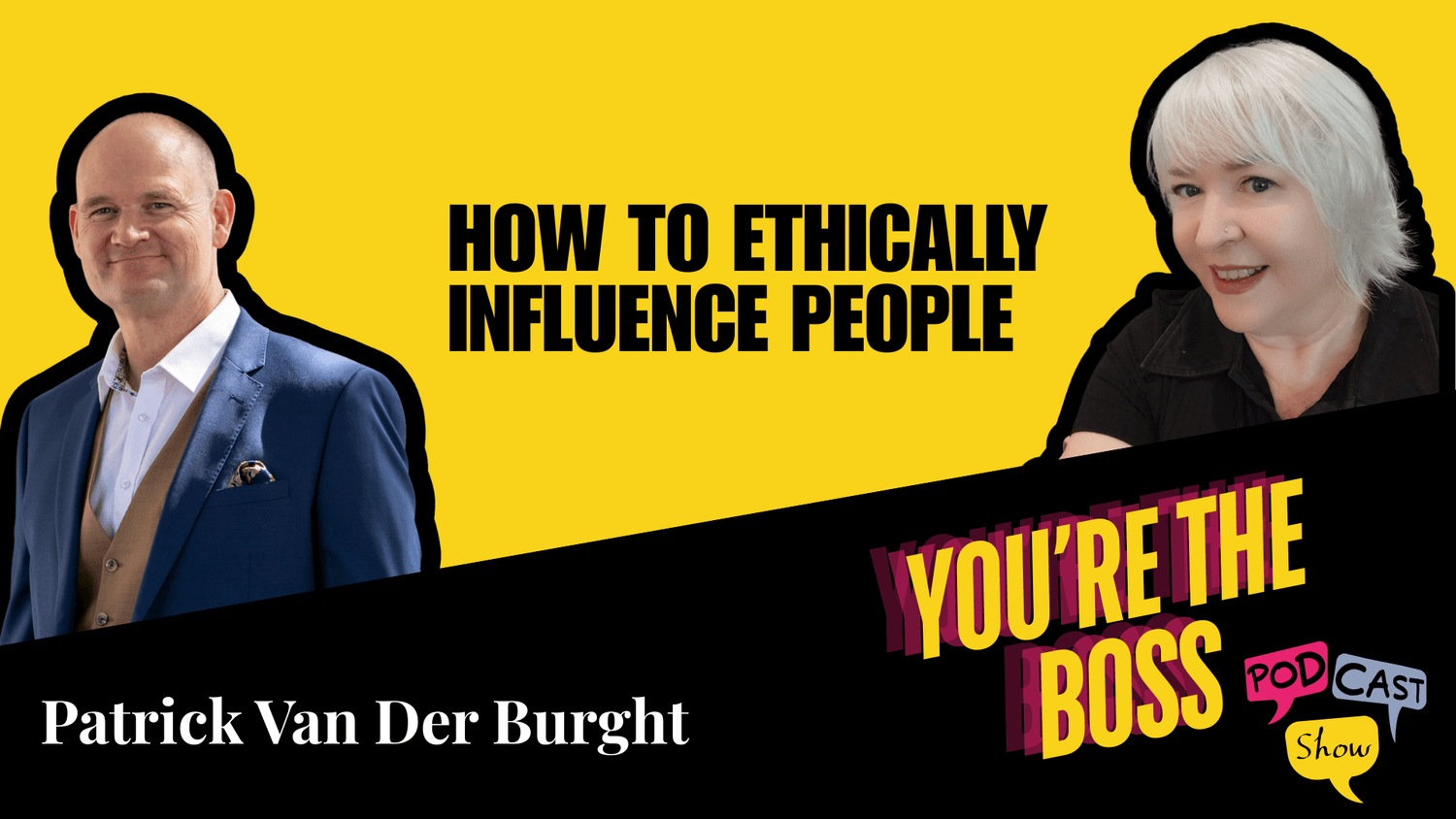
Click the image above to watch
Ange Dove (00:01)
So welcome to You're the Boss Podcast Show. And today I have my guest with me and it's Patrick van der Burgt. So Patrick is basically he he teaches ethical persuasion and he's been doing that since two thousand since since the year two thousand. I'm gonna have to go and do this again because I've stuffed it up. Okay. So Patrick afterwards, yeah.
Patrick Van Der Burght (00:25)
That's all right. That's why I record them afterwards 'cause then you can I can retake and retake and
Ange Dove (00:31)
Yeah, yeah, well I can edit all of this out. So yeah. Okay, so Patrick is a founding member of the Cialdini Institutes. He's a Cialdini certified trainer and coach and the author of the book How to Hear Yes More Often. Patrick will share some insights into the science of ethical persuasion today with references to easy to understand research and case studies.
His aim today is to give you an in an understanding of the science of human decision making and some strategies you'll be able to use and profit from immediately. So Patrick, welcome to this show.
Patrick Van Der Burght (01:13)
Thank you for inviting me. I always recall how impactful it was on me and how much of an eye-opening experience it was for me to discover how persuasion or influence how that actually works. And I see the same eye-opening moment when I do a keynote or do a workshop with a group of people. I can see it in my audience. People just,
Are you serious? Is this how it works? And it's not all that hard, right? And so I think we'll achieve a similar we we can't see their eyes, of course, because it's it's a bit one way, but I'm assuming we'll achieve a similar sort of reaction today with your audience. And I appreciate you for putting me in front of them.
Ange Dove (01:58)
Nice. Well, yeah, because I I think a lot of people think that it's a skill that you're naturally born with, if you can be born with a skill. it's like your your personality is either one way or the other and this is something that people are naturally good at and others are not. But what you're saying is it actually can be learnt. Right.
Patrick Van Der Burght (02:18)
Yeah, absolutely. And actually, there's a great example of that. I mean, persuasion is a science and therefore it can be taught and it can be learned. And you're quite right. Some people think that persuasion is a natural skill that some people have and others don't, or that it's linked to charisma or something. But the best example is actually my business partner, Dr. Robert Cialdini himself. He's actually a rather introverted
Ange Dove (02:33)
Yeah.
Patrick Van Der Burght (02:45)
university professor rather than just sort of, you know, full of charisma, walk into a room, change everybody's opinion around, sort of natural persuader, if there even such a such a look. But he's probably the most persuasive person in the world and probably got paid the most for it as well. So no everybody can learn this.
Ange Dove (03:04)
Okay. Okay. So just taking it back a step a minute, just what is the benefit of being persuasive? Why should people have this skill?
Patrick Van Der Burght (03:17)
Okay, well, whenever we are trying to achieve a goal, especially or predominantly, shouldn't say predominantly, especially when people need to agree with what it is you're proposing, then your success depends on your ability to be persuasive, to get your point of view across to the point where they see your point of view and and agree with and want to go along with it. Even even with ourselves, the internal dialogue we have with ourselves, we can actually be not so persuasive as in, you know, yes, I know I should go to the gym, I know I should go for a run. And what goes on in your own head, now you're the audience, the you can be more persuasive with yourself as well. But you know, in business, especially, whenever we set to achieve a goal that could be sales related, right? When we
Ange Dove (03:57)
Yeah.
Patrick Van Der Burght (04:16)
Sell our service, sell our product, but anywhere where we're trying to achieve a goal, it could be a customer service situation where we want people to, you know, be happy with what the solution that we're offering and be loyal afterwards. It could be that we have team members that, you know, we want them to follow certain procedures. That's also behavior, which is what persuasion is about. Persuasion is not necessarily just sales, it's about persuasion. It's about behavior.
Ange Dove (04:47)
So it's also it could be motivating your team as well. I guess. Yeah, it's an important part of Yeah. Yeah. Love it. Okay. So you say it's a science. So can you break that down for me? What what is so scientific about it? What w should we understand?
Patrick Van Der Burght (04:51)
Yep, leadership, team management.
Patrick Van Der Burght (05:05)
well, maybe a little bit of history would be would be good. as you know, I'm associated with Dr. Robert Cialdini, who wrote the book Influence, the psychology of persuasion. And that was first published in 1984. And last year still, it was on Forbes had a page on their website, you know, the I think it was the the top 10 timeless reads for business owners or entrepreneurs or something like that. Number one, influence again.
Ange Dove (05:19)
Mm.
Ange Dove (05:31)
Okay.
Patrick Van Der Burght (05:35)
Because what's in the book, I mean, it's been expanded on, but i in essence what's in there is the same. Our brain and how the brain behaves and makes decisions is the same, but it's our environment that's changing why we need that information more. And so Dr. Cialdini became a university professor in the late seventies, and he was fascinated with the request process.
Ange Dove (05:49)
Mm-hmm.
Patrick Van Der Burght (06:02)
How can it be that if you ask for something one way, you get a small amount of yeses? But if you ask for essentially the exact same thing, but you ask it in a different way, you get a lot more yeses. How does that work? And he realized that at the time there was already about 50 years worth of scientific research on the topic. But most of that, if not all of it, was laboratory-based studies.
Ange Dove (06:14)
Okay. Yeah.
Patrick Van Der Burght (06:28)
As in, you devise an experiment, you invite people to come in, and then you sort of experiment on them and see how they react. But he realized that if he was going to figure out how this really works, he would have to go into the real world where the the battles of persuasion are fought every single day, where people's livelihood depend on getting other people to say yes to their request. And so he did something that was.
unheard of at the time. He took three years off, and he, you know, with disguised identity and disguised intent, he enrolled in as many new employee training courses as he could possibly get access to. He sold cars from a lot. He sold portrait photography over the phone. He spoke to police officers about con artists. What did they do then?
Ange Dove (07:14)
Mm.
Patrick Van Der Burght (07:25)
You know, get people to relinquish their life savings to a stranger. Not that we should do that, but if we understand the the psychological triggers that make that work, then we've got to be able to use that in an ethical way. He worked with army recruiters, right? You can't get a 10-year-old to clean up their room, but how do you get them to sign four years of their life away, right? So he you accumulated all these strategies that
Businesses were using, they didn't know why they worked, they just knew they worked. And he accumulated them all. And instead of looking for what made them different, because everybody told them how you know how different different they were. People in sales were, what we do in sales, so different from marketing. The people in marketing said, what we do is so different from advertising, right? But instead of looking for what made it different, he looked for what made it similar. What is it?
Behind these things that makes this work. And that's what was published in that book, Influence. And a good, I would say a quarter of the book is all references to research, scientific studies, empirical evidence of how this stuff works. Sometimes the scientific data is a little bit harder to to understand, but it can be explained with relatively simple examples from a practical.
setting. So everything you get from me today is not Patrick's gut feeling of what should work or what could work. it's all backed by science.
Ange Dove (09:02)
Yeah. Okay. That's great. So t tell us a little bit about the the science behind it. I see behind you there you've got your seven universal principles of persuasion. So I think that's that's what the science is based on, is it?
Patrick Van Der Burght (09:17)
Yeah, that that explains what it is and how you can use it. But I think for your audience, what might be good if we did that first is we cover how decisions are made. Because once you understand that, then you can really appreciate why these principles are so powerful. Yeah.
Ange Dove (09:22)
Yeah.
Ange Dove (09:29)
Right. Okay. Mm.
Mm. Okay. So how are decisions made?
Patrick Van Der Burght (09:38)
Okay, cool. all right, so I'm gonna lean on the work of Professor Daniel Kahneman, who was a he died a couple of years ago. he was a professor in psychology and a behavioral scientist. And he won a Nobel Prize in economics in two thousand and two. And that's a little bit unexpected, perhaps, right? I mean, a professor in psychology wins a Nobel Prize in economics. How does that work? Well.
Ange Dove (09:45)
Right.
Ange Dove (09:52)
Mm.
Patrick Van Der Burght (10:06)
A lot of his research was on decision making, and decisions shape economics. So that's where the link is. Anyway, so Daniel Kahneman basically won a Nobel Prize for disproving a popular belief that old economics used to have. Old economics thought that human beings are logical, rational creatures.
Ange Dove (10:27)
Mm-hmm.
Patrick Van Der Burght (10:34)
And we would therefore use logic and reason to formulate our decisions. And Daniel Kahneman proved that that's actually not the case. So he explains that in a relatively simple way, so I can pass it on to you and your audience. So when it comes to decision making, your brain or your audience's brain has two parts. And when I say audience, I don't necessarily mean an auditorium full of people, right? If you are having a sales conversation with someone, right? Then the recipient of your pitch is your audience. If you're trying to convince your child to do their homework and a in a reasonable time before it is true, right? You're gonna have to be persuasive, then does then your child is the audience, right? Whoever hears your message or your appeal. So we have two parts to the brain. We have system one. System one is the intuitive part of the brain.
Ange Dove (11:08)
Hm. Yeah.
Ange Dove (11:19)
Yeah.
Patrick Van Der Burght (11:33)
System two is the logical, rational part of the decision-making brain. Let's look at system one first. System one is fast. It's a brain that sort of works unconsciously, it works outside of our conscious control, and it is always sort of running in the background. It takes very little effort to run system one, and we use it for everyday decisions. And system one runs a lot.
On shortcuts, rules of thumb that we've either learned or that are sort of ingrained within us, that are true most of the time. Things like expensive equals good. Right? We know from experience that most of the time, if you've bought something cheap that it didn't work out so well.
Ange Dove (12:21)
Mm, okay. Mm.
Patrick Van Der Burght (12:31)
And if you spend more money on something, then it tends to work out better, right? We've learned that more expensive things tend to have better quality, are better suited to purpose, and are gonna last us longer. It's not true all the time. Sometimes expensive things are still rubbish, right? But most of the time that rule holds up. So standing in a store looking to make a purchase, or you know.
Ange Dove (12:35)
Yeah. Yeah.
Ange Dove (12:45)
Mm-hmm. Yeah.
Patrick Van Der Burght (12:58)
Listen to this also from the other side when your client is looking at what you're offering, they're using this line of thought. They could, if they don't know anything about it, or you don't know anything about the decision that's in front of you, let's say, I don't know, computer monitors or something. You could in that moment halt your decision. You could go to the library and you could start reading on that particular topic that you need to make a decision about.
You might be able to go and do some courses to learn about this. And so three, four months later, you could come back to the shop and make a much more educated decision about this decision you need to make. But I don't know about you. I'm pretty busy. I don't have the time to go and study something. Yeah, like a monitor for three, four months, right? So in that moment, I might realize well, hang on a second.
Ange Dove (13:39)
Mm-hmm. Yeah, nobody's doing that. Yeah.
Yeah. Yeah.
Patrick Van Der Burght (13:54)
If I just spent a little bit more money than I was intending to, I'll probably have made a good decision here today. Right? And so expensive equals good allows me a shortcut to a quicker decision. And so there's there's other rules of thumb like that. Another one is if a lot of other people are doing it, that must be the right thing to do.
Ange Dove (14:10)
Okay, got it. Yeah. Mm. Mm. Mm-hmm.
Ange Dove (14:23)
You tend to get that with restaurants and stuff like as I notice like going down Boat Key or something in Singapore. There are loads of restaurants, right? And you tend to avoid the ones that look empty because it's okay, there's something wrong with that. But if someone goes in, then somebody else sees then they'll go in and that would be a change perception maybe an hour later if that restaurant is suddenly booked. But the perception when you first walk past is okay.
There's something wrong because nobody's in there. Yeah. Yeah. Yeah.
Patrick Van Der Burght (14:56)
Perfect example, right? You have alternatives. Instead of looking at how many people there are, you could go and talk to people who live in the area who might have gone there. You could have gone to the, I don't know, police station, figured out if there was any complaints about particular restaurants or fights that might happen there. You might type talk to consumer affairs to see if there's any warnings about food poisoning, but you haven't got the time for that, right?
Ange Dove (15:00)
Mm, mm.
Ange Dove (15:15)
Uh-huh. like
Patrick Van Der Burght (15:26)
And so the visual that there is a half-filled restaurant and there is one that's practically or completely empty, that's good enough for you, and the decision is made. Right? And of
Ange Dove (15:33)
Mm.
Ange Dove (15:40)
And I think as well it's it's important today because we may we we don't have time for anything, right? We're we're rushing through everything and we have to make decisions very quickly, right? So yeah, it's very important thing to consider, yeah.
Patrick Van Der Burght (15:54)
Yeah. And so your audience is also in that boat, right? I mean, I'm I'm I'm liking how this discussion is going, as in you can flip this around. I'm explaining it from your perspective, but think of your audience, right? You know, when you come with your proposal, they can halt their decision, they can research things, they can ask about you, but they haven't got the time. If they can see, just like with the restaurant, that hey,
Ange Dove (15:59)
Mm, yeah.
Ange Dove (16:04)
Yeah. Yeah.
Patrick Van Der Burght (16:24)
This is probably the right decision for me based on a couple of little clues. The decision can be made quickly. And that's exactly where we're going with this discussion. All right. So system one, system two. Let's let's venture back into that. So system one runs on shortcuts, right? Rules of thumb that we've learned. And they work most of the time, but not all of the time. Okay, great. On the other side, we've got system two. So system two is the logical part of the brain.
Ange Dove (16:41)
Mm-hmm. Mm-hmm.
Patrick Van Der Burght (16:54)
System two is slow, where system one was fast. System two takes a lot of effort to run, costs a lot of energy. It has a caveat, it requires attention to work. And fast and it is conscious thinking, where system one is unconscious thought. So system
Ange Dove (17:20)
Mm-hmm. Yeah. Yeah.
Patrick Van Der Burght (17:24)
Two is more reliable. System two looks at all the available information and comes up with a well-balanced decision. And so it's good that we have system two, but it takes a lot of effort to run and it doesn't actually want to engage. It's quite happy for system one to make the decisions as long as no red flags go off. Well, Daniel Kahneman demonstrates in 2002, which is quite a while back now, that nine
Ange Dove (17:45)
Right. okay.
Ange Dove (17:51)
Mm. Mm.
Patrick Van Der Burght (17:54)
80% of our decisions are made by System One, the intuitive part of the brain, unconsciously, outside of our conscious control, automatically, largely based on shortcuts. It's now said that that's 95% and that is increasing to more, 98%. And so there's
Ange Dove (17:59)
Okay. Yeah. Hmm.
Ange Dove (18:15)
Does does does this result in, you know, you hear this thing of bias remorse where people can make a decision based on quick decisions or gut feeling or emotions, right?
Patrick Van Der Burght (18:26)
That does happen, but what what happens even more is confirmation bias, where system one might make a decision, and most of the time system two justifies the decision that system one made. So yes, buyer's remorse is something that exists, but what happens a lot, lot more is confirmation bias that system two actually agrees with system one and starts justifying why the decision was made.
Ange Dove (18:32)
Mm.
Ange Dove (18:39)
Mm, mm, mm.
Ange Dove (18:54)
Yeah, as I'm saying you justify with logic why your emotions were right at the time.
Patrick Van Der Burght (18:58)
Right.
Yeah. Have have you ever bought in a very expensive sports car like a Ferrari?
Ange Dove (19:06)
No, but I've I've made loads of rash decisions on buying things and then afterwards tried to persuade myself I did the right thing. Yeah.
Patrick Van Der Burght (19:13)
Yeah, exactly. So with with the with the Ferrari, ne neither have I, right? But if I thought of it ahead of time, right, you know, like should I buy a Ferrari? Then my system two brain would probably go, Well, Patrick, that's probably not such a good idea for your bank account, right? But had I bought a Ferrari, then system two would go, Well, you really deserve it. You work so hard. Right. Now it's a whole different story. So that happens, that happens as well.
Ange Dove (19:41)
Yeah. Right.
Patrick Van Der Burght (19:43)
All right, so we've got this 90-95% of decisions made by system one. Right? Now some people argue with that. They say, well, maybe if it's an everyday decision like deciding where to sit, maybe it I use intuition. But when it's really important, right? When it's, you know, a service contract for my business or you know, an expensive purchase or buying a house, well, I would use logic and reason. And
Ange Dove (19:46)
Hmm. That's a lot. That's really high actually. Yeah.
Mm.
Patrick Van Der Burght (20:14)
That is interesting to unpack. If we take buying a house, you know, most of us have got some experience with that. So when we buy a house, we do a lot of work. We research where we want to live. We compare maybe local schools that the children might need to go to. And once we've decided on a suburb, now we go look at homes and we go in with a notebook or with a tablet and we make notes about everything.
Right, the the size of the bedrooms and the bathrooms and the the parking spots where they are located and the size of the garage, all this stuff. And all that work is system to work. But how many times have you spoken to someone that've just bought a house? And they say something along the lines of, well, it was a bit above the budget, but we just fell in love with it. We had to buy it.
Ange Dove (21:08)
Yeah. Yeah. Yeah. Yeah.
Patrick Van Der Burght (21:09)
That's not logic and reason. They did do all the system two work, but when decision-making time came, system one took over. There were other decision triggers involved. And so here's a punchline when it comes to that system one, system two way of thinking. If we're using conscious thought to figure out how are we going to convince someone.
Ange Dove (21:20)
Mm, mm.
Yeah.
Ange Dove (21:32)
Mm.
Patrick Van Der Burght (21:38)
To buy our product or service, to be loyal to us, to come back to us, to engage with the lead-generating efforts that we keep sending out there. When we're thinking how we're going to achieve that, we're using conscious thought. So we're in system two at that time. Right? And so system two comes up with the type of arguments, the types of reasoning that require
Ange Dove (21:58)
Right. Yeah.
Patrick Van Der Burght (22:08)
requires system two in our audience to process that information. Things like it's good for the environment, it's gonna save you money, right?
Our audience doesn't have the time for that anymore, because the reason that that percentage is increasing is because our attention span is getting shorter. And so when we give logical, rational information to people why this is a good choice for them to make, we are actually creating more uncertainty in them. And they decide to push back from you, and you're wonderful, genuinely good for them.
good value proposal and they decide not to decide. And what we therefore need to do, we need to understand the science and we need to be able to look in the situation for genuine facts that are there, right? No need to lie or cheat or manipulate anybody, right? This is ethical persuasion. We need to look for the right types of information that we can put into our
Ange Dove (22:51)
Mm.
Right.
Patrick Van Der Burght (23:19)
Persuasive appeal, our messages, our brochures, what we're saying, what we put on a website, what we put in our lead generating efforts. Pieces of information that system one can go, hey, that's probably a good decision for me. And the decision is made, like, hey, that restaurant has a lot of people in it. Let's go to that one. It's probably safer or better food.
Ange Dove (23:46)
So how how does this come into it? You you hear of people that have different kind of personality types and you've got the people that will naturally make decisions very fast. Like I'm I'm one of those. I don't dwell on things if I know if I feel something is right, I'm right, okay, I'm I'm getting it, don't care, you know, then I'll justify it afterwards, right? Whereas I've got a friend who never makes any decision without like in depth analysis.
Right. And and which drives me absolutely insane. But the th there are people like that that that do that, right? So you've got those two opposites and then you've got things in the middle. So how does it work? Does does it work differently for each personality type in doing going through this? Have you got to factor in different
Patrick Van Der Burght (24:33)
I'm not aware of particular research on personality types, but the principles of persuasion work on everybody. Actually, we call them universal because they work in all languages, all cultures, and all countries. And so while somebody might be more in a habit of taking decisions more slowly, they'll still be affected by the same types of elements. The reaction to it might just come a little bit later.
Ange Dove (24:36)
Mm. Mm.
Ange Dove (24:41)
Hm. Right.
Mm, mm. Nice.
Ange Dove (24:54)
Yeah.
Ange Dove (24:58)
Right.
Mm, okay.
Patrick Van Der Burght (25:02)
But it still still sort of works. It's interesting that especially in countries where but let's say, you know, I'm based in Australia, right? So over here we've got that tall poppy syndrome, right? Don't don't act more important than you are, basically, right? and so here, if you wear jewelry, an expensive watch, right? Fancy shoes, fancy car, you you run the risk that people go, look at him.
Ange Dove (25:12)
Mm. Mm, mm. Yeah.
Patrick Van Der Burght (25:32)
Right. Or look at her. I'm I was born in the Netherlands where this is also the case. Right. If you go to the dentist office and there's a nice car in front of, you know, in the dentist car park, then Dutch people go, see, that's my money right there. That's what they say, right? So they have a cultural tendency to push against it, but it still works on them. Right.
Ange Dove (25:33)
Mm. Yeah. Mm.
Ange Dove (25:47)
Okay.
Ange Dove (25:57)
Uh-huh.
Okay. Interesting. Yeah.
Patrick Van Der Burght (26:02)
So in those cultures, what you might do is you might, you know, I think you don't want to turn up in your trek suit pants and a t shirt when you're about to do a business deal. You still need to look good, but you certainly don't want to boast about it. You want to downplay it a little bit, be more casual about it, right? And then it doesn't su your liking doesn't suffer so much, but your authority was never really in question.
Ange Dove (26:20)
Yeah.
Ange Dove (26:27)
Yeah. Yeah, that's a a good point. You've just got you've got to look the part but not be too like distant from the person that you're trying to interact with, right? I guess
Patrick Van Der Burght (26:38)
Yeah, exactly. And it's linked to the principle of authority, for example.
Ange Dove (26:41)
Mm. Mm. Okay. So with all that in mind then, run me through the the seven universal principles then. What is it we need to know? What are these things that will aff will affect how you persuade people no matter where you are in the world or who they are?
Patrick Van Der Burght (27:01)
Well, little reality check, as in this stuff is not magic, right? It doesn't work a hundred percent all the time. What we're trying to do is to maximize the chances that someone will say yes to us when it's within them to say yes to us, right? okay, so let's look at the principle. So there's seven. Let's run through Now, all these words, you've heard those before. There's a good chance that you might
Ange Dove (27:09)
Mm.
Ange Dove (27:15)
Mm. Mm. Yeah. Yeah. Yeah.
Patrick Van Der Burght (27:31)
Know what they mean. But there's a large chance that people don't know what actually activates these principles or what amplifies their function. There might also be people that have tuned in specifically to this episode because they've read Dr. Cialdini's book. And while that is an absolute must-have in your library, and it's a it's actually a very entertaining read or listen to on an audiobook, we forget a lot of information that we read.
think we're now say 90% of new information we lose within a week. So even people who've read Dr. Cialdini's book, they might they might go, yeah, influence. Yeah, I know I've I've heard about that. I know how that works. But then when we actually look at their website or we listen to what they're saying or what's in their lead generating efforts, there's hardly any evidence that they're using it. so the trick is the hardest part is knowing what you want to influence or persuade, which is behavior, it's never an end goal. and that we need to always have this habit of looking for this information and infusing it in our communication.
Ange Dove (28:39)
So I know that when we were talking before, you said that once you know these things you can see them everywhere, right? So you're constantly looking for this, right? That's one of the hazards of the job.
Patrick Van Der Burght (28:51)
Yeah, that's my my sort of burden. Yeah, we we were having a little chat before and I told Ange that you know we all look at the world through the lens of our expertise. You know, a chef will instantly know that a dish needs a bit more coriander or something like that. I can't cook to save myself. but I can't look at a piece of advertising, a website, or lead generating efforts or a pitch someone has without going, my goodness, if they're just in
Ange Dove (29:04)
Yeah.
Ange Dove (29:10)
Ha ha
Patrick Van Der Burght (29:20)
Use this, they'd have so much more results, as and they wouldn't lose that much success. All right, so let's go through the principles. Let's start with reciprocity. Reciprocity works because we have a tendency within us to want to give back the same type of behavior that was first given to us.
Ange Dove (29:23)
Fantastic. Okay. Right. Hm.
Patrick Van Der Burght (29:46)
And we do that because we've been taught for from a very young age that we shouldn't take anything without giving in return. Right. If grandma gave us a little gift as we were little, right, then our parents might have said, wasn't that nice from grandma? Now, what are we going to do for grandma? Right? It's like there's an emotional bank account. When you do something nice for me, that means that I need to do something nice.
to you. And what's interesting is that
Ange Dove (30:15)
Yeah, when you you feel like you owe, right? You're in a situation where you owe them something then. Yeah. Yeah.
Patrick Van Der Burght (30:19)
Yeah, you owe that person something. But also that the there's an enormous long expiry date on on efforts you do. If you help someone today, you'll be surprised how much later down the track they still know that they owe you something, right? Because they don't want you to feel that they're a taker, right? And so they go to a a lot of length and effort to reciprocate or even
Ange Dove (30:27)
Mm.
Ange Dove (30:37)
Okay.
Ange Dove (30:41)
Yeah. Yeah.
Patrick Van Der Burght (30:48)
Typically go beyond what is necessary to reciprocate. And in the context of compliance, people saying yes to you, people are more likely to say yes to someone if they feel they owe that person something. And the the I don't know, classic but beautiful example of this is the is a tray of cheese that you get presented with sometimes in the supermarket. Right? There's a boy or a girl there, a lady or a
Ange Dove (31:14)
Okay.
Patrick Van Der Burght (31:18)
Gentlemen with a tray of cheese pieces, and you're you can try one, or it could be a piece of sausage or yogurt, whatever. And most people who take the piece of cheese, they honestly believe that that does not change their behavior. And the data is really clear. You give things away, things come back to you. And what I think is fascinating and entertaining without no end.
Is that it doesn't even matter if you don't like the piece of cheese that you're trying. You buy more of something else because it wasn't about the cheese, it was about behavior. You gave me something, you were nice to me. Now I need to be nice to you. So in business, and of course, you know, I'm conscious of who we're talking to here, people who are considering starting their own business or already in it.
Ange Dove (31:50)
Right.
Ange Dove (32:07)
Right.
Patrick Van Der Burght (32:16)
we tend to take this idea of reciprocity as in okay, we got to give people stuff. And that's in essence correct, but a lot of people, even large businesses, get this completely wrong, and they they think they're investing in reciprocity and they're completely missing the boat. A gift is something that's given without a requirement needing to be met. And so
Ange Dove (32:37)
Right.
Ange Dove (32:44)
Okay.
Patrick Van Der Burght (32:45)
Give you example of where that goes wrong. So people might have a website and have a downloadable ebook, like a lead generator, right? Just with this wonderful ebook for you. Just put your name and your email address in. We'll send you the download link. Our gift to you. Well, it's a nice try, but that won't activate reciprocity because a gift is unconditional. And in case of the downloadable ebook, it was give me your name and your email address first.
Ange Dove (32:48.472)
Yeah.
Ange Dove (33:01)
Mm-hmm.
Ange Dove (33:06)
Mm.
Right.
Ange Dove (33:15)
Yes.
Patrick Van Der Burght (33:15)
And then I'll give you the download link. And so people feel they paid for that book with their email address, which you're probably gonna email to and market to and send a newsletter to. So it could be a good lead generator. I'm not knocking that per se, but if you think that that ebook is gonna activate the principle of reciprocity, you're you're you're making a big mistake. So what we what we need to come from, the thought process we need to have is that.
Ange Dove (33:39)
Right.
Patrick Van Der Burght (33:46)
How can I help this other party genuinely? And forget about the fact that reciprocity tends to have things flowing back to you. If your intent comes from how can I be helpful, how can I be considerate? How can I help this person? Then that breeds the right type of reciprocity that will later flow back to you at a given period of time.
Patrick Van Der Burght (34:15)
And so I mean we just touched on on people starting their business. I think this is very imp I mean, this is important for anybody, but especially when you're starting something new, you don't have, you know, a a whole bench of business opportunities in front of you. They're they're more scarce for you, they don't come to you so readily. So
Ange Dove (34:39)
Mm. Yeah.
Patrick Van Der Burght (34:41)
For you to go into a situation without maximizing the chances that you're going to be successful is an enormous waste, right? I've I've seen this in in real estate firsthand. I was in real estate for a little while and it spit me back out. I didn't like it. but real estate, you know, a lot of people go in and and agencies know that they get new agents coming in and
Ange Dove (34:58)
Yeah.
Patrick Van Der Burght (35:07)
Basically they work really hard and knock on doors, they talk to people, but they don't have a history of clients behind them that refer more work to them. They're not well known in the suburb. It's really, really hard work. And most of them, or well, probably most of them, they drop off. And an enormous amount of people enter real estate and and and they're out in a number of months, which is, you know, sad for them because it was a dream they followed and didn't succeed. But it's also for the agency that they might work with.
Ange Dove (35:29)
Right.
Ange Dove (35:37)
Mm.
Patrick Van Der Burght (35:37)
Because there's constant influx and and and loss of agents, which is also for them a big cost. So
Ange Dove (35:41)
Yeah. So same with insurance as well. I think you get a good turnaround of insurance agents and and same for the customer. The customer then, okay, that insurance agent's gone. I need some you need to build a relationship with someone else, right? So
Patrick Van Der Burght (35:56)
Yeah, and it doesn't sound very good as they're not working here anymore. so we owe it to ourselves, especially if you start, you know, your business and working from home, you know, you can do that relatively easy. And I've I've got some experience with that as well. So that's fine, but you still, you know, you're still investing a lot. You're investing your time. you know, your family is very likely depending on you, right? So you owe it to yourself to go into it.
Knowing the science that's available for what it is you're doing. It's a bit cheeky to say, but you know, I often say if an architect was building a skyscraper without knowing or using the available science, that wouldn't turn out very well. Right. And business is exactly the same. If you're in business and you don't use the science, that's not going to turn out so well either. You might still make a profit, you might make do.
Ange Dove (36:45)
Mm.
Patrick Van Der Burght (36:50)
There's so much that's slipping through your fingers, which is a waste. All right. We'll move on. so with reciprocity, how can I help someone genuinely? That's where things should come from. And you don't always need to give, if you want to give something to someone, it doesn't always need to be a tangible gift. You can give a physical gift. and just whilst we're on that, if you have things that have your company details and logo on it.
Ange Dove (37:04)
Right.
Ange Dove (37:10)
Mm-hmm.
Ange Dove (37:21)
Mm. That's not yet. Yeah. Okay. That's just
Patrick Van Der Burght (37:21)
That never activates reciprocity. Might be given, might be a gift, but it's advertising, right? but you can have intangible gifts as well. Whole different topic. All right. So let's move on to liking. We like people that are like us. We like people that like us. And we like people who like us.
Ange Dove (37:28)
Yeah. Yeah.
Ange Dove (37:36)
Mm.
Mm. Mm-hmm.
Ange Dove (37:45)
Uh-huh.
Patrick Van Der Burght (37:49)
And say that they like us. There's sort of three different elements in there. the first one we like people that are like us means similarities. So when we meet someone and they they they look like us or they might have the same hobby as us, we like them more, right? If you if you talk to people, and that's why we should always
Ange Dove (37:52)
Bye.
Patrick Van Der Burght (38:19)
Have some informal time before we go into business discussions with people. Actually, I've got some some data on that. Northwestern versus Stanford, they were doing email negotiations of difficult business contracts. And they figured out that 30% of those ended up in deadlock. And the negotiators were encouraged at the first outreach.
Ange Dove (38:29)
Right.
Patrick Van Der Burght (38:48)
In their email to not get straight into work mode, but to share some personal information about themselves, hobbies, interests that they had, where they spent their free time, what foods they like, travel they've done, that sort of stuff. And that of course, you know, reciprocation kicks in, right? When I share things about me, then well, you share things about you. And it turned out that by having those that interaction, deadlock negotiations.
reduced from 30% to six percent. Which had a massive, massive impact. So and it wasn't about how much information was shared. It was about how many similarities that information uncovered. Right. Because I mean I had a an a meeting with someone before and they did martial arts and so have I. And now hang on. We like each other more already because we have more things in common. So
Ange Dove (39:21)
Mm, good.
Ange Dove (39:33)
Mm.
Ange Dove (39:42)
Yeah.
Ange Dove (39:46)
I think it's quite natural for people to try and find some common ground, right? When they first meet. You're looking for something that, you know
Patrick Van Der Burght (39:55)
No, there's sometimes and some people are very much like that because they're really interested. They want to, you know, if you're a very, you know, interested individual or you're a very helpful individual, that actually makes you more persuasive because of the trade. But a lot of people also don't have that. They walk into a big, big business meeting and it's straight into into the details of the deal without taking time to build that relationship first.
Ange Dove (39:59)
Right.
Ange Dove (40:07)
Mm.
Ange Dove (40:10)
Mm
Ange Dove (40:17)
Right. Yeah.
Ange Dove (40:23)
Yeah, I had a had a meeting earlier this week, well last week, with someone exactly like that. They got got into the meeting and they were straight down, no introductions, nothing, straight into it, no smile, very serious. And I I left that meeting like nearly hyperventilating. I was like, I can't I can't cope with this. I can't do this. I never want another meeting like that ever again. It was like I was talking to a robot. It was yeah.
Patrick Van Der Burght (40:50)
Classic, classic example, right? If that relationship isn't there, it's very hard to do anything else, right? I mean, I can talk about how how it's gonna, you know, the deal's gonna be finished soon, and we only got three of these left. Like I'm gonna try and motivate you into action. But if I don't like you or I'm indifferent to you, it's much harder to achieve a result. So depending on where you are in a in a proceedings,
Ange Dove (40:58)
Yeah. Yeah.
Ange Dove (41:07)
Mm, mm.
Patrick Van Der Burght (41:19)
You would focus on achieving different things. And might be interesting to give a little sidetracked here. So we could argue if we're trying to achieve something with people that we need a good relationship, right? If if they don't like us, they're gonna go out of their way not to deal with us, right? So a relationship is important. But then there are people that you are interacting with, you have a good relationship with them, but they're still not buying.
Ange Dove (41:22)
Yeah.
Ange Dove (41:46)
Right. Yeah.
Patrick Van Der Burght (41:47)
Right. Typically that is, or or they're they're not doing as you asked, right? I mean, persuasion is not always about sales. it could be that they're not doing what you asked them to do, maybe staff members or something, right? Or maybe your local council that you're applying for a grant for or something, right? So persuasion. So the relationship might be there, but people might still be uncertain. And of course, price objections are, you know, often a smokescreen objection.
Ange Dove (42:04)
No.
Patrick Van Der Burght (42:14)
As in they're just uncertain about what it is you're offering. Could be the value, but it could also be many other elements. So if they're uncertain, then that's not gonna help us. So we need to reduce that uncertainty. And there is particular principles of persuasion which are great for building relationships, other ones are great for reducing uncertainty.
Now, when we got both of those covered, now we've got people who love us, they love what it is we have and what we offer. when I'm ready, I'm gonna get your stuff. But they're still not doing it or they're still not buying it. Right now, motivation is lacking. So there's other principles that can motivate people into action. So depending on where you are, and that's why AI is typically not very good at persuading, because they have no situational awareness, right? People.
Ange Dove (42:52)
Right.
Ange Dove (42:56)
Mm.
Ange Dove (43:05)
Okay.
Patrick Van Der Burght (43:06)
Often ask me what's the most powerful principle? There's no answer to that because it depends on where I am, where I'm in that conversation. Have I got a relationship already? Is that good? How's uncertainty? It'll depend on these sorts of things, which principle you lean on more heavily. So with liking, we want to look for similarities. So if you have a meeting and you know ahead of time.
Ange Dove (43:26)
Right.
Patrick Van Der Burght (43:34)
Then you could do some research to find out about that person, what they might be into. Most people have a social media feed. And so you can look for things you might have in common and let that surface in conversation. Of course, if you're meeting someone at their home or at their office, there might be clues around, you know, like the photo of them with their sailing yacht or something, and you like sailing as well. Well, great, start talking about that, right? But look for similarities and then people like you more helps build a relationship.
Ange Dove (43:51)
Yeah.
Ange Dove (43:55)
Right.
Ange Dove (44:01)
Mm-hmm.
Patrick Van Der Burght (44:05)
All right, then let's move on to unity. So unity is often confused with liking. Liking is more about similarities. Unity is about a feeling of community that we both feel part of. We say a feeling of we-ness. If I can describe you and me as we, as in us, a group, then unity is at play. and so
We might have things in common in terms of where we grew up. Schools we went to, now we're part of a community. We might have a membership to the same organization that we're part of. We might be part of a religion together, right? That creates a bond of unity. so it's good to look for these things. But another element of unity is co creation. If we work together on something.
Then we take ownership of whatever comes out of that. And so if you're in a business where you're gonna make a recommendation to someone about products they might need or a service that they need or a proposal that you put together, you could ask them, you know, what do you want? And then you come up with the solution as in, well, you know, in your case, this is what you should be using. Instead, what you could do is you could
Create a process where you take information, you let them give you input about what is important. And so now, because you've created this proposal that comes out at the end together, it's much harder to say no to it. So, and some brands do this really well, like Apple especially in the past, you know, seek you know, their consumers to give input on what they wanted in a phone, what they wanted in a computer. And so
Ange Dove (45:48)
Right.
Ange Dove (45:59)
Right. Which makes sense, right? Yeah. Yeah.
Patrick Van Der Burght (46:01)
The audience of Apple is far more loyal. Apple could make a mistake and and their followers wouldn't, you know, make such such a big deal out of it than other hi fi or, you know, phone manufacturers, let's say, if they produce something and it had a fault in it, then they'd be held to pay because they don't have that relationship with their audience. So that's Unity. I'll I'll move on because time's ticking by.
Ange Dove (46:16)
Right.
Ange Dove (46:27)
Okay, let me stop you there for a minute.
Click the image above to watch
Don't leave without your free gifts

Check out my page of freebies designed to help you make progress towards your goals.
From free training on making $10,000 months to how to create your brand message to access to the resources I use in my business that may help you too!
I've got some
gifts for you!
Check out my page of freebies designed to help you make progress towards your goals.
From free training on making $10,000 months to how to create your brand message to access to the resources I use in my business that may help you too!
About me

Hi there 👋 My name is Ange Dove, professional copywriter and messaging strategist. I help Gen X professionals find the words to express who they have become, and to build a career or business that owns it.

GET YOUR UNCHAINED AUDIT
Let’s have coffee online for 60 minutes on Zoom, where we'll look at your profile, your message, and your next chapter together and give you the roadmap to take your next steps.

GET THE NEWSLETTER
Straight-talking insights for experienced professionals who want to turn what they know into income, options and greater freedom over what comes next.


