Call: +65 6012 3433 | Whatsapp +65 87792453
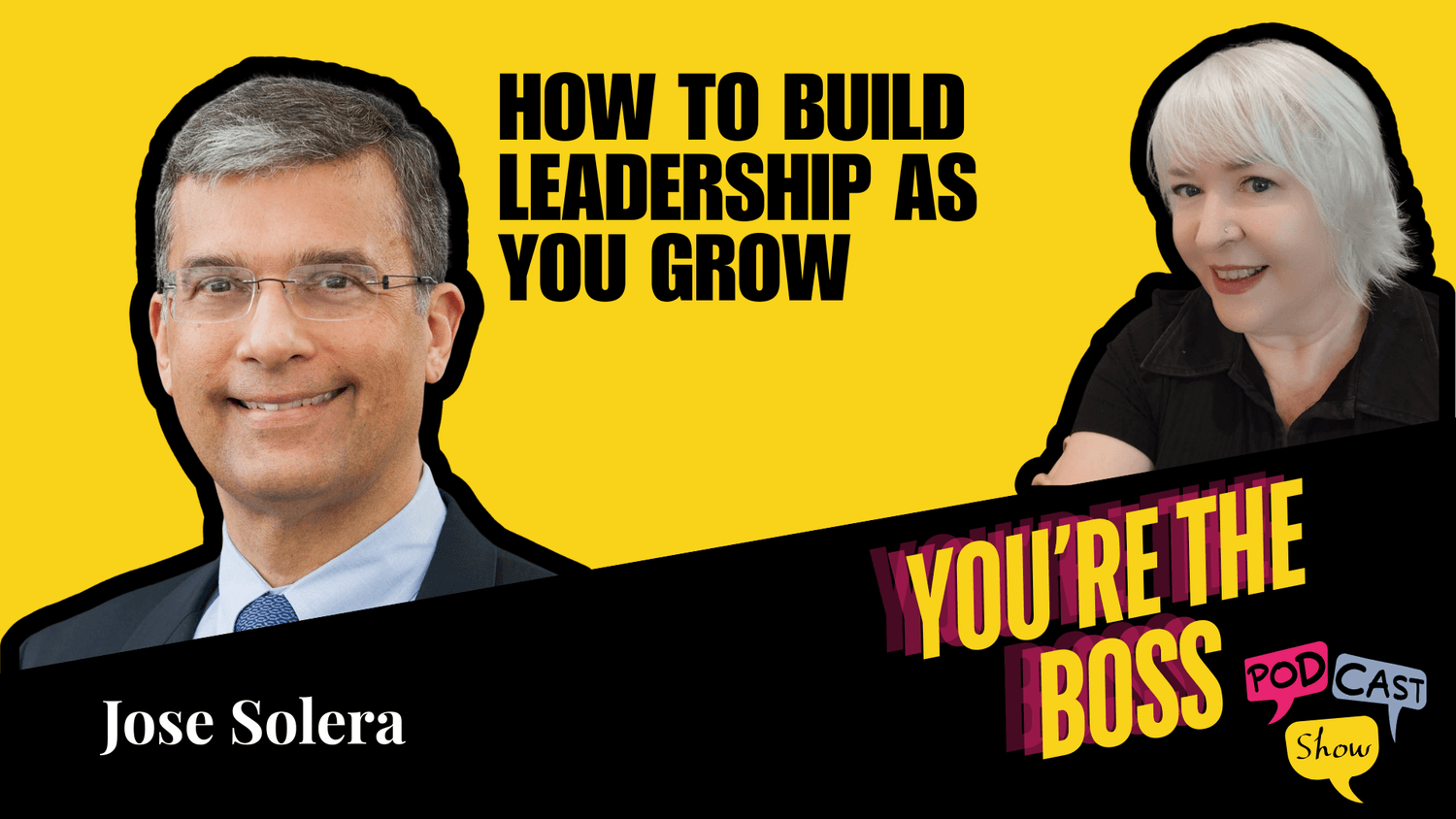
How To Build Leadership As You Grow
Click the image above to watch
Ange Dove (00:01.383)
Okay, welcome to the You're the Boss podcast. So exciting to be starting this off again after such a long hiatus. And I've got with me today a very interesting guest. His name is Jose Salera, and he is a consultant and coach in the leadership technology and project management space. So Jose, it's so nice to have you here today. Thank you for joining us.
Jose Solera (00:26.606)
Thank you, Ange. It's wonderful to meet with you here and meet your listeners and viewers.
Ange Dove (00:33.213)
Yeah, that's great. Okay, so we're here to talk today about your experience in running a business, how you transitioned over from corporate life into running your own business, because that's especially what listeners are interested in here learning today, but also to learn a bit about your expertise in leadership and what our listeners can take away from, you know, becoming leaders themselves in their business. So just start by just explaining to us what is your history basically, how did it all start and how did you transition? What was that journey for you?
Jose Solera (01:10.51)
Great, Well, I'm a corporate drone, if you will. I work for corporations all my entire professional career. I'm back in 2000 and seven we relocated from California to North Carolina in the United States. At that point I started thinking, okay, well, know, at that point it was my 50s, I guess. I said, okay, well, I want to retire at some point, but I don't play golf, I don't fish, I don't hunt, I don't play dominoes all day long, I need to do something. And probably because of the... the way the retirement plans are here, I need some extra income too. So I started looking and happened to be that if.
I had spent 23 years at Intel and part of that I did leadership development. was my background when I was a point grad, so leadership to us is a big thing. And I started looking around and helping people at Intel. And it was good, but I also realized that management needed to to want it. And so that ended up being a...
great experience, but he gave me the foundation. A friend of mine, she found out I was moving here, said, hey, one of my professors from Penn State is there on a sabbatical I do, so you should meet them. And I met with them, turns out that they introduced me to the company I am the coaching for, I still coaching for them, a company called Delta Leadership. And you can Google them, they have their website up, deltaleadership.com.
Jose Solera (02:47.24)
And I started coaching with them. So, and I did that, and I still doing it part time, but I was working full time. trying to time that properly. But my idea was let's figure out how do I set up a quasi retirement employment time that I can work 20, 25 % of the time. I don't have to do all the bureaucratic stuff. I started that at the same time.
I had been doing some workshops in California with PMI on project planning and execution, product acceleration. There's an approach that came out of Intel Semiconductor Design that gives you a plan for complex or complicated program very quickly. You can get it done in a day or two if you have the right people. Otherwise, it would take weeks or months and not be comfortable to have a complete plan. So I used to teach on that and then...
Ange Dove (03:31.036)
Mm-hmm.
Jose Solera (03:43.598)
One of my attendees asked me, hey Jose, can you come and help us plan this program that we have? And I did. And in the process of doing that, one of the first things I did, and this is what I'm going to say is true to the United States, by the way, know, this is the United States. I am not a lawyer. I am not a tax accountant. So whatever you hear from me is just my experience. And you can, you know, please consult your own lawyer or accountant, which is what I did. I set up a limited liability.
Ange Dove (03:49.769)
Mm-hmm.
Ange Dove (04:00.935)
Right. Yeah.
Jose Solera (04:12.174)
So that I could, various reasons, one of them obviously is protection, but also another one is that I also applied for a tax number from the government here so that I could receive income through the company and pay expenses to the company. if you're considering going into business, that's one of the first things I would suggest you do. Obviously consult your local laws and regulations. I used a lawyer.
Ange Dove (04:30.952)
Hmm.
Jose Solera (04:42.126)
Although in the United States there's the sort of website, legalzoom.com, I think that you can go in, I will do everything for you at a much lower expense. But then again, I did this back in 2008 or so, so there were as many options. But I set that up, I went and did that engagement with a company in California. went very well, while at the same time I was coaching with...
Ange Dove (04:50.045)
Mm-hmm.
Jose Solera (05:09.454)
with Delta leadership. Most of the work with Delta was with Duke University here in the United States, their business school, Fuqua School of Business, and their executive leadership program. And that continues to be the case. So growing a business is interesting because in my case, most of that income is coming through Delta. So I have not marketed as much as I would have done if it was on my own. And that's the area I'm trying to focus on right now.
Ange Dove (05:33.021)
Hmm.
Jose Solera (05:38.682)
grow my own business so that I'm not as dependent. A friend of mine in California who was a PMI said, said you need multiple sources of income because at any point in time you can be laid off and that's it. And it happened to me. So at the time in California I didn't have that but luckily I able to secure a job quickly but I said I got to figure out how to do that.
Ange Dove (05:42.098)
Yeah.
Ange Dove (05:51.091)
Mm-hmm.
Ange Dove (06:05.025)
So you went in quite intentionally after you left your job to not be in retirement doing nothing. You knew you had to have a purpose, I guess, right? Do something. Yeah. Yeah.
Jose Solera (06:17.678)
Right. I just continued doing what I was doing now. Delta asked me, and I did it until about middle last year, to be their coach, organize, identifying potential coaches, making sure they got trained on making assignments of the various clients and programs that we had. So it's sort of a, it's a continuation of what I was doing part-time. And I will encourage your listeners to...
Ange Dove (06:25.609)
Mm.
Jose Solera (06:43.702)
If they haven't started yet, know, started while they still have a job so that you have a little bit more safety in terms of you're not dependent on your company. So
Ange Dove (06:52.647)
Yeah.
Ange Dove (06:56.507)
Yeah, that's what happened with me. I started my business 20 years ago while I was working part time. And so just to have that safety net, just in case, kind of thing. But I think within three or four months, I had so many clients on the books that I could actually leave. So that made it very easy for me. But yeah, definitely don't quit your job tomorrow.
Jose Solera (07:08.93)
deal.
Jose Solera (07:22.21)
Right. Well, I'm not totally involved with working that I want to just go on my own. I mean, to me, there was value in working for a company and that association, but everybody's different. Which is why I didn't just work on marketing and selling to grow my own business. I was lucky in that I have the source of clients that I didn't have to market on. So, but I'm trying to...
Ange Dove (07:27.923)
Mm.
Ange Dove (07:32.72)
Right.
Ange Dove (07:49.897)
Right.
Jose Solera (07:51.694)
As I said, trying to work on that now.
Ange Dove (07:53.873)
Right. Did you have any challenges when you first started? Was there anything?
Jose Solera (07:58.702)
Imposter syndrome? Yeah, so those of you who are not familiar with imposter syndrome basically means that while you're highly qualified you feel you're not and you undermine yourself.
Ange Dove (08:00.581)
Okay, okay, that's a big one.
Ange Dove (08:10.59)
Yeah.
But with all your experience that you had for so many years, why do you think you had imposter syndrome? Was it just because it was a new role in terms of it was your business?
Jose Solera (08:25.358)
It was more a new role with new client. So when you engage with a new client, there's a lot of contextual information you'll have to quickly acquire. Who are they? What's their mission? What's their vision? Where are they going? Who are the power brokers? Besides what they tell you, what's underneath that may be relevant. So back in 2015, I became a
Ange Dove (08:28.927)
okay.
Ange Dove (08:33.128)
Yes.
Right.
Jose Solera (08:53.298)
Chief Information Officer for a medical insurance company in I work remote, well, I spent time in California, but I worked remotely, never relocated to California. They said, Jose, we need a CRM, customer relationship management system. So I said, fine, I've done that. Okay, let's go do that. But as I started investigating and trying to figure out, what's really going on here, turns out that the...
Ange Dove (08:56.296)
Hmm.
Ange Dove (09:01.458)
Mm.
Jose Solera (09:18.754)
While true they needed a CRM, the bigger pain point was processing insurance applications. Because of legal changes in this country, they receive almost 90 plus percent of their insurance applications in the fourth quarter of the year, October through December. It needed to be processed very quickly with certain quality levels and all that. So I said, okay, sure, we need a CRM, but we need to focus on that.
Ange Dove (09:24.37)
Right.
Ange Dove (09:35.463)
Hmm. Well, okay.
Jose Solera (09:47.948)
But it came about in that sense making that understanding the context, which is true even if you're just consulting or coaching. You need to a sense of what's really going on. And that's why in our engagements, depending on what it is, we like to have an assessment phase upfront to just over as much as possible what is going on. You arrive and just have a client say, well, come and coach us on leadership.
Ange Dove (10:07.241)
Mmm.
Jose Solera (10:16.952)
say yeah we can do that but I think we can do a lot more if we understand the context of what's going on.
Ange Dove (10:17.373)
Yeah.
Yeah.
So it's like you really show your value as a consultant then in that sense when you can come in and say, yeah, we see what you've got, but we think you need this as well. So you can put them in a much better position.
Jose Solera (10:37.698)
Well, in more than we see what you want and we can help you love more random buttons.
Ange Dove (10:43.377)
Yes. Yeah, yeah, you've got to give them what they want as well. So how did you get your clients after? how did you get enough clients to keep you going?
Jose Solera (10:48.226)
Yes, definitely.
Jose Solera (10:57.036)
Well, again, most of my clients have come through Delta leadership. So and I have the luxury that while I'm retired, my retirement income allows me not to have to look for a full time level of income. So, you know, I'm not swimming in money, but it makes it somewhat less stressful. I mean, to some extent, that's good and that's bad in that it has forced me to try to grow my own business. So
Ange Dove (11:00.712)
Mmm.
Ange Dove (11:09.161)
Mmm.
Ange Dove (11:24.649)
But it's also good, think, because I fell into this trap as well. And I think it's something that's useful for people to realize and to know that it's your business, that you're in control of how big you want it to grow. So it doesn't have to be big. It can be just enough. And when you actually work out how much money you need, and then you work out actually, maybe it's not that much, you can release some of the pressure and just build a business that's comfortable for you to run. So I ended up at one point with my business where I had 10 staff under me and the overheads were crazy. And I was like, I didn't sign up for this. I want to do this. I just wanted to work from home, which didn't work out at that point. But I've built my business now since to do that so that it fits within my lifestyle. So you've kind of done the same. It fits within your retirement lifestyle. So you still have quality of life. You still enjoy yourself.
Jose Solera (12:16.014)
exactly.
Jose Solera (12:20.046)
Right. Right. I don't want to have a company with more than one person me. If I need help, I'll subcontract it. I did it a couple of months, three years ago. We had to do a planning workshop with a luxury automotive maker. And I contacted a friend of mine from Intel days who's an excellent facilitator. And together we did the workshop online with 65 people in Zoom on
Ange Dove (12:27.145)
Okay.
Jose Solera (12:48.684)
came out with a plan that actually got them going. They were working, but they had 25 teams working independently. So they were not talking with each other.
Ange Dove (12:58.696)
Yes.
Ange Dove (13:02.158)
This is the business model you can have now with technology now just allows you to do that, right? Which you couldn't in the past, right?
Jose Solera (13:07.116)
Right. Yeah, I think it was in Arizona and I was here. The client was mostly in California. So we did the facilitation and the value of what we deliver, which at times and that's why I won.
Ange Dove (13:14.643)
Yeah.
Jose Solera (13:24.942)
listeners to think about is what's the value? That's really what you're selling. So at the end of the session, the vice president of quality assurance said, Jose, for the first time, they're talking with each other. And they're actually realizing the dependency that they have. Because I run projects and programs for a very long time. In my experience, things break in the boundaries between teams or between people. It's very key that they talk with each other. So that's a beauty of that approach.
Ange Dove (13:37.235)
Good.
Ange Dove (13:47.592)
Bye.
Jose Solera (13:55.168)
If I have more clients, if I need to grow more, I am not planning on having a staff. I will put my friends in contact. Yeah.
Ange Dove (14:00.517)
Yeah, yeah, you don't need to, think, these days. Yeah, you just don't need to. I think.
Jose Solera (14:06.19)
Well, I'm setting up a limited liability company with a tax ID allows you to make those payments. The United States issued a 1099 at the end of the year for tax reasons. you don't have to, if you don't do it, it's much more complicated. As an individual, cannot issue a 1099 and other things that come into play.
Ange Dove (14:13.523)
Mm.
Ange Dove (14:17.673)
Mm.
Ange Dove (14:24.606)
Yeah.
Ange Dove (14:28.693)
you can leave yourself open to all sorts of litigation and stuff and you take all your possessions from you. I mean, I was told when I first, when I very first sat at my company, I was the sole proprietor at first. So that was still like, it's just like a personal income really, is how it's treated tax wise, right? In Singapore anyway. And
Jose Solera (14:34.316)
Yeah. Right.
Jose Solera (14:49.164)
Mm-hmm.
Yes, thank you.
Ange Dove (14:54.599)
Then I went to see a lawyer, same thing about, okay, what should I do with my company? And he said, there's no downside to being a private limited company. You know, you're protected, just go and do it. So, so that's what I did. And it made a difference as well with the type of clients I got afterwards, because when they saw the private limited at the end of the name, I started to get bigger clients as well. So that's another another advantage. Okay. Can you talk a little bit about the
Jose Solera (15:20.332)
Yeah.
Ange Dove (15:23.601)
Like you mentioned how when you went in and consulted with this company and then the staff are actually starting to speak to each other and communicate in a way they hadn't. Can you speak a little bit about how important communication is in running a business? if, you know, like people might not take on staff internally, but they probably will eventually need to have some staff remotely, right? How important is communication in being a boss?
Jose Solera (15:37.134)
you
Jose Solera (15:53.496)
Communication is the glue that enables anything that you want to do. So I use a leadership development model called the six domains of leadership. Delta leadership has information, and that's where it comes from. While communication is not one of the domains, it is everywhere.
Ange Dove (16:07.848)
Yeah.
Jose Solera (16:15.374)
So because there is if I as a leader you have a vision, but you don't communicate it you don't have a vision It was a leader You want to get to know your people, but you don't spend time with them and talk with them You don't know them They don't know you and they don't trust you So if as a leader you want to there's a need for your team to understand
Ange Dove (16:15.507)
Yes.
Ange Dove (16:23.721)
Mmm.
Ange Dove (16:35.689)
Mm.
Jose Solera (16:43.118)
the abilities and limitations of what they can do and how they work with other people, et cetera, unless you communicate, that doesn't happen. and it is, we as leaders tend to underestimate the need to communicate and the need to repeat ourselves in many cases. So
Ange Dove (16:46.984)
Hmm.
Ange Dove (16:51.634)
Yeah.
Jose Solera (17:04.494)
I was running the year 2000 program for Intel and we had asked the CEO to issue a statement to the company, company wise saying, year 2000 is important.
Ange Dove (17:04.615)
a good fight.
Jose Solera (17:14.796)
while Jose's team is working on it, they will not solve every problem. They will only solve the major enterprise systems. You need to focus on your own things because everybody had their own little program, et cetera. And so the message went out and about two or three months later, we went back to the CEO. So we need to do it again. And he said, why? I just did it. And the answer that we gave him was, hey, listen, if it's not repeated, it's the flavor of the month. go away.
Ange Dove (17:43.731)
huh.
Jose Solera (17:43.8)
there are too many other demands on people's plates in terms of what they have to do, needs to be reinforced. And yeah, maybe we'll...
Ange Dove (17:48.541)
Yep.
Jose Solera (17:52.43)
phrase it differently, so there's some newness to it, but at end of the day, you need repetition. in our research using the six domains of leadership, contextual leadership, which is one that addresses the fact that people need to understand who, what, where, why, et cetera, is usually one that most leaders struggle the most with. And that comes down to a need to better communicate more.
Ange Dove (17:55.795)
Mm.
Ange Dove (18:10.505)
Hmm.
Jose Solera (18:19.734)
So there's no way around it. If you want to be a leader, you have to communicate. If you want to create the next big widget that solves the world's problems, you can do it on your own in your little private office. But unless you communicated to somebody, nothing happened.
Ange Dove (18:37.757)
Yep. That's the same with everything, right? And marketing is the same. If you don't communicate that you exist, you're not going to get any sales.
Jose Solera (18:45.358)
Well, when I coach clients, we use a survey, the 60 Minutes of Leadership Survey. And we tell them the survey is based on frequency of observation of a behavior. So the supervisor rates the individual and says, you know, how often do I see them do X, or Z? And then when I coach people, I say. The fact that somebody scored you as rarely, they rarely see you, doesn't mean you don't have the ability to do it. Just as if they haven't seen you do it. So there are two pieces to any of these behaviors. One is you need to have the ability to do it, but two you have to have you have to demonstrate the behavior and you have to have the opportunity to do it. There are certain circumstances where if your boss is very much a top-down kind of person, you may not be able to exhibit certain behaviors of a leader. You have to take that into account. But in other cases, it's because we're not as comfortable displaying that and that old Kim's act of communication. And it's not just verbal communication. There's non-verbal too.
Ange Dove (19:35.997)
Hmm.
Ange Dove (19:59.699)
Right.
Jose Solera (20:01.23)
people are watching you and seeing what's going on.
Ange Dove (20:04.251)
Yeah, yeah. And how, if someone wanted to improve their leadership skills, how would you advise them to go about doing that?
Jose Solera (20:16.994)
Leadership, if you Google it or search for it on the web, you're going to get millions, not billions of responses. Leadership is one of those things that at times is difficult to define, yet it's easily recognizable. So, you know...
Ange Dove (20:34.653)
Mm-hmm.
Jose Solera (20:40.472)
What you need think about is, okay, the definition of leadership is having the skills to be able to work with a team and communicate where you're going and have them work with you to proactively help you get there. and I looked at a number of models and I have an encyclopedia of leadership back in my bookcase over my left shoulder which you're not seeing right now. I couldn't, when I was doing this at Intel back in 2005, 2006, I did not find a good model. The six domains of leadership, which I learned about when I moved to North Carolina and engaged with Delta and Duke, is probably the simplest yet most powerful model to understand the behaviors. It is not complete. There are other models, social situation or leadership from Hiroshima Lantern, that are also very powerful, but those are, they have the uses of their specific situations. So if you want to learn about leadership, search in the six domains of leadership, and by the way, depending on the search engine, you may find a lot of other things that are not related to it. So the best bet is to go to deltaleadership.com.
Take a look there. They do have the There's a book that professor Simpson can and Alan Lind the creator for the model Published that's available there. There's a lot of other things out there So the book is a little academic, but it's very good and thorough I also write a lot about system itself leadership if you go to Yes, yeah, what's that? Lara the medium calm
Ange Dove (22:22.705)
Mm-hmm. Yeah, I've seen some of your articles on LinkedIn.
Jose Solera (22:30.156)
you'll see my writings there is not always about tick domains. And actually I need to write one today and I'm thinking about AI as a coach. So, you know, because I can get an AI tool to actually do an initial assessment of a survey and tell me what it is. So, which is really amazing, to say the least. But anyhow, so go there. There are a lot of...
Ange Dove (22:39.688)
nice.
Ange Dove (22:47.537)
Okay.
Jose Solera (22:58.72)
writers, lot of things. John Maxwell has a lot of stuff about leadership. So be careful because sometimes the kitchen sink gets thrown into leadership definition. don't know if that's a US term maybe, but when I started researching leadership back at Intel, I realized that things such as strategic thinking, a lot of the management skills that are important.
Ange Dove (23:02.365)
Right.
Jose Solera (23:26.548)
are not necessarily leadership skills. They're all need to be there. And actually, we talked to the professors here. They'll make a big difference between management and leadership skills. And leadership skills are really, you know, how do get people to do the right things while management is more or less getting them to do them the right way. both are extremely important as a leader, so you need to have them. So that academic distinction to me sometimes is not as relevant. But
Ange Dove (23:45.341)
Hmm.
Ange Dove (23:50.985)
Mm.
Ange Dove (24:03.113)
Okay.
Jose Solera (24:03.852)
You know, think about understanding leadership as a subset of understanding the behaviors that an overall manager slash leader needs to have with their people or their clients. By the way, we lead up, down, and across. and we lead at all times. So, even the little kid playing soccer, some of them will be leaders and they exhibit certain behaviors. So
Ange Dove (24:13.705)
Hmm.
Ange Dove (24:29.299)
Yeah
Jose Solera (24:30.275)
So don't think that you cannot be a leader unless you have people working for you. That is not true.
Ange Dove (24:34.897)
No, I remember one time when my son was still in primary school, actually, and one of the notes that came back from his performance and that was he's a natural leader. And I think he's obviously exhibiting those qualities just in the classroom, right?
Jose Solera (24:46.445)
Mm-hmm.
Jose Solera (24:49.836)
Yeah. You make a good point. There are people that are born with certain skills and behaviors that make it easier for them to be leaders. But it doesn't mean that no one else can be leader. Leadership to some extent is an acquired behavior based on natural abilities ideally, but not necessarily. So the classic...
Ange Dove (24:59.081)
Mm.
Ange Dove (25:05.246)
Right.
Ange Dove (25:12.658)
Hmm.
Jose Solera (25:18.03)
classic analogy is playing basketball. know, if you're Michael Jordan, I don't know if you know who Michael Jordan was, or Riaz, but he used to be a very star in basketball. You have some natural abilities, height, speed, agility, etc. That no matter how much training Jose Soler has, will never even come close to even, you know, one tenth of one percent of his ability. But I can still improve. So
Ange Dove (25:22.609)
Mm-hmm. Mm-hmm. Yep.
Yes.
Ange Dove (25:41.509)
Mm. Yeah.
Jose Solera (25:44.526)
Same thing with leadership. Some people have the skills and some people don't. But if you don't, or if you do, you can acquire and enhance them. And that's why it's something like the six domains of leadership allows you to.
Ange Dove (25:53.288)
Mmm.
Jose Solera (25:57.902)
to learn about. So the six domains are, they're shown in a pyramid with the base being personal leadership, which means that the person is credible as a leader. Relational leadership, which is in the middle bottom, which is, it is the keystone of the entire model because that yields trust. You're trusted as a leader and you trust them as people you work with. Contextual leadership on the far right, which is the one that gives you a sense of
Ange Dove (25:59.453)
Yeah.
Ange Dove (26:09.501)
Right.
Ange Dove (26:16.521)
Mm-hmm.
Jose Solera (26:27.856)
community have worked together. And then in the middle you have inspirational leadership which helps your followers or your team members have high aspirations while next to it to the right is supportive leadership which makes them feel safe and allows them to take the initiative because it is very important if you want to encourage people to take the initiative that it is safe for them to do it.
Ange Dove (26:50.633)
Mmm.
Jose Solera (26:51.374)
If it's not, guarantee you, will not have any inspiration in your team or in foundation. And then on the top is responsible leadership, is really being a steward of the organization, of the team or everything, balancing long and short term, having high ethics, et cetera, that comes into play. So that's the model. It's simple, yet as you dig into it, the more you learn, the more insights you get.
Ange Dove (26:55.977)
Hmm.
Ange Dove (27:09.177)
Mm.
Ange Dove (27:19.945)
still dealing with people, right?
Jose Solera (27:22.574)
Well, I've been coaching using it for, since 2008, what's that? Six, five, 15, 16 years. And every time I do it, I learn something new. Yeah. So long way to answer your questions. How do you improve leadership? So, and there are programs out there that you can, people can participate if they're interested. Delta has some, has some, Duke runs a
Ange Dove (27:32.733)
Yeah. Interesting. Okay. That's cool.
Ange Dove (27:46.334)
Yeah.
Mm.
Jose Solera (27:52.064)
a week long executive leadership program that's really taught by, excuse me, Delta leadership. And I thought about it. So for a while they were doing virtual sessions, doing Zoom. I think they've stopped that because most people want to do it in person rather than Zoom.
Ange Dove (27:59.091)
Mm.
Ange Dove (28:10.727)
Right, yeah, yeah. I think it's a lot more fun when it's done in person and more effective, right, when it's done in person. Right, as I said, thank you so much for joining me today. It's been lovely to have you on. I'm gonna post under wherever this video appears, I'll post your links to your LinkedIn and your website, but just tell us where they can reach you.
Jose Solera (28:25.39)
great.
Jose Solera (28:38.766)
The simplest way is Jose of coach Solera solera.com using an email there. Um, you can find me on LinkedIn The ends with Jose Solera Simple I don't have a whole bunch of numbers. I became a member way back when before many other hoses whereas So that's the other option
Ange Dove (28:44.691)
Mm-hmm. Mm-hmm.
Ange Dove (28:51.399)
Yeah. Yeah.
Ange Dove (29:02.504)
Right.
Jose Solera (29:06.626)
to follow me on josecelera.medium.com. then, that's right to my writing. will usually post a brief blurb in LinkedIn so people see it. And if people are interested and they send me a note, I'll add them to my mailing list, which when a meeting will send me the article and I forward it then to everybody in my list so they get it. So
Ange Dove (29:10.704)
OK, so that's where you do your writing is on medium, right?
Ange Dove (29:19.037)
Then they can catch you from there.
Ange Dove (29:25.031)
Mm-mm.
Ange Dove (29:28.647)
Yeah, okay, okay, cool. Okay, so I will put those links there so people can reach out to you. And so thank you so much for your insights today. It's been wonderful having you on.
Jose Solera (29:37.602)
Excellent.
Jose Solera (29:41.208)
You're welcome and happy to answer any other questions for you and your viewers. Just reach out to me. Great. Thank you. Have a great day.
Ange Dove (29:46.289)
Yeah, OK. Fantastic. OK, thank you.
Lorem ipsum dolor sit amet, consectetur adipisicing elit. Autem dolore, alias, numquam enim ab voluptate id quam harum ducimus cupiditate similique quisquam et deserunt, recusandae.
Don't leave without your free gifts

Check out my page of freebies designed to help you make progress towards your goals.
From free training on making $10,000 months to how to create your brand message to access to the resources I use in my business that may help you too!
I've got some
gifts for you!
Check out my page of freebies designed to help you make progress towards your goals.
From free training on making $10,000 months to how to create your brand message to access to the resources I use in my business that may help you too!
About me

Hi there 👋 My name is Ange Dove, professional copywriter and messaging strategist. I help Gen X professionals find the words to express who they have become, and to build a career or business that owns it.

GET YOUR UNCHAINED AUDIT
Let’s have coffee online for 60 minutes on Zoom, where we'll look at your profile, your message, and your next chapter together and give you the roadmap to take your next steps.

GET THE NEWSLETTER
Straight-talking insights for experienced professionals who want to turn what they know into income, options and greater freedom over what comes next.


