Call: +65 6012 3433 | Whatsapp +65 87792453
How To Build A Scalable Business With A Remote Team
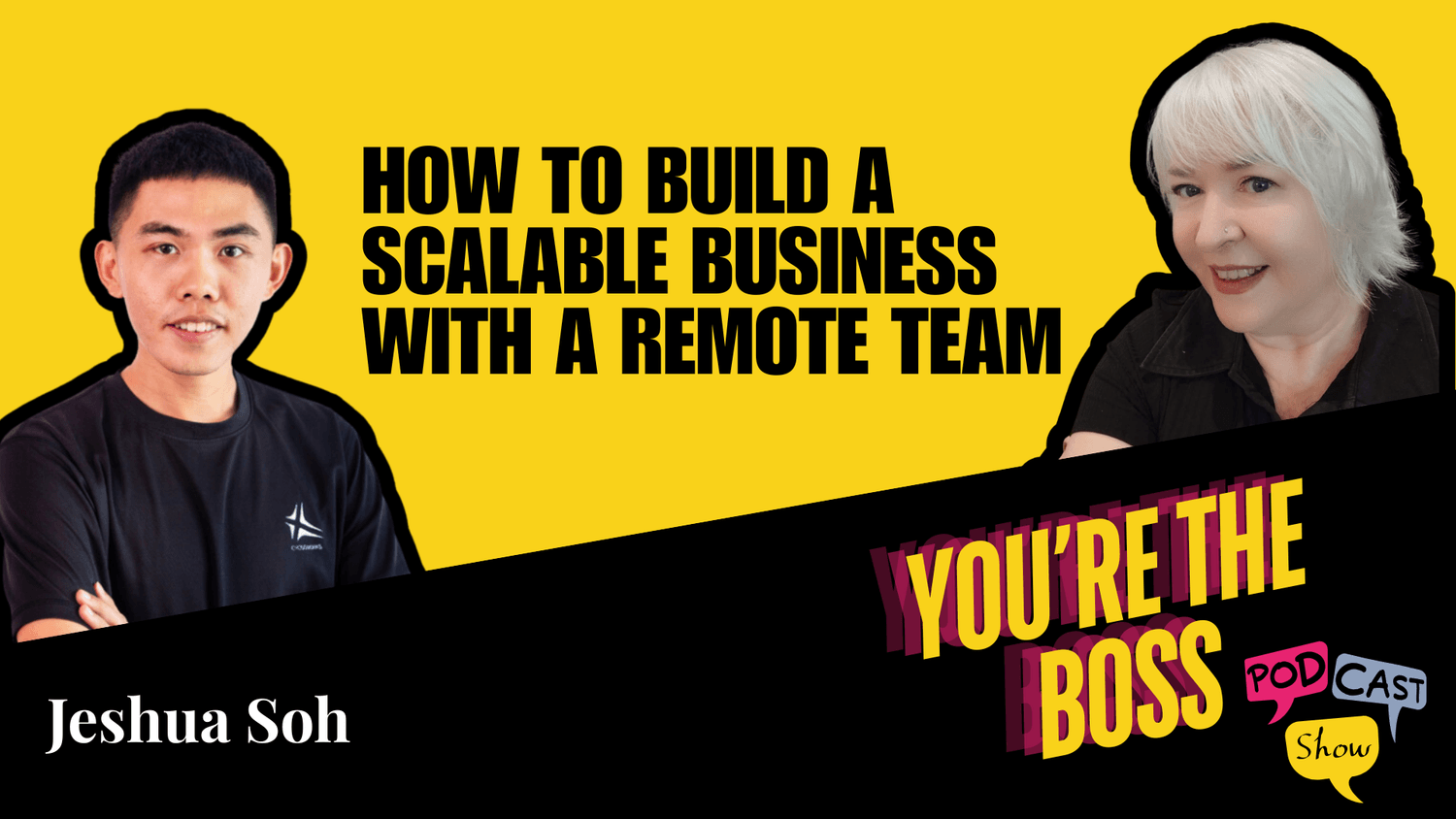
Click the image above to watch
Ange Dove (00:01)
So welcome to You're the Boss Podcast Show. And today I have Jeshua So with me. Now he is an entrepreneur, filmmaker, investor, and traveler. And he's not your typical Singaporean. He started an entrepreneurship very early on. And I'll I'll leave him to explain how that all happened. It's a fascinating story. And he ended up founding Crossworks in Myanmar.
at the time solely to hire staff for his two companies, but that ended up becoming a business in itself as he recognized that other companies could use that service as well. so now Jeshua spends although he's based in Singapore now he spends a lot of his time and his focus in Myanmar working on helping out there. So Jeshua welcome to the show.
Jeshua Soh (00:59)
Hi, good to see you, Angie.
Ange Dove (01:01)
Yeah, good to see you. So so as I said, you you have a fascinating story. So can you just explain to us how it all got started? How did you enter entrepreneurship? How did everything grow for you to to where you are today?
Jeshua Soh (01:18)
Sure. yeah, so like I like to tell people I actually born and raised in Singapore. Contrary to popular belief, maybe some people think that, you I'm Burmese or I have some kind of family background in Myanmar. But because of what I do, you know, I think it's quite a natural conclusion. yeah, but my my growing up years were pretty much like a typical Singaporean, you know, you go to high school and then I guess what changed for me was the decision at the age of sixteen to start working and to stop schooling. And
Ange Dove (01:30)
okay.
Jeshua Soh (01:47)
Basically, I dropped out of the sort of quote-unquote formal education rat race. I was in one of the top junior colleges. I didn't have to take the O-level, N-level, A-level examinations. And then I eventually skipped the whole university route as well. So the intention then was to go into filmmaking and sort of home my craft, do some internships, take on some freelance work, and then eventually sort of see myself in the filmmaking career.
However, of course there were a lot of twists and turns along the way. And the first of which I guess happened just as I was about 19 years old. And I had already been doing a bit of freelance work for like two or three years and accumulated some filmmaking equipment, which you can see behind me, right? Some lights and tripods and stuff like that. So I had the national service obligation as a Singaporean. For two years, you know, every Singaporean guy has to serve the nation.
Ange Dove (02:34)
Okay.
Ange Dove (02:41)
Mm-hmm.
Jeshua Soh (02:45)
And I was thinking that you know all these cameras and lenses and lights were going to be collecting dust during the two years that I was serving the nation. So I thought, you know, why not I put up a simple Facebook page and list them out for others to rent so that I can make some side income and cover the depreciation while you know not needing to sell everything and then maybe buy them back when I finish the two years of service.
And that turned out to become like a organic marketplace because we had a bunch of other friends and acquaintances in the industry who also had the same issue or also resonated with the issue of having equipment lying around collecting dust and not always being able to utilize them. And yeah, so basically with no tech background or ideas or even know-how on how to start an online platform.
I ended up hiring a bunch of developers, you know, we put together this website and became like Airbnb sort of thing for cameras. Yeah, where we had about two hundred owners and yeah they would rent f to all the people around Singapore.
Ange Dove (03:45)
Thanks.
Ange Dove (03:50)
my god, that's just so fantastic. So it's like so just just to clarify for people listening if they're not aware of what happens in Singapore. So males have to go for two years in the army as a conscript. yeah, army or or one of the yeah, armed forces or whatever, yeah, to serve two years, right? And in that time you're not able to work.
Jeshua Soh (04:05)
Not necessarily the army. Yeah, license army there.
Ange Dove (04:17)
Your your full time in the in the s the services. So so just just explain to me. So when you decided to s to rent out your equipment and then you realize there was a market for it and other people would wanted to do the same, what was it that made you think, okay, I need to get a developer to help me here? Was that something? Okay.
Jeshua Soh (04:17)
Yes.
Jeshua Soh (04:40)
It started off as a Facebook page. So we had like a list of equipment and then you know some terms and conditions and you know instructions on how people were supposed to collect and return items. But the list kept getting longer because it was at the beginning just my items. And then I had like one acquaintance join in, I had like another friend come in and then so there were like multiple locations for people to collect. And it got to the point where I think there were like 20 of us with 20 different locations and
Ange Dove (04:54)
Yeah.
Ange Dove (05:05)
Wow.
Jeshua Soh (05:06)
The user experience was not just like, you know, they had to go through so many pages of equipment just to find what they need. So yeah, it's kind of like more out of necessity that we needed a more user-friendly interface.
Ange Dove (05:12)
Okay.
Ange Dove (05:18)
Okay, and and was this before carousel?
Jeshua Soh (05:22)
I think it was around the same time as Carousel started. But probably Carousel is more like a buy and sell marketplace. Yeah, and and plus the big factor was about trust because these camera equipment are quite expensive.
Ange Dove (05:24)
the same time. Yeah.
Ange Dove (05:29)
Yeah, yeah. It was just purely rent, yeah. Mm.
Yeah.
Jeshua Soh (05:36)
And yeah, basically like the same issue with Airbnb, right? You're not sure whether you want to trust someone with a five thousand dollar piece of DSLR equipment. So there was a huge importance to verify the identity of the user, right? Which carousel doesn't require really require because you're just buying and selling things. Yeah. So that's the key differentiator with our platform, which was the whole verification process and the terms and conditions and yeah, making sure that all of these things are done properly so that there's trust to be built.
Ange Dove (05:48)
Okay.
Ange Dove (05:53)
Right.
Ange Dove (06:05)
Okay. Okay, so you ended up with quite a successful business kind of by accident. There wasn't a plan to do that really, right? And then it kind of took off because there was the demand.
Jeshua Soh (06:13)
Yeah, and of course there were lot of challenges along the way as well and you know, I I think being from a kind of self educated background, didn't go to business school, anything like that, I also wanted to get myself, you know, a bit more educated in terms of how to scale this company. And that was also the reason why I started the second company called Startup Media, because previously I had been doing a lot of freelance work for like
Ange Dove (06:33)
Mm-hmm.
Jeshua Soh (06:41)
Bloomberg, Accenture, China News Asia, big outfits that that people know and hear about. But usually the type of work is a little bit less creative and you know, usually more rinse and repeat kind of stuff because they want safe and you know, tried and tested stuff rather than too novel. And by by starting to work with more startups and the ecosystem partners like accelerators, incubators, very small startups with like teams of two or three people, I was able to be in the same room as
Ange Dove (06:44)
Right.
Jeshua Soh (07:11)
you know, a lot of these founders when they were discussing about, you know, growing their companies or, you know, joining a lot of these hackathons or accelerator programs and being paid actually cover those events and get included at the same time. So
Ange Dove (07:21)
Mm. Okay. Nice. So what so what kind of things did you learn from that experience?
Jeshua Soh (07:29)
I I think the whole step of you know from how to actually look for unique selling points in your business to how to you know pitch to potential customers or investors. And a big part of it was about storytelling because usually for for new companies there's mostly just a pitch tag and an idea, right? There's nothing to show for it, right? No product, sometimes no traction, no proof points in terms of the efficacy. So the founders being able to, you know, vision vision
Ange Dove (07:48)
Mm. Mm mm mm.
Ange Dove (07:54)
Right.
Jeshua Soh (07:59)
Being visionary enough to come up with the idea is what makes the company at a very early days. And yeah, I I think I had the good opportunity to meet with people from many different industries and understand both sides of the table, right? Like there's the investor side which funds these ideas and then there's of course the founder side which executes all these ideas.
Ange Dove (08:20)
Right. And then you've gone on at some point to actually invest yourself as well, right? Yeah.
Jeshua Soh (08:27)
Yes, so I guess along the way of doing that, this is kind of a parallel track, but I sort of see some of these companies growing from two or three people to, you know, maybe worth a hundred million or two hundred million when they raise their subsequent funding rounds and when they scale into a larger operation. And yeah, I'm I'm sort of thinking that, you know, this potential is exponential, right? Like the technology and scale
potential for a lot of these novel business ideas and innovation is great. Of course there are there are many dead bodies along the way, right? I think for everyone that makes it many of them don't. And I also see that some of it so yeah I appreciate that it's not like it's not an easy money kind of journey, right? You will have high risk, high risk
Ange Dove (09:04)
Yeah. Yeah.
Ange Dove (09:12)
So so is it yeah, so is it the were you inspired to go into investing because w of what you saw in the incubators? Because obviously you you had no background in business previous to that and as you said you left school early. So it was purely so that was a really useful l learning ground, I suppose, for you for your business. Yeah.
Jeshua Soh (09:35)
Yeah, I like to call it a front row seat, right? And you know, usually usually it's a pay to play game, right? You you have to put in a lot of money first and then you learn from your mistakes. Whereas I I had the privilege of even making money a bit from this industry. Yeah. Yeah. So so I I feel that the experience was a lot more neutral because it wasn't like people were trying to sell me anything or convince me about anything. I I had time to understand, you know, what was going on for myself and to my own conclusions.
Ange Dove (09:42)
Yeah.
Ange Dove (09:47)
Yeah. You were getting paid for it at the same time. Yeah.
Ange Dove (09:57)
Yeah.
Ange Dove (10:01)
Okay.
Jeshua Soh (10:04)
Yeah, but I guess very young into my life or career or education, I've also learned from a lot of mentors in my life that it's better to make money work for you than to work for money. And yeah, I think it was probably in my teenage years where I bought like my first stock or ETF and things like that. So investing in and of itself wasn't like a very new concept. I think it was kind of like diversifying as well from what
types of different asset classes you can explore and and I guess I was younger than most of the other investors. So naturally my horizon is a bit longer. Yeah I think the general advice that I hear a lot of people say is you you invest what you can lose. And because I wasn't you know having any dependence or you know living a luxurious lifestyle by any measure. So I had a little bit more disposable income that I could work.
Ange Dove (10:52)
Yeah.
Ange Dove (10:56)
Nice. Okay, I love that. And then so how did how do you how did you get involved in Myanmar? What was the story there?
Jeshua Soh (11:06)
Yeah, so going back to the first two companies, right, the Bentor Platform and Startup Media, as the two companies were growing, then naturally we have to expand our team and have people come in for operations, marketing, video editing. And of course I I tried hiring some local people here in Singapore and the challenge that I had was really not of finding these people but more of retaining them. Because it's a it's a small population in Singapore, right?
three, four million people and the unemployment rate is virtually always below three percent. So usually for SMEs or smaller companies like myself, I wouldn't be able to compete with the likes of Google and Facebook in terms of compensation packages or even in terms of the what the government can offer with stability and brand name. The yeah, smaller companies sometimes become a stepping stone where
The talent might just park themselves there for a couple of months to one or two years, and then as and when a better opportunity comes, you you know you can't really fault them for moving toward those in the pastures as well. Yeah. So the issue of retraining people and consistency was was real. And eventually I tried looking at freelancers as well, you know, from webwork.com or Fiverr and things like that. And
Ange Dove (12:08)
Yeah. So the turnover's high then in that sense, right?
Ange Dove (12:15)
Yeah.
Jeshua Soh (12:27)
I found that it was a hit and miss. You know, some people are really good, some people are not so good. But the issue that I came back to again was that of retention. Because as a freelancer, you sort of want to be free, right? Sometimes you don't want to work, you want to take care of family, or you get a project which pays you more. So you prioritize what matters to you rather than to the company. And that's how I eventually came to the conclusion that I needed to work with full-time people, but maybe not in Singapore.
Ange Dove (12:44)
Yeah.
Ange Dove (12:55)
Mm-hmm.
Jeshua Soh (12:57)
I had already visited Myanmar a couple of times before that as well as visited most of the other Southeast Asian countries. So I guess what made me want to try Myanmar, like really started as an experiment, was number one, the fact that they were also a British colony like Singapore. So the language was like English was the second language, people speak it in the garden. And I think the mindset of the more educated people is vastly different from
Ange Dove (13:13)
Mm-hmm.
Jeshua Soh (13:26)
Especially our neighboring countries here in Southeast Asia, I mean in Singapore, our Southeast Asian neighbors, because the time and age where Singapore received our independence and maybe compared to Malaysia and Indonesia was quite similar, right? So we all became independent from the the British and the Dutch around the end of World War II, plus minus 20 years. And Myanmar also received her independence around there, but they were under
a very strict military rule all the way until twenty eleven. So the development of Myanmar was significantly lower, I mean, in many indexes compared to let's say Malaysia or Indonesia. And the mindset perhaps of the people, right, is a lot more of how can I learn from you guys? Because they see Singapore as you know being very far ahead in terms of many things. whereas perhaps the
Ange Dove (14:20)
Mm-hmm.
Jeshua Soh (14:22)
Neighbors, like you know, there's a bit more of a sibling rivalry. Like, you know, how come we we both you know started around the same time, and you know, maybe now the the ring gate is true to one for the sing dollar. And maybe the mindset is a little bit more of how can I earn from you guys? And yeah, I mean, when it comes to working with people, I I just felt that working with people who are hungry to learn is very important. so I started an experiment and I rented like a
Ange Dove (14:34)
Yeah.
Ange Dove (14:38)
Mm.
Jeshua Soh (14:50)
six hundred square feet space, just put out a few job posts on Facebook and I was surprised to figure out that more than a hundred people applied for the post. and again like I I wasn't too positive, right? I was a bit skeptical and like, okay, even if I hired them, would it really stay like long term? Would I have the same challenges as I face in Singapore? But thankfully, you know, that didn't happen. And
I actually found quite a lot of people who actually studied in Singapore and went back to Myanmar and were very excited to work for a Singaporean company based in Myanmar so that you know they didn't have to choose between like country and home. Because sometimes back in Myanmar, a lot of the opportunities are more with like traditional companies, and these traditional companies can be a lot more hierarchical. So boss is always right, don't ask questions unless you're being asked.
Ange Dove (15:38)
Mm-hmm.
Jeshua Soh (15:48)
And usually when you have been educated overseas or maybe in an international school, they sort of teach you to be a bit more analytical, critical, thinking, you know, and it doesn't really gel well with them. So it's sort of quite I would say a godsend thing that we had this experiment, and there were people who were very happy to work for Singaporean companies based in Myanmar. and again, because of the platform.
company I had, we had many partners who started interacting with my team members and they were pleasantly surprised by the command of English that the Myanmar people had, as well as their understanding of the subject matter. yeah, which led to them sort of saying, it could you could we rent a small table from you in your Myanmar office and and also hire like a video editor or like a developer or graphic designer. yeah, which was what we did for a couple of years until
Ange Dove (16:31)
Nice.
Jeshua Soh (16:47)
The pandemic happened.
Ange Dove (16:49)
Right. Okay. So so you were getting extra income in that way as well because they were renting from you as well. Okay. Yeah. But you you clawed some money back there from from doing that. Yeah. Okay, so then COVID happened and then how did that affect things?
Jeshua Soh (16:55)
It was more of like cost reduction, right? Because we already had to rent the space and we already had to like purchase the infrastructure. Exactly. Yeah.
Jeshua Soh (17:10)
So around the time when COVID happened, it was also the inflection point where we started having more people working for other companies than my own company. So it sort of all happened within a few months where first we had to employ like HR people to take care of the other employees because it became like a full-time job, right? To just manage people's payrolls, to check in, check out, you know, handle the leave, handle the
Ange Dove (17:20)
Mm.
Jeshua Soh (17:38)
office maintenance and everything. So I had like one or two people who were kind of operationally involved in running the Myanmar business. And basically our job back then was a lot simpler because everyone was coming to a co-working space and we had already rented a bigger office by then. But we had to engage these employees, right? So organizing like dinner parties or you know weekend sessions, making sure that the office had like backup power or
solid internet connectivity. But when COVID happened, I think everything changed because no one could come to the office anymore. And our work actually multiplied because now everyone was based in their own homes. So our job description became how can I make every home a suitable workplace? And beyond the infrastructure challenges, how can we also help to engage this remote workforce? Yeah, because
Ultimately it's back to the the fate the first problem that we face on employee retention, which is that if they are working from home for eight hours a day and staring at the screen, it's not going to be the most engaging experience. socially speaking, you know, there's there's very little interaction, isolation, and then also from a learning standpoint, if you have a challenge, you know, in the office environment, you might be able to speak to a colleague next to you or across the office. Whereas
Ange Dove (18:40)
Mm.
Jeshua Soh (19:03)
You probably have to make a lot more intentional effort when you are based remotely at home. So our job description or our company offering shifted a lot to how we can firstly augment the like backup power situation, internet situation, every house. And then also to yeah, organize virtual activities at at the beginning and then as COVID started to wane, then in-person activities, learning and development, you know, focus on
community service and helping people to pay it forward as well. all towards the mission of you know how can we actually make the employees feel engaged, how can we make them feel like they are learning in the job, contributing to their communities. And so that you know they would find that these companies that they are working with isn't just like work as an end to itself, but you know as a means to something more. And ultimately and that's a win-win-win, right? Because the companies that engage these people
They don't have to keep finding replacements or you know retraining people. And you know, the employees, they also feel like they are growing in their role and being able to contribute more over time. So yeah, that that's currently what we do basically. We manage about 125 remote employees for 60 overcome.
Ange Dove (20:05)
Yeah. Yeah.
Ange Dove (20:21)
Okay. So the difference I think you're I remember you telling me when you when COVID started you had so many employees and by the time it ended you'd grown quite significantly, right?
Jeshua Soh (20:33)
Yeah, when when COVID happened we had about twenty five people and then we actually lost about half of these people in a few months. Some owing to companies closing down, right? So a lot of businesses in Singapore were affected. Some owing to the employees resigning because they wanted to return to the countryside to be with family. so at the lowest we had about twelve people, like let's say around early twenty twenty. And then I wasn't able to go back into the country either because
I don't have a visa to to enter during COVID. And when I came back in 2022, about two years later, the team had grown to like sixty or seventy people. and now we are double of that. So that's none of it is my credit, right? 'Cause like I was stuck traveling around the world and yeah, doing my own thing. So I was working in a VC for two years as well when all of this happened.
Ange Dove (21:05)
Right.
Ange Dove (21:24)
Right. But it it's credit to you as well though that the the company I mean that that's the success of a company when it can still grow and succeed without its founder, right? As you've got the operations going and it's still growing without you, which is it's a really good sign, right?
Jeshua Soh (21:43)
I think it was a blessing in disguise because we didn't hire actually anyone to oversee this operations during the pandemic. The people that we hired initially had left just before the pandemic. And the people who actually led this transformation, I would say from just being a co-working space to you know offering our whole benefits and engagement program.
Ange Dove (21:54)
Hm.
Ange Dove (22:08)
Yeah.
Jeshua Soh (22:09)
was the same people that I hired for my camera rental platform. Because during the pandemic what happened was that no one was going out to film anymore. Right. So traffic on our platform ground to a halt. There was like a single digit number of rentals every month. So I basically told the team that, you know, we have two options here. The first of which is that you guys can go and look for another job because you know there's clearly nothing much to be done here. And the second of which is that, you know, we have this
Ange Dove (22:14)
Night.
Ange Dove (22:19)
Yeah. Yeah.
Right. Mm-hmm.
Jeshua Soh (22:39)
Other issue with everyone now working from home. And if you guys would be interested, that could be something that you'd like to work on or pivot toward. And yeah, thankfully they they chose the second option. That's why we have the company that we have today. And I think one benefit that happened out of that whole experiment or exercise was that the people who were once remote workers themselves, like working remotely for my Singaporean company.
Ange Dove (22:52)
Okay.
Jeshua Soh (23:08)
Had a lot more empathy for what remote work feels like, right? What challenges they would have. Rather than a professional manager who comes in and sort of runs this whole thing like a with a proper business plan and everything. I would feel like the innovations that happened and a lot of the things that we did actually came out of their own needs, right? The people who once worked.
remotely and once experienced you know the potential challenges with communication or with networking or yeah things that like culture differences. So a lot of the initiatives that right now are in place actually came out of practical lived experiences of of the initial team that was once a remote worker themselves rather than somehow a theoretical
Ange Dove (23:58)
Yeah, they were in it so they knew. Yeah. Okay. So so on the other side of that coin, if somebody is setting up a business and they're wanting to hire people remotely, what should they be looking for? How what advice would you give so they have as smooth an experience as possible?
Jeshua Soh (24:18)
I I would actually be a bit controversial and say that hiring should be one of the last solutions. Yeah. And it should be a solution when when you have expired, you know, looking within your your existing team or looking within your existing capabilities to do something. And hiring is a bit like an accelerant. So if you were doing poorly to begin with and you try to hire your way out of the problem, you'd just sort of like, you know, accelerate your decline.
Ange Dove (24:32)
Mm-hmm.
Ange Dove (24:48)
Right.
Jeshua Soh (24:48)
because you're kind of like you don't have a good foundation, right? You need thought Exactly, right? So you're just increasing your burn and making things more expensive. and usually when people come to me and they tell me that, you know, hey, I'm having this problem, you know, should I hire someone to take care of it? Sometimes it might work, you know, I'm not saying all the time it's a bad idea. but more often than not I find that you need to have the capability in-house.
Ange Dove (24:51)
And then you're just bringing in more expense. Yeah. Yeah. Yeah.
Jeshua Soh (25:16)
or at least a know-how in-house, and maybe you have run out of bandwidth, right? So maybe you just have like too many customers, or you you have reached a point where you want your internal team to take care of other aspects of the business. and that's those are good reasons to be hiring because you're sort of like in a in a growth phase, or you know, you you want to pass on some of this expertise in-house that you already have. doesn't work so often is maybe someone wakes up one day and says that.
Ange Dove (25:20)
Right.
Ange Dove (25:39)
Okay. Right.
Jeshua Soh (25:46)
I have this idea to use AI, right? That's what I hear a lot these days. I have this idea I'm gonna use AI to automate like X, Y, and Z. And I'm gonna ask a bunch of developers and they're gonna give me like this amazing tool or this amazing app. And then I'm even able to like sell it off to a third party. And that almost never works because it's usually like a chicken talking to duck situation, right? Where in the company they don't even have the expertise to create this, right? And and they expect a outsider.
Ange Dove (25:53)
Okay. Uh-huh.
Jeshua Soh (26:15)
Who is has no idea what the business does or you know right how how they can sort of make this work for them or even for other people. And then there's no technical capabilities in-house either. yeah, and it's kind of like if it works, you're just like lucky, in my opinion, right? We're just you've just been been fortunate. and same thing works for like marketing, right? So let's say an engineering company who has like no marketing background, they realize they need to do marketing.
Ange Dove (26:44)
Yeah.
Jeshua Soh (26:44)
And sometimes their solution is like I'm gonna hire a marketer, right? So this is regardless of whether this person is based remote or or on site. Usually that's not the best idea. sometimes it's even better to get like a marketing consultant or you know a marketing agency or you know some kind of a fractional person to at least at the at the higher level, you know, understand what the requirements are and some kind of a roadmap before you onboard to do the work.
Ange Dove (26:52)
Hmm. Uh-huh.
Ange Dove (27:13)
So get some consultant on first that can create the SOPs and get things going, right? Yeah.
Jeshua Soh (27:17)
don't have that in house capability, right? I think you are trying to do something, you know, especially maybe more core to the product or or business. You you want to make sure that you you have that in house expertise or like even for sales, right? So sometimes like you just don't hire a salesperson to go and sell something when you yourself as a founder might not have sold much or you know like you you yourself haven't found a way to convince
Ange Dove (27:28)
Mm.
Ange Dove (27:41)
Yeah. Yeah.
Mm.
Jeshua Soh (27:46)
prospective customers that it's a good value proposition. How can hiring someone yeah how can start hiring someone and then hoping that it works be a good solution. If it works then you're just lucky, right? I don't think that you are you've done anything right. Just you're just lucky.
Ange Dove (27:49)
Yeah. You need a proven model first, right? We hand it over. Yeah. Yeah.
Ange Dove (28:00)
Yeah. Okay. So so if someone did then decide they're in a place to hire remotely, then you know, because then that there will be, I suppose, extra communication issues. They're not right in the office, you've got to talk via computer and stuff. So what what would you advise people in terms of if they are gonna hire remotely, what are the pitfalls? What should they do? What should they look out for?
Jeshua Soh (28:09)
Yeah.
Jeshua Soh (28:30)
I would say that it depends company to company, but generally speaking we found that if you have the time it's good to put the individual or the team through their paces, meaning to maybe give them more assignments or even a paid trial before you actually make any offers. this can be helpful for two reasons. The first of which is because these days, you know, like with AI, some people c might come to you with like a very nice cover letter and resume and things like that.
Ange Dove (28:59)
Yeah.
Jeshua Soh (29:00)
You know, it it might not really be representative of their capabilities. Secondly, sometimes someone might be a really great worker but it's just not a good fit with the organization. Then they they could be a really high performer in their past companies or even you know have the potential to contribute a lot to another company. But when it comes to the team dynamic or you know the alignment of of values and you know the way that people communicate, that might not be a good fit. So
Ange Dove (29:04)
Yeah.
Ange Dove (29:11)
Mm.
Jeshua Soh (29:28)
Nothing beats actually working together on some project. It could be a past project that already you know is inconsequential how the work turns out. But it's a it's a good indicator of whether you know the communication is tight and the ability to take instruction is there. And sometimes it happens the other way around where the management style, right, of of the company or the the manager may not fit well with with the talent. So
Yeah, I usually encourage people if they have time to take a bit more time, right? one interview and then maybe go through an assignment, go through a paid trial. if the person is already employed in another job, that could actually save them from you know complete unemployment because now that they have for example, if the company were to make them an offer and they accept the offer and then two weeks later they realise that it's not a good fit and they resign from that job and to put a new job and now they're in no job. You know, that's not a good option. Same thing for the company, right? Like
Ange Dove (30:25)
Yeah.
Yeah.
Jeshua Soh (30:28)
They waited one month for this person to to serve their notice, they onboarded this person. Two weeks later they realized that wait, it's time to go back to the drawing board. You know, that that could be a huge risk of time for everybody. So
Ange Dove (30:36)
Right.
Yeah. So I think this is the thing as well, is it's it's a lot of the time it's on the onus of the company hiring to make sure that they are like giving clear instructions, not assuming things, you know. Yeah, because otherwise you get you get problems there as well, right? Yeah.
Jeshua Soh (30:52)
It takes to length of that, yeah, I think. Yeah.
Jeshua Soh (30:59)
I also say one more thing is that a lot of people have maybe some stereotypes about remote employees. And one of the biggest stereotypes that I've heard is concerning the communication that you mentioned. I I would say this is a double-edged sword. Like definitely it will not be as smooth or native as someone from the same city, you know, who speaks the same like first language. however
Ange Dove (31:08)
Hmm.
Ange Dove (31:14)
Mm.
Jeshua Soh (31:29)
Sometimes when you have the opportunity to work with people from a different place, that also refines your own messaging internally. So regardless of whether it's Myanmar or Philippines or Laos or Cambodia, my recommendation to business owners is always to go and explore the whole range of options that you have.
Ange Dove (31:38)
Hello.
Ange Dove (31:45)
Nice.
Jeshua Soh (31:59)
know, it might sound counterintuitive but you know you can always interview people from ten countries or five countries. It's free of cost, right? Interviews and to to assess people for their fit. And you should then choose the person based on who is the best fit for the company, not based on their nationality or you know, things like that.
Ange Dove (32:16)
Yeah, yeah, exactly. Yeah, they can do the job, right? So so just just moving on from there a little bit now, I remember you telling me that when you did return to Myanmar, it was at the time when they had the earthquake, right?
Jeshua Soh (32:19)
Yeah.
Jeshua Soh (32:31)
actually it was slightly before that, but the earthquake came last year and I guess the transformation of the business since twenty twenty two when the COVID situation was waning was that the year before that Myanmar had a coup, right? And the military basically ousted the existing parliament under alleged fraud, which led to a huge exodus of youth young people.
Ange Dove (32:33)
Okay.
Jeshua Soh (33:01)
So estimates are like five to ten million people have left Myanmar in the last five years. Yeah, and these are like some of the most educated and well off people who can afford to relocate or would get such opportunities. So that was when we also doubled down on our whole company's vision to stop the brain drain. Because if you know all of these talented people were to leave the country, there would not be a future for the country, right? Like no
Next generation of entrepreneurs, leaders, mentors, trainers. And I guess that vision was a lot more amplified during last year's earthquake. Because one of the big things that we saw during the earthquake last year was a huge lack of coordination amongst the the eight groups that were well-intentioned, right, trying to bring in water or
essential supplies or food to affected areas but a lot of the leadership of the country a lot of the more educated people were no longer there physically so we had the opportunity to coordinate you know about 10 or 12 different aid groups and assist them with some level of logistics and you know mobilize about 50 to 60 volunteers to some the affected regions and
Yeah, I think that that's only because the people that were working with us were very resourceful and and you know, pretty well connected. Because the the guys that we work with are are more, you know, of the educated elite. Usually they only can work remotely with foreign companies if they had a certain level of education. so yeah, either they studied overseas or in an international school or worked with an MNC for a couple of years. So we realized that there was such a shortage of
Ange Dove (34:50)
Mm.
Jeshua Soh (34:59)
of those people and the people that were within our company were the exception rather than the norm.
Ange Dove (35:04.854)
Right. Okay. So so w where has that left you now? What are you doing now?
Jeshua Soh (35:11)
personally I I've always believed that, you know, even though we are not working with the the poor and destitute, you know, like the typical image of what an NGO might be doing in in a country like Myanmar is you know helping out the widows and the homeless and the displaced children in orphanage. our target audience is quite the opposite of that, right? We work with the best and brightest in the country. A lot of them have a lot of resources to be able to get that education in the first place.
So even though we work with this demographic of individuals, our goal is that these are the people who have the best chance to help their own people in the long run, right? So I see my role as being more of a catalyst to help these people to realise that now that they have been taken care of in terms of maybe job opportunity or a good environment, they have now the opportunity to help out the many communities that are around them.
which there's no shortage of needs of. And yeah, one one big factor that I'm focused on is how we can pay it forward. as a company as well as be a channel for these individuals or the companies that we work with to help you know some of the the more less fortunate people in the country. So we have a scholarship program.
We have an ongoing project to fix roofs and provide clean water to communities around Yangon. And we offer mentorship on a paid forward basis for all of our cross workers. So that means that they have the opportunity to meet with people virtually or in person with more experience than them. And the only ask is not that they pay for it, but you know, they either mentor someone a little bit more junior or they volunteer for some of these initiatives that we organise.
yeah, and I guess for companies how they are involved is basically they have very significant cost savings, you know, when they engage someone remotely. could be in the order of eighty to eighty five percent of the manpower costs being saved compared to you know hiring someone locally. And our request is always that maybe you consider giving one percent of that right back to the community. So let's say it costs four thousand dollars to hire someone in Singapore for a month.
Jeshua Soh (37:33)
That's thirty-six thousand a year, exclusive of CPF, exclusive of you know laptop and working space and so on and so forth. It might cost like ten thousand dollars to do that for someone in Myanmar. So you save about thirty to forty thousand. If you contribute one percent of that, you know, it's kind of like not much. We supporting one person through university for a year, one of our scholarship programs. And it actually helps the employees also see that the companies are not just profit driven or know, looking at the bottom line, but also very involved and and wanting to communic contribute to their communities and it helps with the employee engagement and retention design.
Ange Dove (38:11)
Yeah. Yeah. Well I love I just love everything you're doing. I just think it's it's really inspiring. So where can we send people to to for them to find out more if they want to use your services in Myanmar and then through doing that they're able to also give back. Where d where can we send them?
Jeshua Soh (38:34)
They can look for me on LinkedIn and drop me a message. I think above and beyond using our services, which will always be welcome. I'm always happy to host people in Myanmar. I I feel like it's it's a great joy and pleasure to bring people around and to show them you know, the city of Yanggon or even beyond that.
I've never heard any negative feedback from a foreigner who's visited. and we have already hosted at least two or three dozen people over the last year or so. So my call to action for people is always very simple. You know, hop onto one of the flights that goes to Myanmar. I think there are like four or five flights daily from Singapore. And you will be surprised by the contrast between what you experience and what you read online. Because maybe this is my media person coming out, but
Ange Dove (39:09)
Love that.
Ange Dove (39:18)
Hm.
Jeshua Soh (39:22)
As someone who formerly worked in in news agencies and things like that, I know that for a fact there are no foreign journalists left in Myanmar. So a lot of what people read and see and hear is based on citizen journalism. which while they are well intentioned, you know, they usually want to maybe do some fundraising or help out a local community.
Ange Dove (39:29)
Okay.
Jeshua Soh (39:45)
You can't expect people to open their wallets by showing that things are going well, right? And usually the state media, which is run by the government, is also for perceived as biased. So no reputable international media would, you know, repost something from which means that the narrative is just like very skewed because create anything on the ground and all the locals
Ange Dove (39:49)
Mm.
Ange Dove (40:01)
Right. Okay.
So it's come and see it for yourself then, right? Yeah.
Jeshua Soh (40:14)
you know, out of a good intention, are sharing a a pretty one sided story about what's going on. So yeah, what people read ends up being that.
Ange Dove (40:23)
Yeah, okay. So I'll send them to your LinkedIn page then and I'll put the link around wherever you're listening or watching this, you'll you'll see the link that you can contact Jeshua directly as well. So Jeshua, thank you so much for coming on today. As I said, it is really an inspiring story and I was just so happy to come across your profile and I just thought, gotta speak to this guy. What a wonderful story. So thank you for coming on.
Jeshua Soh (40:51)
Thank you very much. And you're welcome to visit as well.
Ange Dove (40:52)
You're welcome.
I will. Yeah.
Don't leave without your free gifts

Check out my page of freebies designed to help you make progress towards your goals.
From free training on making $10,000 months to how to create your brand message to access to the resources I use in my business that may help you too!
I've got some
gifts for you!
Check out my page of freebies designed to help you make progress towards your goals.
From free training on making $10,000 months to how to create your brand message to access to the resources I use in my business that may help you too!
About me

Hi there 👋 My name is Ange Dove, professional copywriter and messaging strategist. I help Gen X professionals find the words to express who they have become, and to build a career or business that owns it.

GET YOUR UNCHAINED AUDIT
Let’s have coffee online for 60 minutes on Zoom, where we'll look at your profile, your message, and your next chapter together and give you the roadmap to take your next steps.

GET THE NEWSLETTER
Straight-talking insights for experienced professionals who want to turn what they know into income, options and greater freedom over what comes next.


