Call: +65 6012 3433 | Whatsapp +65 87792453
How Not To Suck At Presentations With Fern Chan
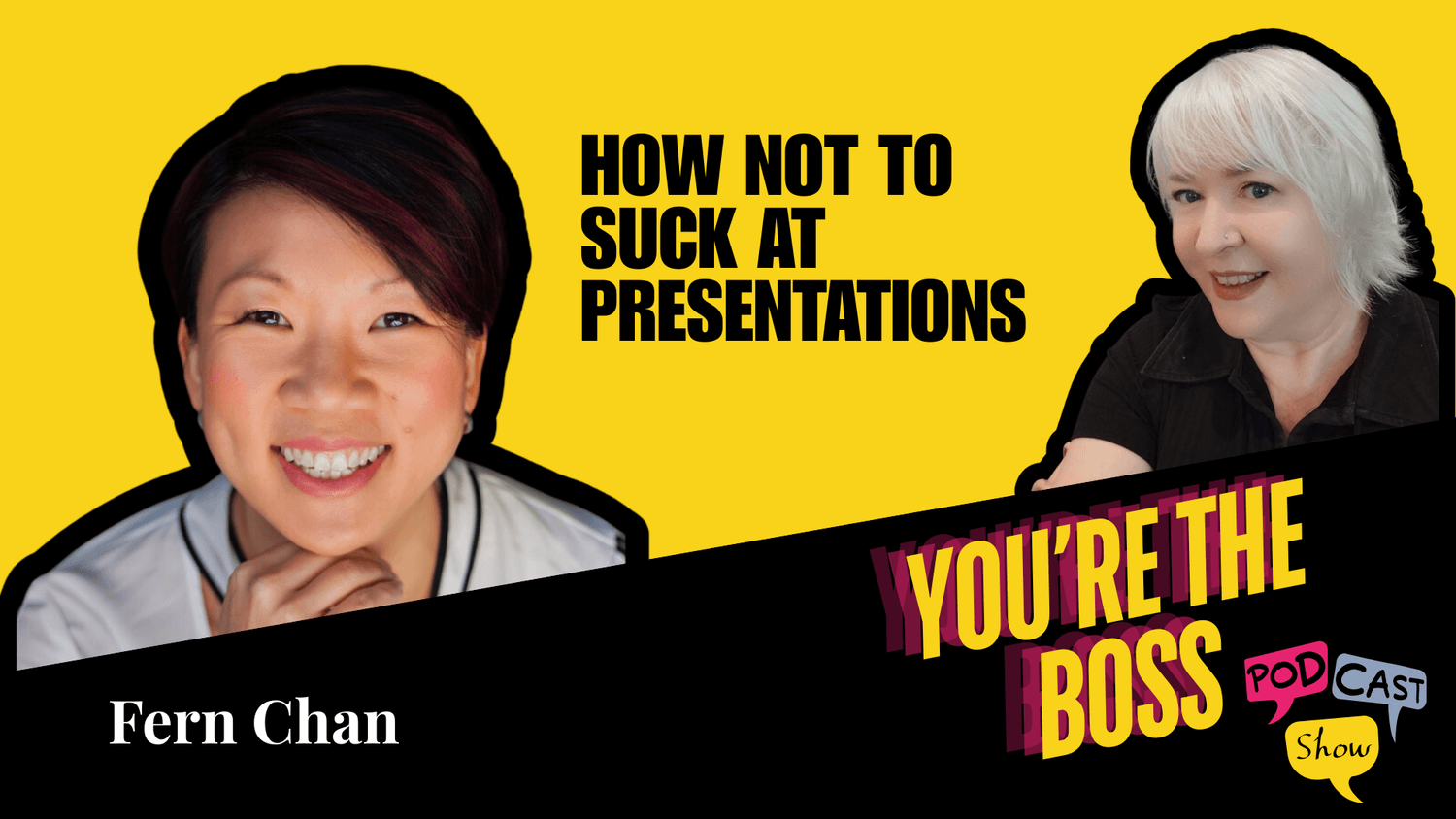
Click the image above to watch.
Ange Dove (00:06)
Welcome to You're the Boss of Your Business and Your Life, the podcast show where we empower you to escape the 9-to-5 and build your dream business from anywhere. I'm your host, Stav, business coach and your guide to turning your ideas into bold actions. Each week, we bring you actionable advice and bite-sized tips and inspiring guest interviews to help you take charge, not just of your business, but of your life. Ready to make it happen? Come on in.
Fern Chan (00:38)
you
Ange Dove (00:45)
Okay, welcome to this episode of the You're the Boss podcast show. And I'm really excited to be speaking with you today. Today, we're going to have a guest Fern Chan, and she is an expert at presenting. So we're going to talk about presenting skills today. So Fern is a bestselling author, educator and mompreneur on a mission to help power up your presentation skills. So you never lose your audience to boredom. OK, so let's bring Fern on.
Fern Chan (01:21)
Hello, thanks for having me. I'm thrilled to be here.
Ange Dove (01:26)
It's great to have you, Fern. Welcome to the show. So as we see from your book on the background there, you are on a mission to help people. way.
Fern Chan (01:40)
Even though I'm pointing.
Ange dove (01:41)
On a mission, how to not suck at presentations. And you're mostly talking about death by PowerPoint and how to avoid that, right? And just improving communication skills in general. So when you're starting a business, you're looking at making pitches to clients, presentation skills are going to go a long way to help you do that. So this is what we're going to be talking about with Fern today. But Fern, just to start off, can you just tell us a little bit about your background, how you started your business, how you made that transition from the corporate world into running your own business? How did that happen for you?
Fern Chan (02:27)
Absolutely. So I, for the longest time, worked in a higher education institution training adult learners. A lot of the adult learners that I was training were law enforcement officers here in New York City. a lot of that required some really strong communication skills because they are a very resistant crowd when you are not a cop and you have to tell them what to do. So, you know, through a lot of the training that I was doing with them, had to really also up my presentation skills. And because I also presented a lot at conferences and things like that, I was seeing a lot of death by PowerPoint. Mind you, I was guilty of that myself. It was this one time.
Ange Dove (03:08)
I think we all have been at some point.
Fern Chan (03:12)
So it was at a conference and I was the president of this association. We brought on this keynote speaker who was really smart, super, super knowledgeable about workforce development. But he was so boring. my God, Edge, I just wanted to escape from that room. And I thought, am I the only one who feels this way? And how you try to really not nod off and you try to do whatever you can, blinking away the tears. thought, I would never.
want my audience to feel this way. And I'm like, what a shame because he had good information. It's just that he didn't make a connection with the audience. And I'm thinking, you've just lost all your people and that attention and that effort that you just put in. What a waste of time. And I would feel.
Ange Dove (03:58)
What was it that made it boring? Was it the way he was speaking? Was it his...
Fern Chan (04:03)
Yeah, so there was just time, was
bit monotone. He had a lot of graphs and charts and so it was very small data points. And then when people say, as you can see from the graph, I'm like, actually, excuse me, I cannot see from the graph because your legends are too small. And I'm like this going, what does that little dot say and who does that belong? I'm like, no. So it's overload of information. that's. One of the reasons I wrote the book, because I thought that this had to be a better way to do it. And have I been doing it myself? what, you know, I myself changed the way I presented because I thought I got to reach my audience. I have to make sure this message sticks so I don't waste their time and I honor their time. You are here whether you want to be here, if you're voluntold to be here, or if it's like the usual, maybe quarterly meetings and you have to report out boring KPIs, you still have to look competent up there. You still want to make an impression so that your bosses, your upper admin can go, wow, is very articulate, even as she's talking about the plunging numbers of our quarterly sales. It's distinct, it's clear, and it sticks. And I think as entrepreneurs, all of us have to have the skill to be able to say, you know, when people say, what do you do to be able to say, my name is Fern, or I'm Fern, I'm a presentation coach, and I help people get their message across so that it resonates and it inspires people to act. And I don't want people to feel when they speak, then it's just a waste of time and nobody wants to feel that, right? So, know, it's like, succinct enough people go, yes, how do get people to lean in when you ask them what to do? And I think, you know, it's a really tricky question, right? So even if now sometimes people ask me and I'm thinking, wait, mom role, entrepreneurial, depending on your audience. And I think that's also a thing is to know who you're speaking to when people ask you that question or even if you're addressing your audience, like know what it is, who they are. So this way you can meet them where they're at. That's nothing worse than a mismatch audience that people don't like, who's this person and why should I care?
Ange Dove (06:08)
So was it that one presentation that sparked the entrepreneurial spirit in you? How did that work? How did you make that transition?
Fern Chan (06:18)
I'm not with the book. So it's funny you mentioned that. I wrote, I was still working full time in higher ed and I was thinking, okay, well, I have to, what can I put together in a book that also helps other people? So I thought like, you know what, I can write this book. And then I, and on the side I'm thinking, I know, as a side business, I can make this book into a digital course and then help other people become better presenters. So I don't have to sit through so many death by PowerPoints, but we just lift up, right? Everybody else. So the book became a digital course and this was still happening. I wasn't fully into it because I still have my full-time job. And then something happened at the job and I thought, this is a signal from the universe to say, it's time to switch. It's now time for you to go all in on yourself, to bet on yourself and go all out and swim for the island. So I cut off those safety bills because I think that's one of the things that we fear, going all in.
Ange Dove (07:16)
Sometimes, yeah, I think sometimes as well, like having, as you say, that safety belt or that safety net with the job can be a blessing and a curse, right? Because on one hand, you've got the financial security, at least you've still got the money coming in from your job, even if you're while you're still building your business. you're still in a comfort zone in that sense, right?
Fern Chan (07:41)
Yes, but it's a bad thing. mean...
Ange Dove (07:44)
But I definitely recommend people keep their job as they're making that transition because you do need that financial security. at the same time, it can stall your progress in a way because you are comfortable. Yes. know, and it doesn't have to happen as soon as you want it to happen. Right. So how how were you feeling at that time when you decided to leave your job? What was going through your mind? there any fears, doubts?
Fern Chan (08:15)
my god, I was scared shitless. I'll be honest. It's just there is nothing more scary than sort of think okay, I am gonna put my money where my mouth is literally and bank on myself Right and so it's all on you to make it happen. But I will say sometimes when your back is against the wall
That is when innovation comes because you have to think, well, you know what? I have to make bills next month. There is no way. So what can I put together? What can I help others with? What service can I possibly provide at this point that people will pay for that I can do something and help somebody else?
Ange Dove(08:55)
So what was that for you? What was that for you?
Fern Chan (08:59)
What was that for me? For me, it was able to help other speakers make an impact. So because I am quite a loud mouth, so I'm not afraid to speak my mind and help others in the best possible way. Sometimes it might be in that fern way that adds a little bit of the, you know, bow bow, you know. Just a gentle, I'm not gonna give the...
the seven to two New York slap to just get things going. But it's like, hey, how much more time are we going to be wasting in this point where you are just malingering and not getting anywhere? I don't want this for you. I want you to shine on stage. I want you to get that feeling of a standing ovation when your crowd just loves you and then they become groupies because they follow you every time you speak because what you say matters.
Ange Dove (09:58)
Who are your main customers? Who do you help the most? Who comes to you naturally?
Fern Chan (10:07)
Business professionals come to me as well as entrepreneurs. So it makes sense because business professionals, they're constantly having to present. And sometimes they have to do the things like, I am going to be at a conference and I'll be speaking on this topic because, you know, it is my wheelhouse. And then I get a very boring presentation. Look at it. Okay, let's make this a little bit more exciting. Right. So I have business pressure, also a lot of sales professionals because they're working on their sales pitch, but it becomes. Very standard because they're using what the company tells them to do. And it's just like company, company, oh, you know, we are this company. we, we, we, it's all about me, me, me, right? Versus like, let's flip the script because whenever you're presenting, whoever you're presenting to, I always say you have to think about your audience's favorite radio station called WIIFN. What's in it for me? So if you can think when when your audience members sing there, they're going, well, why should I listen to you? What's in it for me to hear what you have to say? You're going to tailor your message a little differently because you're really about helping them. It really is. It's not about you. It's about them. About your knowledge. What is it that I can share with you that will help you that transformation to get you out of this pain point? This, you know, where you're feeling stuck because then they'll lean in and go, tell me more because human beings, as we are, we're all self-interested beings. We're also thinking like, how do I survive? What is going to be in the best interest for me so I can survive in this world? And if you can give me that skill, that tip, that whatever that's going to help me survive to my benefit, then I want to know. But you have to know how to say it in a way that makes them want to go, my God, that's me. Tell me what I
Ange Dove (11:57)
It's more like my mind, right? Yeah.
Fern Chan (11:59)
Yeah, no for sure.
Ange Dove (12:01)
Yeah. OK, so the people that come to you, what have you noticed as being a common, something common that they usually, the common things they're doing wrong when they come to you with their presentations?
Fern Chan (12:16)
Too much information for one thing. They really do try to squeeze in a lot of information and a lot of jargon. Again, I believe it's more because of the business that they're in. Sometimes they forget like, well, if you're talking to other colleagues and they are familiar with that, then okay, right? But I think most of the time they forget it's like, you are probably talking to stakeholders who do not understand that same language. So especially when it comes to, when I get people in, finance or compliance and they have to give like the numbers report and then they're talking to people who are not numbers people. Or like tech people who are explaining things to non-techy shareholders, right? And then they, and I'm like, okay, you're explaining a lot of very technical nuts and bolts, but it's just gone, and once this happens, people stop listening. It's just like, know, people don't want to know what goes behind under the hood. They just want to get to their destination.
Ange Dove (13:14)
Yeah and again, it still wasn't it for me. Okay. So that and like crowded PowerPoint decks as well with text on the deck as well.
Fern Chan (13:27)
I am a one idea per slide person right because it gives people a point of focus Hmm, and then you talk about it You don't want to put every single thing you want to say on a slide because this is not karaoke This is not a single off right? once the audience starts meeting they stop listening to you. So you have to think what am I using as a visual aid? And that's what it is and I feel like I love nothing against PowerPoint. I love PowerPoint. That's where we all started, but people misuse it. They use it like a teleprompter. And I think that's where it all goes down, the toilet, right? Because like, it becomes a crutch for them versus like, can I make my points powerfully? That's why it's called PowerPoint. How do I make it powerfully in a way that will resonate with your audience? So I find like, hey, just put one thing up there so there's space.
also for them to think about it. Because if you can use that as an anchor point and talk about it, they're listening to you.
Ange Dove (14:30)
Right. That's a good point as well because they're not listening to you if they're reading everything with you as you're talking.
Fern Chan (14:37)
yeah, and then, you know, people like to put it on super small too, like 8-point font, you're like,
Ange Dove (14:42)
I've seen those. my goodness. I also find that just using decks as well is also a memory aid for you, right? As you're going through your presentation is just something to say.
Fern Chan (14:59)
Yes. Yes. And I'm big on visuals too. So yeah, I always also tell my coaching clients, it's like a picture is worth a thousand words. People don't need to see a thousand words on the screen. So if that's any way you can reduce, you and then use your visual as a way to store it becomes very vivid for your audience to take it and go, that makes sense.
Ange Dove (15:27)
So as you're taking your clients through to build this new presentation, so build their skills, I would say as well, what are the common challenges that you find that get them the most? What is it that you're having to take them through to help them?
Fern Chan (15:45)
The biggest one I get and it's the most common one is the nerves. Yeah. But you know, I always tell them it's actually really normal to feel the nerves and the anxiety before you go on. And it's just your body, you know, going into that adrenaline drive, right? So your body's signaling that eeks.
Ange Dove (15:52)
Stage fright, right?
Fern Chan (16:09)
Something is about to happen. So physiologically, there are a lot of things happening in your body. And so as a reaction, your adrenaline starts to pump and then you start to shake. You think the worst fear that people have is, what if I go blank? So that adds to the anxiety. What if I go blank? What if I forget what to say? What if tech goes wrong and the screen goes poof? All of which has happened to me. Instead of having the deer in the headlights when we're like, oh my God.
What do I do now? So it's also from learning how to overcome those things that I can say, now I just, first of all, take a deep breath. When your body is reacting physiologically, that way your heart's racing, you're starting to get sweaty pits, and you're like, god. You're probably thinking like the worst case scenario. This is when you take control and you take a deep breath.
If you deep breath in fact, because when you do that, it will calm down your nervous system. know, and yeah, it's a loss of control, right in some ways. So you are now gaining some of that control through your breath, because this one thing you can control is your breath.
Ange Dove (17:24)
That's the thing that I find the hardest actually is having shaky breath through nerves, right? And then it's like, can they hear that I'm nervous? Right? So what advice would you have for that? Just breathe deeply.
Fern Chan (17:27)
Leaving. So one thing is, yes, breathe deeply, take a few deep breaths. And this is also something that when I was training law enforcement, it's what they do, right? They are in really high stress situations where it's like, they have to calm their nose, so they take a few deep breaths themselves, and they practice this. So that helps anybody, deep breath, number one. Two, shake it off, right? Sometimes it's like, ugh, all of that is buzzing in you.
That's why sometimes you see speakers they do weird things like jumping jacks and stuff like you know all about little shitting so like, ooh, I can do a little shake it off. So that energy from inside has to go out somewhere. jump up and down, do whatever it is to expend that energy. So if it's appropriate, like sometimes it's like, I don't know if I can do some jumping jacks, just a little, you know, again, what is it that you need to physically do to just expel that energy out? So that's one thing that also helps calm your nerves right and then take a sip of water because your throat gets dry so don't even realize it and then when you try to open your eyes and go yeah
Ange Dove (18:46)
you yeah, that's really important as well.
Fern Chan(18:51)
Then I'll say this one third, it's to don't deny your nerves, accept it as part of this is normal. Every time I go on these nerves come and they just wake me up a little bit. So if you accept that the nerves is normal, I mean, every time I go on to speed, I get a little butterflies in my stomach too. I feel the nerves, but I don't resist it because what you resist will persist. I say to myself, mindset shift. ⁓ Hey nerves, it's okay. This is just good juju waiting to come out into the world. It's like, you I know why I'm feeling this way is because I have so much to share with others and it's what it is. It's just anticipation of all this good stuff coming out to share with this wonderful audience who's given me their time. And so when you sort of think that way, this is just ways of me serving other people coming out. And then you'll feel a lot better because if you're thinking catastrophizing about what's gonna go bad and if your voice wobbles a bit, that's okay. Sometimes I wobble on, sometimes I trip up on my words. go, oh my God, I've been so excited. My tongue got caught in my mouth. And what I meant to say was this. And sometimes I go blank, you Let me just walk back a few seconds. I don't know what mommy didn't talk that just hit me. I forgot what to say. Because you are also real. Yes. When you mess up, it makes you vulnerable and it's okay. You don't have to be.
Fern Chan (20:13)
Perfect because perfection sometimes is hard to perfection is an impossibility, right? But you know, when your audience can see you as a mere mortal, and that makes mistakes.
Ange Dove (20:24)
They relate to you. Yeah, yeah. There was, for years, quite a few years anyway, I resisted doing webinars. And the reason I resisted live webinars and stuff, the reason I resisted it was, what if it went wrong? I was just so scared of the tech going wrong, and then I wouldn't be able to control it, and I make a fool of myself and all that kind of stuff. So finally, I did. Put myself out there and I did a live webinar, my very first one, and all of my fears came true. So I ended up locking myself out of my own webinar, thinking I was still talking and thinking things are going okay. And then I get a message on WhatsApp from one of the participants saying, you're not there anymore. ⁓ So then I had to reboot, re-log back in. just said, just tell everyone I'm... on my way back in. So yeah, so that was kind of, you know, it was the worst thing that could have happened in a way, but it was the best thing that could have happened also, because it was, okay, well, now it's done, right? That tech nightmare came true and it's done and nothing bad happened, right? I just came back in. I wasn't panicking actually either. I just logged back in and everyone was there and we just carried on and I just made a bit of a joke about it. And it was fine and it's like when those things happen, you know that fears then gone in a way
Fern Chan(21:56)
But then it's like, now you know it's live, This is not a recording. This stuff happens. We are at the mercy of the Zoom gods.
Ange Dove (22:05)
Yes. My goodness. Okay, so nerves, nerves is one that people
Fern Chan (22:10)
Too much information is the other.
Ange Dove (22:15)
Too much information, right?
Fern Chan (22:17)
So it's simplicity sake. always tell people work with the power of three. People can remember probably three things. Remember it well. Just like, if you went shopping and you had, you know, a list of three things, milk, milk, eggs, bread, you'll know. But the moment you add like, go get the cocoa puffs and then go get like, you know, the crispy whatever you start to forget.
Ange Dove (22:43)
The human brain can only take three things in a time,
Fern Chan (22:46)
Easily in groups of three. Right. So you're to teach something, one idea put aside and also like how can you do it? So it's only three points that you share.
Ange Dove (22:55)
Right, OK. Anything else that you would advise on what are the challenges that they face that they need to address?
Fern Chan(23:04)
So I think the audience, like I mentioned, like, you know, know your audience. Figure out a point, like, you want to also make it engaging. Like, a point of connection. And I'm also about storytelling as you're presenting. How can I wrap this thing up in a story that makes it relatable? So it's not just dry facts. Because dry facts is really hard for us to contextualize and for us to stay focused.
Ange Dove (23:09)
Hmm.
Fern Chan(23:31)
But when you can wrap up whatever dry facts you have to present in a story, then it makes it more interesting. But not only that, it activates our brain to make us listen. Cause we are. Yeah, it does pro. Yeah. Definitely helps your memory because what we want is to remember what you said. We don't want you to be the. The one of, you know, all the sea of death by PowerPoint is out there because then nobody remembers you. Don't want that to happen. But I also harken back to what Maya Angelou said, and I'm paraphrasing. People will forget what you said, but they won't forget how you make them feel. Yeah. So you want to emote with your presentation. Even if it is the boring, drug-cold reports, if you can make people feel something about what you're presenting, they're going to remember that far more. They'll go, my god, I laughed so much. like, I really enjoyed that because it made me think, it made me smile.
I was like, wow, that was really thought provoking because that made me sad. So whatever it is, how can you make people feel something? And when you emote, use things that are visceral. So describe the feeling, describe the colors, make it vivid. So activate those five senses. Maybe not tasting because you don't want them licking nasty stuff, whatever that may be. What is it that you can then open up their senses because now they are in this storytelling mode where they're listening, they're imagining and now they're remembering more rather than just cold hard facts.
Ange Dove(25:00)
Yeah, yeah, no one wants to sit through half an hour of cold hard facts, right?
Fern Chan (25:07)
Brutal. Mean, that's my word. came from higher education where all the professors love to tell like 20 years of research in like 100 gazillion.
Ange Dove(25:16)
Yeah, you don't want to be giving a lecture, right? That's for sure. my God.
Fern Chan (25:22)
Reach.
Ange Dove (25:25)
So when you're guiding your clients through making better presentations, it's what's involved in that. So the design of the deck itself would be one thing, right? Or do you take them through also then what they do with their hands or their body if they're physically there in the room?
Fern Chan(25:38)
Yes, so. Yeah, for sure. mean, body language, our body is an instrument, our voice is an instrument. So when you are speaking, you you want to have dynamics, just like when you're playing an instrument, if it's all just one tone, one note, one sound, it's like, it's like a drone. We are not drones. We are dynamic people. So I would say that when you have big numbers, go big, but then when you have tiny things like, know, because when you do these sort of things, they'll You know, your audience gets drawn in. Also, because our eyes get drawn to motion when you do things, right? People are following your gestures. Right. I'm a talker. And so know sometimes people are like, in Use your hands. Yeah, it's like, you ever thought? mean, there are very these are like little cues and sometimes it's subliminal to right. It's like, hmm.
Ange Dove(26:32)
So you use your hands and...
Fern Chan (26:46)
Never thought when you do this, like when we think we'll do this. When you do things like, and you lean in, then everybody will lean in because the audience will follow you. You are like, when you are on stage, all the focus is on you, right? So I also like to think like, in that position, if you are the conductor, what do you want your orchestra to do to follow you with the cues as you go up and down?
I think the easiest way also, when you at the end of your talk, if you are speaking in front of an audience and you want them to applaud you and you want them to stand up, you just go, just give them the... And then they just get... It's so subliminal, they don't even know that, right? You do this, people follow. Give them the subtle cue, you know, they'll stand up and then... and then you take your bag. So, yeah, so visual cues, body language, all of it is also part of it. And also I, I always say like, roll your shoulders back on the stage. If you go up there shoulder slump and looking at your shoes or your notes or your phone, they're not going to inspire any confidence in it. God, this is gonna, this is gonna suck. that's we want. I do not suck at presentations, right? We want you to be.
Ange Dove (27:56)
No, thanks.
Fern Chan (28:08)
But that doesn't mean if you are an introvert or a quiet person, cannot be dynamic. You can be very dynamic. My brain coach, Jim Cone, is one of those quiet people I know and observe. And yet what he says is so powerful. So you can definitely make an impact even if you are a quiet, introvert person. Because there are people out there who are just like you. And they're going to resonate with that. So it's just like, how do we now make sure that we are crafting your message in a way using the language that will make people want to go lean in and go, wow, tell me more. I want to know about that.
Ange Dove (28:46)
Okay. So just listening to all of this, I'm just thinking, my God, there's actually so much to learn, right? There's a lot involved in giving a good presentation that we don't really think about, but just some of the things you've talked about today is just, well, actually there's a lot to do. There's a lot to learn.
Fern Chan (29:05)
Yeah, that's a lot. mean, it's also different when you're doing it online. And I think the thing that people realize is I always tell them like there are three things you should probably invest in if you're doing online is a mic, an external mic. Don't depend on your little computer one because it's too far. And then once it records, the sound quality is really tinny. So try to get an external mic to improve your sound quality. The other thing is to get
overhead lighting so it lights you up so that you're bright. So the other you know and then also to get an external camera so you're not also depending on your your computer camera that's embedded because usually think you're the worst angles right you you get chins you get boob shots because you're. Have one mounted so that it gives you the best ratio. And also when you're talking, it's really hard to not look at the people around you. The best way to engage with your audience when you're talking online is to directly at the camera. Yeah. Yeah, the camera is what gives you the eye contact, because that's what they see. So if I'm looking straight at camera, it feels like I'm talking to you, right? We are engaged in that way. But it's hard to not see yourself.
Ange Dove (30:24)
Yes, yeah. And I think as well, from my experience, investing in a good camera also helps because I've used webcams in the past that my normal one broke and I got another one that I had as a backup and I put that onto my camera and I turned it on and I looked and I was like, okay, this isn't going to do. This is not good. So I had to then go out and buy another one. So investing in a good one. Also helps because there are differences in quality.
Fern Chan (30:56)
Yes, yes, for sure.
Ange Dove (30:59)
Yeah. OK. Well, it's been just a wonderful chat and good food for thought on what we should do to increase
the interest in our presentations and not suck at them. And so I see from your background, as you mentioned before, you have a book, right? So how come people get hold of your book?
Fern Chan (31:23)
You can get it online from Amazon. So if you are a Kindle reader, you get it for free. If you are a subscriber to Kindle Unlimited or otherwise it's I believe $2.99 on Kindle or you can pick up a copy for, I think it's $20. I can't remember what it's called. Yes, but you know, I also have a freebie for your listeners that they can get. So they can get my
Ange Dove (31:42)
I'm sure that's what I.
Fern Chan (31:50)
Five crazy simple hacks to keep eyes open and butts in seats during your presentations as a little download that you can just do five things really simple that you can put in your presentation right now to make the impact that you want. I'll send you the link and you can, you know.
Ange Dove (32:07)
So the link will be somewhere around this video at some point that you'll be able to download in the show notes, that's for sure. So I'll put a link to your website. So you'll see Fern's website and the link for you to go and get the book and her freebie as well. So thank you so much for that, Fern. Any last thoughts you want to leave with the listeners?
Fern Chan (32:33)
You know, people always ask me, I have so many thoughts. I will say this. Okay. What you have to say matters. So let's make it count. Let's make it
My cup's up.
Ange Dove (32:53)
Such a good title. Such a good title. OK. Thank you. So that wraps up our episode for this week. So thank you for watching. Thank you for listening to You're the Boss podcast show. And do like and follow and subscribe if you're watching especially on YouTube. Do take that. Yeah. Thank you for that. Follow, like, and subscribe.
And also click the notification bell if you do want notifications. All right, so thank you for watching the show and I'll see you on the next episode.
Fern Chan (33:36)
Thank you!
Don't leave without your free gifts

Check out my page of freebies designed to help you make progress towards your goals.
From free training on making $10,000 months to how to create your brand message to access to the resources I use in my business that may help you too!
I've got some
gifts for you!
Check out my page of freebies designed to help you make progress towards your goals.
From free training on making $10,000 months to how to create your brand message to access to the resources I use in my business that may help you too!
About me

Hi there 👋 My name is Ange Dove, professional copywriter and messaging strategist. I help Gen X professionals find the words to express who they have become, and to build a career or business that owns it.

GET YOUR UNCHAINED AUDIT
Let’s have coffee online for 60 minutes on Zoom, where we'll look at your profile, your message, and your next chapter together and give you the roadmap to take your next steps.

GET THE NEWSLETTER
Straight-talking insights for experienced professionals who want to turn what they know into income, options and greater freedom over what comes next.


