Call: +65 6012 3433 | Whatsapp +65 87792453
How Franchising Transformed Healthcare Business
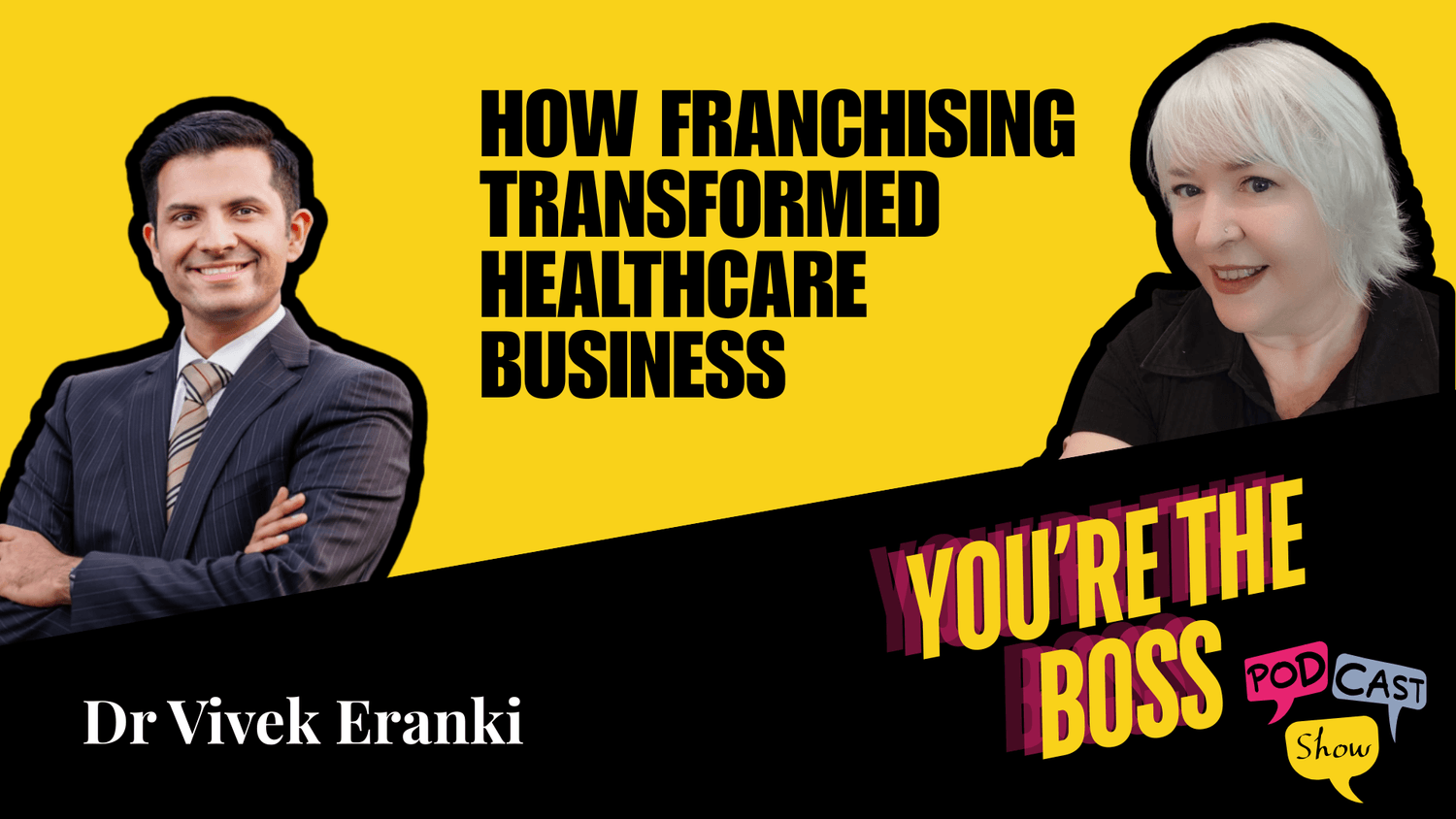
Click the image above to watch
Ange Dove (00:01)
Okay, welcome to You're the Boss Podcast Show. And today my guest is Dr. Vivek Eranke. He's the CEO of Cosmetic, Australia's first accredited cosmetic clinic, and one of the fastest-growing names in non-surgical cosmetic treatments. Under his leadership, Cosmetic has expanded to nearly 20 clinics nationwide.
launched a groundbreaking franchise program and empowered nurses and clinicians to become successful business owners. So Dr. Vivek, welcome to the show.
Vivek Eranki (00:38)
Good to be with you, Angie. Thank you for having me on.
Ange Dove (00:40)
You're welcome. All right. So just to start off with, just tell us a little bit more about yourself and what we should know in the context of what we'll be talking about today.
Vivek Eranki (00:52)
Well, I I graduated medical school in two thousand and eight and since then I've got a fellowship in cosmetic surgery, cosmetic medicine, medical administration and GP, which is family medicine. I've always had a interest in business ventures, but I've being in full-time clinical practice, you never get to see that side of things. And around ten years ago, a bit more than ten years ago, we opened our first business. I really enjoyed it.
thoroughly enjoyed it. And then there was a slow recalibration of amount of working hours dedicated to medicine versus dedicated to business ventures. And as of 2022, I've pretty much transitioned full time into into business now. So what we mainly do is we've got two main businesses. So one of them is cosmetic. So we've got now close to 30 actually cosmetic clinics around the country.
Ange Dove (01:50)
Okay, congratulations.
Vivek Eranki (01:51)
And thank you. We opened the franchising channel last year and staying true to what my story is, we've done it in a way where we give a helping hand to doctors and nurses transition from being in the hospital system to being business owners. And the whole reason for that is a helping hand in terms of getting educating them in how to run run a successful business, how to manage the
administrative aspects of business. There are so many transferable skills, but there are so many other skills that require to be relearned when you go into business from a healthcare environment. And the second business that we've launched earlier this year is a health tech platform that essentially manages the compliance behind delivering safe healthcare. And that's been going really, really well. So we've just onboarded our hundredth client
which is a hundredth clinic and that's that's going spectacularly well as well. And that follows the same ethos of empowering clinicians and doctors and nurses to run a business in a highly regulated sector with that actually onboarding on the stresses associated with regulation.
Ange Dove (03:10)
Okay. So let's take a step back then and just talk about first of all your I mean you trained as a doctor, obviously. So all of those years went into to training as a doctor. And then you decided to go on this different route of becoming a business owner. And that's two completely different things, I guess, right? Really. So in your training as a business doctor, I'm guessing you're you're not really trained to run a business.
Vivek Eranki (03:30)
Mm.
Vivek Eranki (03:38)
Well, I mean, medical school teaches you nothing about business. What it does teach you is how do you how do you perform as a good doctor within a public health system. That's what it trains you to do. it trains several qualities into you from the get go that f fly completely contrary to business. So for example, it it completely eliminates your appetite for risk. Being in healthcare, you can't take risks. Being in business, you can't afford not to take risks.
Ange Dove (04:02)
Yeah.
Yeah.
Vivek Eranki (04:05)
a and then so as I transitioned out, what you realize is there are skills that you need to relearn, and then there are skills that are intrinsic to a person that y you you can just rely on. So for example, I had to do a I had to get a qualification in in business management. So I've got a fellowship from the Australian Institute of Managers, or AIM. I got a qualification in corporate finance, for example. So you need to know numbers.
Ange Dove (04:12)
Mm-hmm.
Vivek Eranki (04:33)
so there are certain skills you need to relearn, but then there are other skills that that you can learn on the job as you go along.
Ange Dove (04:41)
Okay. So so what made you take this route? What was it in your life that made you think I don't want to just be a a doctor alone, I'd rather manage the business. How did that come about? Because that doesn't happen to all doctors, right?
Vivek Eranki (04:51)
Mm.
Vivek Eranki (04:57)
No, I mean, look, I've I've I've got a lot of friends that are doctors and some of them absolutely thoroughly enjoy being a doctor and and it doesn't come down to somebody needs to make a change. It's about having fun, right? If you're if you're having fun in the environment that you're in, great, go with it. If you can see yourself doing that for the next twenty, thirty, fifty years, all the power to you. But if you are in a position where you're
And a lot of doctors are, lot of nurses are, they're in the public health system and they're looking at, well, I have to come in at seven a.m. in the morning, I need to leave at seven pm at night, I need to then manage my C P D hours, I need to meet meet these regulatory requirements in terms of the paperwork I need to submit. And at some point it becomes overwhelming. And business provides a very good a a very good other option in in those s situations. And and what I mean by that is what I've found that
business does is it gives you a passport of freedom. So if I wanted to take two weeks off and go traveling, I can. And I've and I've done I went to Japan in April. It was it was it was great. I've had a great time. You can switch off your phone you can completely unplug and you can't do that when you're in a in a public health system or when you're working as a doctor. There is always something that you have to attend to.
And it gets worse when you're in private practice. And the reason for that is there is no one who can actually look after your patients when you're away. and because of that, what we found is when we opened the franchising channel, we didn't expect to see the influx of applicants that we are getting. To the point now, on our website, there's a whole area dedicated to are you a doctor, are you a nurse? In this case, here's a pathway that is specific for you. And and
When I started speaking to these doctors and nurses, the stories are exactly the same. They worked they work very long hours in the hospital system. They don't feel appreciated. They miss their kids' birthdays. They miss Christmases. They miss the public holidays. They can't take a trip without somebody else are making them feel guilty that they are letting their team down. And when they jump into business, the stories that you hear aren't, I can finally afford a Porsche or I can afford a nice house on the canal.
Vivek Eranki (07:15)
I mean, yes, some of them are taking spectacular holidays, some are Christmas holidays that they never could before. But the stories that you hear are more human than that. You hear stories that they were there for the kids' Saturday, soccer games, they were there for their footy games, they were there, cutting the birthday cake, they were there, spending a lot of time with their partners. And and these and this is the reason why we are finding more people transitioning across from the hospital system into the
into the business world. the other thing that did come about which was a little bit more darker and a bit more sinister is what we didn't know and what being a doctor you never get exposed to, especially with nurses, is nurses on the front line get abused a lot by the patients, a lot by by f other staff members. And we actually I I had no idea about this. And when they transitioned from being a nurse in the hospital
or a GP clinic to being a business owner, that completely disappears. They get treated with respect, they get treated as as leaders in their field. And that is something that they are so grateful for. And and yeah, I I had no idea that th this was happening in the public health system. And w I I should have known better. I mean, when you Google it, there are so many stories that are coming out about this as well.
Ange Dove (08:38)
Okay. So how did you personally make that transition then? When did you realize, okay, this is enough and I need to do something? Was it a gradual journey or was it okay, an immediate decision? This has to change.
Vivek Eranki (08:51)
It was gradual until it was immediate. So what what basically happened is I was I only got a f I got a finite amount of time on my plate, right? So I was dedicating more and more and more time towards the business and less and less time towards clinical. but still I was doing a lot of hours. And then there came a time and it was around when we had ten clinics, when I just couldn't do both. I had to pick a lane. And and and that's when I went full time into into in into business.
Ange Dove (08:55)
Ha ha ha
Ange Dove (09:08)
Mm.
Ange Dove (09:16)
Mm.
Vivek Eranki (09:21)
And and being in medicine gives you this degree of comfort knowing that if something goes bad, you always have a qualification that is in demand to fall back on. and so the way I saw it at the start is if I absolutely miss being a doctor, I'll be back. I'll be back in a year. But I haven't and I just can't see myself I just can't see myself going back now. so yeah, it's
For me it was a it was a risk mitigated transition.
Ange Dove (09:53)
So how did a cosmetic actually come about?
Vivek Eranki (09:58)
cosmatique came about when so previous to this we had multiple other businesses. We we opened a chain of dental clinics that got acquired by a corporate. We same thing happened in the GP world as well, same thing happened in the Allied Health World. So we opened several clinics that got acquired. I went I transitioned from hospital work into the community work, but I I I like procedural work.
Ange Dove (10:08)
Okay.
Vivek Eranki (10:25)
So I did a fellowship in in cosmetic surgery, I did my master's of surgery in spinal surgery. So I I enjoy the procedural aspects of healthcare. So that led me into the cosmetic space because nothing about cosmetic cosmetic industry is just about talking or prescribing. It's all about hands-on. and it and you get to see the change immediately. And what appealed to me more is that you'd never ever approach a patient from from
a position of of standing over them when they are in the most vulnerable. So in the cosmetic industry is the only industry where you are literally approaching a patient when they're at their best. So when they're at their best health, when they have no other ailments and they want to improve themselves. In every other facet of healthcare, you're approaching the patient when they are severely compromised either because of an accident or an illness. And and that really appealed to me because you this is the only part of healthcare
Where you're actually improving and bringing a net benefit to the patient compared to what their baseline was. so we essentially brought in all the lessons we learned in dental, in GP, in LAT health, and in running day hospitals into cosmetic industry. At the very time cosmetic industry was undergoing a a bit of a transition from being an unregulated industry to one that is in focus.
So but bringing in these strengths that we had around patient compliance so around practitioner compliance, patient safety, governance and bringing that to the healthcare the cosmetic industry, that essentially catalyzed the growth that we've we see to we saw today.
Ange Dove (12:08)
So it sounds like from what you're you're talking about, you've you've actually started several businesses and sold them, right? So you've you've obviously got a knack for business. Did that come from family or how did that come about? Was that just
Vivek Eranki (12:25)
Well, I mean all but pretty much all my family members are doctors, so none of them none of them are in the business space. when I approached any of these ventures, I approached them from the perspective of how can I bring value to the and end user which is a customer. And that helped us scale, that helped us gain market dominance. And whenever you have scale and market dominance, you are acquired. And that's what that's what basically happened in those cases.
Ange Dove (12:40)
Hmm. Hmm.
Ange Dove (12:53)
Okay. So so how did you achieve market dominance? This is interesting. So
Vivek Eranki (13:00)
you need to have a good product to start with. So before anything, the what you give to the market, it has to be exceptional in terms of quality and outcome. That's what I've learned from the start. The second thing that I've learned is to surround yourself with good people. So we always were fantastic at onboarding really good talent and very quickly offboarding people who are not aligned. and the third thing is efficiency in messaging. So we were very good at
Ange Dove (13:02)
Yeah.
Ange Dove (13:10)
Hmm. Hmm.
Vivek Eranki (13:29)
And we still are very good at conveying what our strengths are in the perspective of the end user to the end user. and that that was a mantra that worked again and again, and that's pretty much what we did in in every in every facet. An example of that is the GP Clinic. we acquired the G P Clinic what back in more than ten years ago now. And it we sold it about what seven years ago or six years ago.
Ange Dove (13:37)
Mm.
Vivek Eranki (13:57)
And when we purchased it, it was a small GP clinic in a very large regional hub. And we took that small GP clinic, made it into a training center. So we partnered with the RAC GP to bring in junior doctors to train them there. We added on a significant amount of LA Health. So there was a large indigenous population. So we added on Aboriginal health workers, we added on psychologists, dietitians, we added on who
Who else did we Physiotherapist as well, we added on. And by adding all these additional services on, we man we managed to scale it from a tiny little GP clinic to one of the largest in that area. So at its peak, it we actually held the contract for Uber and we were doing a bunch of Uber's medicals when they were expanding into Australia. We also were doing a lot of the medicals for the US Defense Department and their veterans.
Ange Dove (14:51)
Mm.
Vivek Eranki (14:51)
and and that's when that's when we were approached and it got it got bought out. And funny enough it was actually acquired by a large Chinese corporate. So we actually had to s get approval from from the US Defense Department about that actually. And funny enough they had no no qualms with it. So so yeah.
Ange Dove (15:07)
Yeah. Okay. All right, so so these these clinics were based in the US, were they at that point? Okay.
Vivek Eranki (15:16)
No, no, no th this is all in Australia. So Australia's got a lot of U US soldiers. We we we have a couple of US bases in in in Australia and yeah.
Ange Dove (15:21)
Okay. Okay. All right. Okay. Nice. Nice. Nice. All right. So so tell me then about the franchise model. When did you decide to go into franchising and how has that benefited the business?
Vivek Eranki (15:36)
Yeah, so we opened the franchising channel up approximately this time last year. And the first franchisee will be celebrating her first birthday towards the end of the month. since then we've now got close to ten franchisees. we've been onboarding at a rate of about one a month. we're just waiting on the paperwork for the for one that's gonna be coming on board this month, actually, and onboarding so and recruiting for the next franchise as well.
And the reason we did that is because we have a large number of really high quality nurses. And we found that that was a good pathway to to empowering the nurses and giving them a an ability to really target their patients and and and have job security as well. And that's why we opened the channel.
And what we found in the first month, month and a half were was that we had to understand how the whole system works. But now the position that we are in is we get several hundred applicants on a on a monthly basis. So the the role went from trying to recruit franchisees to now being able to efficiently sift through the franchisees or potential franchisees to make sure that we only select the ones that we think bring value to A, the patients and B the brand.
so initially where we were saying yes more often. Now nine out of ten times we say no. simply because we think that we think that by saying yes to a small number of people and and really investing our resources into a small number of people, we think that we'd be able to bring much more value to the customers.
Ange Dove (17:18)
Nice. And and why is it you're targeting nurses in particular?
Vivek Eranki (17:23)
well, doctors and nurses actually. and simply from my story, simply because I transitioned from the hospital system into business and that is a story that I can relate to. So when I and and I know this sounds bad, but when I speak to a nurse or when I speak to a doctor who basically is echoing exactly what I've been through about six, seven, eight years ago, I can see how they would be once they transition completely into business.
rather than somebody coming to me and saying, Listen, I've got about ten other franchises, I've got a Burger King there and a Hungry Jacks there and a and a McDonald's there and a subware there. And I just want to put this in my portfolio. I just think that a doctor or a nurse working in the franchise will have way more to gain from that franchise than somebody who just wants to hold it in a portfolio. So yeah, I'm I'm not I'm not saying anything bad about those guys, but
Ange Dove (17:58)
Yeah.
Ange Dove (18:16)
Hmm.
Vivek Eranki (18:19)
I can just see see I can just see one group of people that would benefit a lot more from this.
Ange Dove (18:23)
Right. So it's more is it more that they've got their heart into it more than it's just a business venture, yeah.
Vivek Eranki (18:28)
That's exactly right. And and if you then pick somebody who's who's got a direct frontline access to the people that they treat, my view is that they are going to take it more personally.
Ange Dove (18:39)
Mm.
So so how did you put the franchise together? Did you get professional help to do that? Is there a particular company that helped you to do that or did you do it yourself?
Vivek Eranki (18:51)
absolutely. No, no, no, no. I the the it's a very, very regulated system that we live in here. So so basically I had to get I had to find out who the best franchise lawyers are, sit down with them. You always gotta look at what the pitfalls are and and and work backwards and and put something forward that benefits both the franchise and the franchiser. The problem with the traditional franchise model.
Ange Dove (18:57)
Mm. Mm.
Ange Dove (19:03)
Mm.
Vivek Eranki (19:16)
is the franchise, especially in the retail side and especially in the in the beverage side, food and beverage industry, is that my view is that they sometimes get a bit greedy and they try and hold all the gains for themselves, making it very hard for the franchisees to to win at the end of the day. And that causes a fracture in the relationship. My view is that if you approach everything from a win-win perspective, then
The longevity of the brand and the alignment of the brand stays intact. And that's how we approach it from the start. So one of the things that we do is rather than doing a very like so some of the other brands do a short franchise on term. So some of them do three to five years, we do a 10-year franchise term, right? So this way they have peace of mind that they will be here for a long time and they get to run their business and no one gets to interrupt them. We also give them an option for another 10 years.
Ange Dove (19:52)
Right. Okay.
Ange Dove (20:01)
Hmm. Okay.
Ange Dove (20:07)
Mm-hmm.
Vivek Eranki (20:13)
And the option stays with them, which means that they can then choose to exercise that option if they want to. we also are very, very critical in picking the sites that they're in. So some of the other other brands, for example, they are in large shopping centers where the rent goes up to $300,000 an year. Yes, it's sustainable, but it's such a burden. So we are very, very critical in terms of
making sure that the sites do not exceed a certain rent. And typically that's around fifty thousand dollars a year. So it's fraction of the price. we make sure that before they take the franchise, ever all the licenses are in place, all the permits are in place, and everything is a turnkey solution. So they don't need to expel energy on on administrative aspects of running a business. So those are steps that we put in place to really benefit the franchisee.
Ange Dove (21:08)
Right. So when you're taking these people on board, obviously they were they they went through training in the medical profession, they didn't have training in business. So how do you manage that in terms of what training do you give them for for that?
Vivek Eranki (21:21)
Hmm. So what we do is we we have a very comprehensive interview process. So they they meet with several people in our in our operations team. After that, we place them in one of the existing clinics for about a month. we already have a system where we seek feedback from all our patients. So we know how a certain nurse performs. So if we find that their values align with the brand, we by that point we already know where if they're successful, where they would be going.
Ange Dove (21:50)
Mm.
Vivek Eranki (21:50)
And we will then start discussing franchising with them. And we slowly transition them from a purely clinical role to one where they understand what the what the compliance requirements are, what the regulations are, to then what the administrative requirements are. We we try and make the administrative burden as minimal as possible by by allowing b by utilizing things such as software solutions. There's so many out there nowadays. So yeah.
Ange Dove (22:19)
Okay, all right. So speaking of technology then, so now you've developed your own. So can you tell me about that?
Vivek Eranki (22:25)
Hmm. Yeah, about two years ago, what we found is that's about the same time there was a lot of compliance changes happening in the cosmetic industry, as well as the telehealth industry in general. And a lot of the changes that were coming out were common sense, so in that there were already regulations in place that that stipulates what is and isn't allowed. But thankfully the regulator came out with changes that were so clearly articulated.
that everything can come down to a one or a zero. so for example, a patient has to be above the age of 18. a patient cannot have the following contraindications. And when they articulated so well, you can actually bring a system in place like a software in order to do the compliance. And that's what we did. We basically then developed a software platform and and we've rolled it out in the in the in the cosmetic industry now, where it can essentially bring a patient on
put them through this washer of of of compliance questions. At the end you get a series of ones and zeros and and if the patient can have treatment, they'll they can go ahead and have the treatment. So this means that the nurse or the doctor who's undertaking the treatments will have peace of mind that they're not breaking any rules, any laws, any regulations and yeah, and they can proceed with complete peace of mind. And people might be wondering why why is that important? Why can't they just read the regulations? Each of those
tax are about a few hundred pages long. And and it's horrible. It's horrible. Like the amount of legal fees that the regulators must must spend drafting these things, yeah, now you can see where all the tax money in Australia is going. But but but putting putting financial mismanagement aside, that those are things that can be programmed very easily into software. And and and on top of that, because all the case law is published
Ange Dove (23:53)
Whoa, okay.
Vivek Eranki (24:20)
on on the court registry. Anytime there is a, for example, a case that comes out that challenges the existing regulations or that makes the gray area into black and white, we can very easily program that in within a day or so. And that and that's been the massive strength of it. So we've launched that internally in October last year and and externally in March this year and between March and well late February, early March and between then and now
Ange Dove (24:35)
Okay. Cool.
Vivek Eranki (24:49)
We've onboarded on more than a hundred clinics that are unaffiliated with us. So yeah, it's been it's been qua it's been fantastic.
Ange Dove (24:54)
Mm.
Ange Dove (24:59)
That's great. So that's a another revenue stream for you, just that's completely different from what you're doing. That's a and is does that involve AI at all? Does that come into it or?
Vivek Eranki (25:03)
Correct. Correct. C completely different.
Vivek Eranki (25:12)
AI it does. So most of the code is funny enough written by AI. and and what we found with with that is it if you prompt it properly and and onboard on the correct engineers who have ability to to use AI to code it it's actually a lot more efficient. We use AI on the back end in that in that it helps with the business reporting.
Ange Dove (25:34)
Hm.
Vivek Eranki (25:39)
The front end use of AI in healthcare is still a bit of a gray area in Australia. And the reason is that that if you look at the letter of the law, if it does have a clinical fingerprint attached to it, you need to get TGA approval as a medical device. and that's why we're just waiting for that to consolidate before we bring AI onto the on onto the front end. But in the back end, absolutely that it's it's working, but it has nothing to do with patient care.
Ange Dove (25:44)
Mm.
Ange Dove (25:55)
Mm.
Ange Dove (26:01)
Yeah.
Vivek Eranki (26:06)
It's just to do with business efficiency and code optimization.
Ange Dove (26:10)
Okay. All right. And and then so I know like in Singapore, for example, it the there's very strict regulations around advertising. So that which is a key part of running a business, right? You need to get your message out there that you're so is is there similar things in Australia around that?
Vivek Eranki (26:19)
Mm.
Vivek Eranki (26:27)
absolutely. So so especially in the cosmetic industry, you need to be very, very precise in terms of how you're advertising. And the other problem that we have in the cosmetic industry is you have multiple regulators with overlapping and conflicting interests. So for example, TGA states that you can't ever advertise a product or but you can only advertise a service.
Ange Dove (26:34)
No.
Vivek Eranki (26:51)
So f before and afters, for example, you need to go out of your way to say that before and after was because of the work of the doctor or the nurse. Whereas if you then look at the medical board or the nursing board, which is another regulator, th they very clearly state that you have to be very transparent in terms of what your outcomes are. So one regulator says you have to put all your before and afters up so the patient can make an informed decision. Then you have another regulator that basically says, well, before and afters may be indirectly promoting a product.
Ange Dove (26:59)
Mm.
Ange Dove (27:09)
Mm.
Vivek Eranki (27:20)
Such as a scheduled medicine, and so it may not be allowed. So there is a very small line that that sadly people have have to traverse. which again, we are able to do very successfully. So yeah, it's as regulation goes up and up and up, the cost of compliance and the cost of l legal goes up as well, sadly. And again, that those are things that that's another reason why we found that.
Ange Dove (27:23)
Mm.
Ange Dove (27:28)
Yeah.
Vivek Eranki (27:47)
a lot of franchisees come to us is because we are able to provide that expertise to them in a in a very easy to understand way.
Ange Dove (27:55)
Yeah, because I think that that can be a a major worry to to businesses right in the medical field because of the regulations, right? You've got to be compliant or else you could lose your business, right? Or yeah. Yeah. So like yeah, I've seen cases in in Singapore where rival clinics have reported on clinics and said they're advertising, they shouldn't be advertising this way. Do you get the same thing?
Vivek Eranki (28:01)
Yeah.
Vivek Eranki (28:05)
Hmm. That's exactly right.
Vivek Eranki (28:25)
yeah, all the time. so f f funny enough, there is actually a we have a term for that. It's called vexatious notifications, right? So so so that's that's not allowed in Australia. So the the health regulators spend a tremendous amount of money getting a vexatious notification framework developed by a law firm in terms of how it identifies vexatious complaints and how it processes them. After spending the god knows how many million
Ange Dove (28:25)
It doesn't cut very right.
Ange Dove (28:38)
Right.
Vivek Eranki (28:54)
Of dollars on it, they've managed to only say that one notification thus far out of something like a few hundred a few thousand notifications were vexatious in nature. So the ROI for them is is is outright like is horrible. so yes, it is a it is something that is observed on a regular basis. But then again, if you dodge your R's, cross your T's, and everything is algorithmically defined.
Ange Dove (29:05)
Mm.
Vivek Eranki (29:23)
Even if somebody puts a vexatious complaint against you, and if you provide the evidence in a way that a regulator was able to understand, then it gets dismissed on pretty much at at the start. so it absolutely does. Exactly. So so yes, people can can say whatever, but but at the end of the day, when you actually provide all the evidence going, well, here's everything.
Ange Dove (29:37)
That's good. So does your app help with that then? If they have the app that yeah. Yeah.
Vivek Eranki (29:51)
And this is why we follow the r rules and thank you very much. Regulator can't do anything. yeah. And the other issue that I see in Australia, especially on the regulatory side, and I don't know what it's like in this in Singapore, but I think a a a constructive society is one where the regulators work hand in hand with with commercial enterprises. In Australia, there is a tendency of looking at the regulator as a boogeyman and the regulator looking at businesses like a nail and
Ange Dove (29:56)
Yeah.
Vivek Eranki (30:20)
them identifying themselves as a hammer. So it's not a collaborative environment. It is one that is that is a very conflicted kind of environment. Is it is it the same for you guys in Singapore or is is it different?
Ange Dove (30:22)
Mm-hmm.
Ange Dove (30:34)
I'm not really sure. I think it tends to be more collaborative in general in Singapore. I think they they definitely look at the the the long term view and why are we here? We're here to help, we're here to support. I think that that's f comes across quite quite well. Because the these businesses need to stay in business, right? So you know, they they help them in that way. But yeah, as long as they're following the requirements, right, and they're proven to, it should be okay.
Vivek Eranki (30:39)
Yeah.
Vivek Eranki (30:48)
wow.
Vivek Eranki (30:51)
Mm.
Vivek Eranki (30:55)
Mm.
Vivek Eranki (31:04)
Mm. Absolutely.
Ange Dove (31:05)
Yeah. So anything that you want to bring up that we haven't talked about today?
Vivek Eranki (31:13)
good question. I can't I can't think of I can't think of anything, but when we had a chat earlier today, you were you were talking about what the challenges are in business and and how does one how does one navigate through challenges. And I thought that was a very, very interesting question. And I my view is that if you're constant if you're not constantly hitting against a challenge, you're not pushing yourself hard enough.
Ange Dove (31:14)
Ha ha ha ha ha.
Ange Dove (31:24)
Yeah.
Ange Dove (31:28)
Yeah.
Vivek Eranki (31:40)
I'm not I'm not saying that in healthcare we adapt the you know move fast, break things ethos. you can move fast but don't break anything is the ethos that that we prescribe to. Because when things get broken, people get hurt. So so yeah, no, we don't we don't we don't we don't we don't break things. But at the same time being having the ability to solve problems as you go along is I think I think very important in the in the in the business side and and especially on the franchise side.
Ange Dove (31:59)
Yeah.
Vivek Eranki (32:10)
Anytime any of the franchisees run into problems or have any issues or have any concerns, they have a whole phone book of or roller decks of people that they can call in order to get rid of the problem. and what I mean by that is a lot of these problems are problems that other people have been through before. So so y rather than trying to problem solve for the first time, you can stand on the shoulders of giants and and and and and and put the problem behind you pretty quickly.
Ange Dove (32:39)
Nice, nice. And then in terms of when you look back when you very first started as a doctor and you see your life then and your life now, how much more like given that you've got so many clinics and everything as well, and then you've got your app business, how much time do you have for yourself and your family as compared to before when you were a doctor?
Vivek Eranki (33:00)
When I when I was working in healthcare, I looked at I looked at that as a work life balance in the in that I looked at it in terms of I have to work and now I need to balance that that with life. And because you can't actually amalgamate the two of them. what I found about business isn't a work life balance but more like a work life homeostasis. For example, like when I was when I was on holiday, when I was exhausted at the end of the day, so when I went to Japan I went skiing, for example.
And at the end of the day I was exhausted. I really wanted to go and check my emails to see, well, what's happening now, kind of thing, right? So so rather than ha looking looking at that as a burden going, crap, I another email. So you find that transitioning from a from a from being a doctor to being in business, at the end of the day, you are looking forward to getting those reports from the teams or looking at how the teams are going and just catching up on everything.
Ange Dove (33:41)
Yeah.
Vivek Eranki (33:55)
Yeah, yeah. it's simply be and and I said looking forward because it's a team that you created, it's a system that you created and and and seeing the problems come up and getting sorted by the system itself is in a way a rewarding kind of s like yeah, sit situation, yeah.
Ange Dove (34:08)
Yeah, yeah. Yeah. Yeah, I completely get that. Yeah, and it's it's not like it's not work anymore, right? It's it's your your baby, right? So you're you're bringing it up and building it, yeah. So yeah, completely get that. So Dr. Vivik, thank you so much for joining us today. It's been a pleasure to talk to you. Where can we send people to find out more about you and your business?
Vivek Eranki (34:17)
Correct.
Correct.
That's right.
Vivek Eranki (34:34)
Absolutely. So for cosmeteak websites, everything's on our website. So that's cosmatique.au. So there's not.com, it's just C O S E T I Q E dot AU. And the Yuli website is Y O O L I dot C O. and all the information is is on there. yeah, and if they ever have any questions they can always reach out. there's sh there's an email address, there's a phone number, there's everything on there as well.
Ange Dove (34:40)
Mm-hmm. Mm-hmm.
I do. Right.
Ange Dove (35:01)
Great. So we'll put the links below wherever you are listening or watching to this podcast so you can go and visit the websites and have a look. So thank you so much for your time today. It's been a pleasure.
Vivek Eranki (35:13)
Thank you so much, Angie.
Don't leave without your free gifts

Check out my page of freebies designed to help you make progress towards your goals.
From free training on making $10,000 months to how to create your brand message to access to the resources I use in my business that may help you too!
I've got some
gifts for you!
Check out my page of freebies designed to help you make progress towards your goals.
From free training on making $10,000 months to how to create your brand message to access to the resources I use in my business that may help you too!
About me

Hi there 👋 My name is Ange Dove, professional copywriter and messaging strategist. I help Gen X professionals find the words to express who they have become, and to build a career or business that owns it.

GET YOUR UNCHAINED AUDIT
Let’s have coffee online for 60 minutes on Zoom, where we'll look at your profile, your message, and your next chapter together and give you the roadmap to take your next steps.

GET THE NEWSLETTER
Straight-talking insights for experienced professionals who want to turn what they know into income, options and greater freedom over what comes next.


