Call: +65 6012 3433 | Whatsapp +65 87792453
How Asking The Right Questions Can Scale Your Business
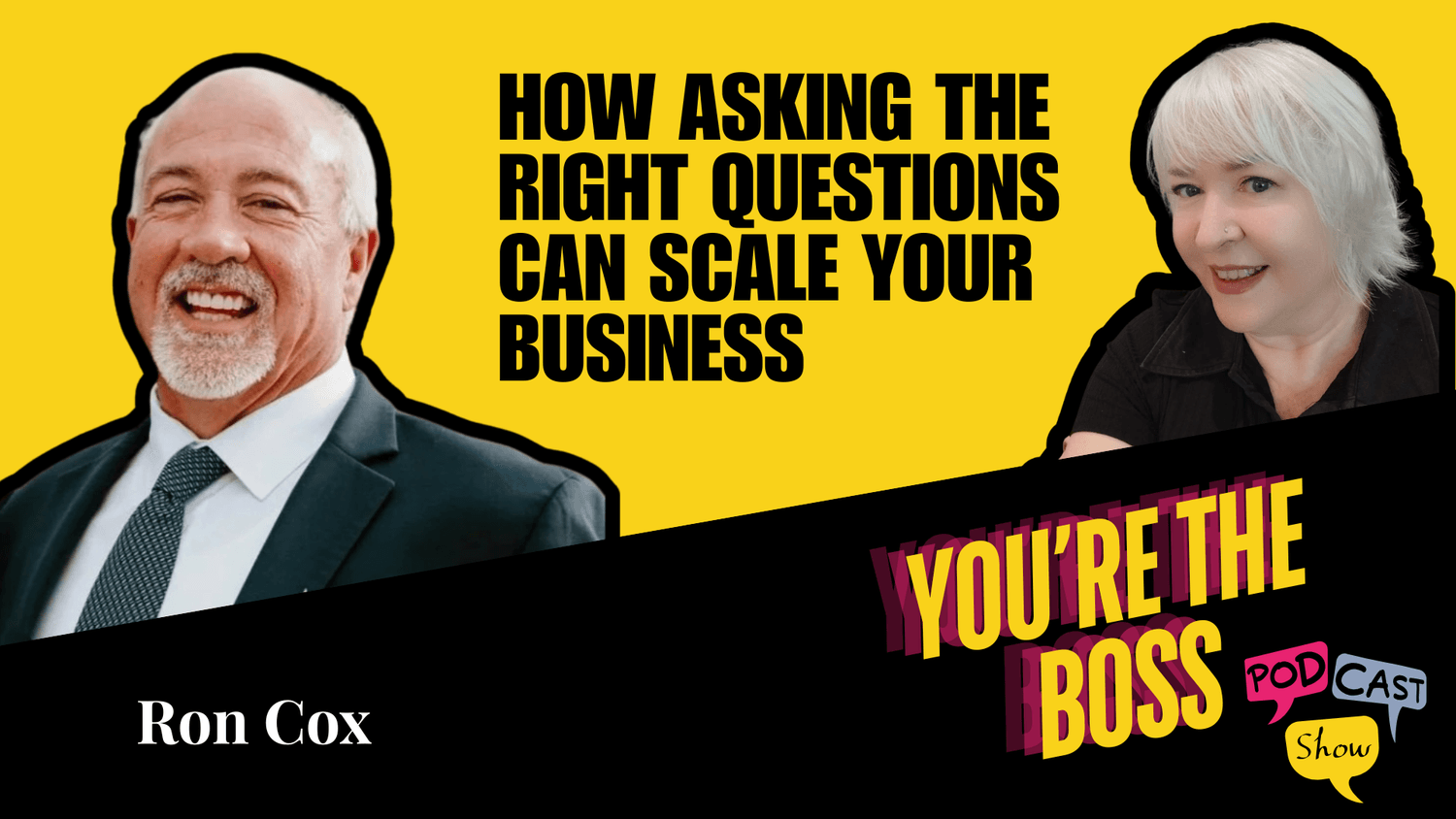
Click the image above to watch
Ange Dove (00:01)
Welcome to You're the Boss podcast show. And today I have a special guest with me, Ron Cox. Ron, welcome to the show.
Ron Cox (00:10)
Well, thank you. Thank you for having me. I appreciate it and I look forward to our conversation today.
Ange Dove (00:14)
Yeah, I'm excited about this because this is a very special topic. I think that will help a lot of listeners and a lot of viewers in their business. So Ron, just before we start the conversation, can you give me a bit of a backdrop to yourself, your past, what it is that you've achieved so that we know we're in the right space here?
Ron Cox (00:35)
Yeah, I appreciate it. First of all, Ron Cox, and I think I've been defined as a strategic leadership team builder, entrepreneur building successful organizations. And I've had experience in not-for-profit education, both K through 12, higher ed, and probably more recently, my exit involved growing on the enterprise zone. so I'm taking a company from
Basically from a negative EBITDA all the way up to 40 EBITDA in about 48 months
Ange Dove (01:11)
Okay, all right. So just explain that to the listeners if they don't know what that means in terms of that growth. Can you simplify that down?
Ron Cox (01:20)
Yeah, what it means was we were, it was a small organization that was spending more than they were making. And so we lost $2.56 million to be exact in the prior year. And so at that rate, obviously they weren't going to be very successful and we were able to build a successful leadership team and transition that organization into a 200, roughly a $280 million sale.
Ange Dove (01:28)
Okay.
Ange Dove (01:38)
Mm.
Ange Dove (01:48)
Right, okay, so you're taking them from a negative loss into an amazing profit, right, and then they were able to exit the business from there. Is that right? Yeah, fantastic. Okay, so Ron, so we're here today to talk about, obviously you've got all these skills involved in, because that doesn't happen without good leadership, right?
Ron Cox (01:51)
Mm-hmm.
Ron Cox (01:58)
Yes.
Ange Dove (02:11)
So, and your skills are in leading people. So I think one of the critical things when people are starting a business, especially if they don't have maybe the experience, you know, if you're just starting a business from nothing and you don't really have that experience of managing people and inspiring people and getting people on the team ready to work with you. Can you give us some insights into what are the first things people should be thinking about as they start to build the business around that idea of building a team?
Ron Cox (02:41)
Absolutely. I authored a book, it's called Unbroken, and we talked a little bit about that and we break that down. But I will tell you that throughout my 30 plus years in organizations, found that the reality is no one will succeed alone. So it's impossible to succeed alone. So we break it down. And the first thing we talk about is the people. And then we break it down even further and we say, OK, if the people, what categories would
Ange Dove (02:45)
Mm-hmm.
Ange Dove (02:59)
Mm.
Ron Cox (03:11)
you group them in and I came up with three. Time and time again, first of all, you cannot overlook the obvious, which a lot of people do and I did in my young entrepreneurial days is you overlook the impact it has on your family. So have on your family because when you start and you launch and you move, you're gonna devote a lot of additional time, energy and effort. So you better have the support of your significant family.
Ange Dove (03:25)
on your family yourself. Right. Okay.
Ange Dove (03:36)
Mm.
Hmm.
Ron Cox (03:39)
You're married, your spouse, if you have children and your family's a little further developed, let's have that conversation with our spouse and the impact it could have on our children. And so let's get that conversation. Let's hit it head on and say, for the next quarter, six months, first year, I'm going to devote time, energy and effort into creating an organization and leaving a legacy. And a lot of times it's for our family. So we have that conversation. And then number two.
Ange Dove (03:44)
Mm.
Ange Dove (03:49)
Mm.
Ange Dove (04:06)
Yes. Right.
Ron Cox (04:09)
I always say, let's have a deep dive with our mentors who have traveled that road prior to you, who has had success and probably most important who has failed and then ask that question, why'd you fail? Please help me. I don't want to necessarily get into the shortcut and have an easy path because it's not easy, but what are some of the things roadblocks that are stumbling blocks that you've encountered?
Ange Dove (04:23)
Mm.
Yeah.
Ron Cox (04:38)
And how could I foresee that and react quicker, you know, with, be a little more prepared. And then finally three, I always say, it's the team and the people that you decide that you want to grow an organization with. A lot of, a lot of training, working with government. And one of the conversations that you know, you have is who do you want to go to war with? Who do you try? Because you're going to have some very, very tough decisions to make.
These are people that are on the front line with you that are taking, you know, a lot of the brunt of the criticism, the blunt of the enemy. And the enemy can be a competitor. So however you use that analogy, but you have to have somebody that walks with you that you trust. Those are my three categories that I really spend a lot of time on before we say, let's move forward.
Ange Dove (05:33)
Right, so okay, so let's just break that down a little bit. So I like the fact that you're saying basically open conversation with your family to get them on board, to get them supporting you and just saying for this period of time, I need to devote my time to this because it's not going to work if I don't, right.
Ron Cox (05:52)
Exactly.
Ange Dove (05:53)
And then I love the idea of mentors. I think sometimes people resist having mentors thinking, as you say, they can go it alone, they can do it themselves. But that's the hardest part, right? If you just talk to someone who's actually done it, you just learn so much more and you can cut ties, right? You can cut time in that sense. But I also like the fact that you say it doesn't make it easy, because it's not easy. And I think that's one of the things people...
sometimes don't pick up on running a business. So it's going to be easy and it's not an easy path. You've chosen a hard path to haul there. So mentorship, I think is crucial. All right. And then the team. So I want to get into the team because this is the hard part, right? This is the who do you hire? And a lot of people, I think,
How would I say it's not hiring cheap, but in the early days of your business, it's like, obviously cost is a factor, but also the fact that if you're running a business and you're building a team, have to, it's worth paying for the right people, right? And it makes a huge difference. So what would you say around that? Maybe that first hire, what's that first move you need to make?
Ron Cox (07:15)
I'll give you my own experience and I will tell you that through the mentorship that I had and one of my mentors was Dr. Steven Covey and Seven Habits, a highly effective people. And so we dove down into those seven habits like a highly effective. And so even today, even though he's gone, we had the opportunity to work together and I still fall back on those conversations we had 25 and 30 years ago. They're relevant.
Ange Dove (07:36)
Mm. Mm.
Ron Cox (07:44)
They're timeless. so one of the things we talked about is trust and character. so we went in and we didn't really talk about cost. We talked about building a leadership team around trust and character. And that's what matters most. So this community that you put around you of leaders is important. So what we did was we, and there's several, several of these, and I'm not going to endorse a single brand because there's a lot of good ones out there, fortunately for entrepreneurs, but
You ready for this? We did a culture value index. so CBI and what we did with the CBI is there's a great tool for me to say, if I have a stimulus, whatever that happened, what is the reaction? So what's the stimulus? So basically stimulus and response. So the CBI will say, if this occurs, this human is hardwired.
Ange Dove (08:19)
Right.
Ron Cox (08:43)
to make this decision. And the accuracy is a lot of these psychological profiles, a range of 93 to 98%. It's not perfect, but I like my chances. So I went in and I took all the people that I wanted to see transition to the new organization. And then I said, I want to test the character. So I'm going to put this test together, give it to them. They answer the questions. It tells me how they're hardwired. And then I did a little
Ange Dove (08:45)
Alright.
Ange Dove (08:49)
Mm.
Mm. Mm.
Ron Cox (09:13)
further analysis. And so I said, okay, let's take this CVI. Again, there's Meyer Briggs, there's all the I there's all these other two. Yes, I went back and I said, okay, let's use that tool to create a description. So if I have a job description that I have the right person to say, hardwired to create this culture and environment based on these stimulus.
Ange Dove (09:22)
Yes, a lot of them. Yeah.
Ange Dove (09:30)
Hmm. I don't Hmm.
Ron Cox (09:41)
What are the demands of the customer? What are the demands of the owners? What are the demands of my team, my colleague? And so all of a sudden I said, I'm going to have a higher probability of success because I created a description that created, this is what we expect. Then I went in and I said, how are you wired? Are you wired to get the highest chance of success? So I did that and that's where I really spent my money. It wasn't that expensive, but
Ange Dove (09:54)
Mm-hmm.
Ange Dove (09:57)
Mm.
Ron Cox (10:09)
I had a solid job description. Part of the onboarding and interviewing and recruiting was, me your CVI. fascinating. Marry the two up. And then I knew it would be a good fit for my community. You share the same values. And I think the culture is going to be very positive because of who is on that team.
Ange Dove (10:12)
Mm.
Ange Dove (10:32)
Right. So my experience, right, when I very first set up my business 20 years ago, I didn't understand this concept at all, that people were different and they're hardwired to do different, react different ways. And I just thought everyone was like me, right? I'm just the same, which is a horrendous mistake to make, but I made it early, so it's okay.
Ron Cox (10:41)
Mm-hmm.
Ron Cox (10:52)
Mm-hmm.
Ron Cox (10:57)
You've been there.
Ange Dove (10:59)
Okay, so my first hire I had was an admin assistant. And I just thought, she must be bored doing the same thing every day. I'll give her something extra to do. So I was loading her with things that I thought would be interesting for her to contribute, right? But all she wanted was to just do the same things every day. And she was quite comfortable doing that. And she was good at what she was doing.
And I tried to change her role, which was the worst thing I could have done. So when I got to understand this psychological profiling and we put our staff through that, really, the understanding that you've got from that of, that's how they work, that's how they need to be treated, that's how you need to talk to them. And just that communication of talking to people as well. And then I learned through customers as well.
There was one case study of a communications company here that was working with doing communications for oil rigs. So the satellite communications. And on the oil rigs, people are coming and going all the time. And obviously, the communication has to be really tight because you're dealing in life and death situations on an oil rig. You don't know who you're working with half the time because they're new people.
Ron Cox (12:03)
Mm-hmm.
Ange Dove (12:22)
So they put them all through the psychological tests and color coded those results and put the color on their helmet. So you knew who you were speaking to when you saw the color. So if it was a red, was just give them the details, just on details, give them the overview, what they need to know and move on. Don't waste any time. If they're a blue, sit them down, make them comfortable, have a cup of tea, have a conversation. And all that kind of stuff.
Ron Cox (12:30)
Okay.
Ron Cox (12:51)
Oh my gosh. It'll speed up the process and it'll increase your outcome as far as success goes. You're right. Some of the worst organizations I've seen, know, label, I think, well, some of the blocks were titles builder, banker, merchant, innovator, and it's like your colors. So you had a label and you do not, do not, do not want a banker.
Ange Dove (12:57)
Yeah.
Ange Dove (13:08)
Okay. Yeah.
Ron Cox (13:15)
who is looking at spreadsheets all day and P &Ls, and they are so excited to see the balance and the numbers and the formulas and the spreadsheet. And then all of a sudden, if you say, you know what, you are so smart, here's what I want you to do. Call a customer and ask them to buy another one. Whatever, widget, car, and they're going, how about it? You go, hold on, you want me to talk? Well, you want me to call somebody? And you go, yeah, yeah, yeah, because you're smarter than I am. You're very analytical, boy.
Ange Dove (13:38)
I might talk to someone.
Ron Cox (13:44)
And you're very good with numbers. So give them a call and tell them what it's going to cost. But more importantly, tell them why it costs that. they're going to go, whoa, whoa, whoa, whoa, whoa, whoa. I'm not going to call stranger and try to sell them on something. No, no, no, no, no, no. That's the, it's just like you said with the color. I saw an organization one time too. And we, and you and I talked a little bit about this earlier, but we had an older generation. and we had, we didn't have a.
Ange Dove (13:44)
Uh-uh.
Ange Dove (13:51)
Yes.
Mm. Yeah.
Ange Dove (13:59)
Yeah. Yeah.
Ron Cox (14:12)
good retention rate of employees, the success rate was hard. And so one of the things we talked about in exit interviews, so why are these young generation XYZ, whatever you want to label them, why are they not happy? Why are they not staying? Why are they job hopping? Why are customers calling saying, hey, I don't even know the new guy who showed up, you know, and I had a great relationship with the old guy or gal or whoever. So all of a sudden we these conversations and we go, oh,
Ange Dove (14:38)
Yeah.
Ron Cox (14:41)
Okay, the exit interview said, I don't function well in command and control environments. First of all, I don't like getting talked down to. Second of all, I hate being screamed at. Third of all, I don't like the direction and I tried to schedule a meeting, but nobody will take it or listen to me. And so we said, well, that doesn't seem very smart or very, how would you say it? A very great idea to grow your business.
And so we sit down, we did exit interviews with all the employees that had left. We reached out, we asked the clients, how are our employees doing in engagement? And then all of a sudden, so we had a customer satisfaction survey, we had employee satisfaction survey, we rated our leadership team, we compared it to that CVI, and we're like, we need to change. We literally drew a bus on the wall with 13 seats.
The driver, we put the founder of the company in the front and we said, do what you always done, have vision. Out of the 12 seats, we had people go plug and play with a sticky notepad, where they thought they fit, what seat, what title, what job description. After the interviews, we came back, eight of the 13 people were in new seats or no longer in the organization. We implemented a three year strategy plan. We said at the end of year, we're gonna do this, we're gonna do this, The 39, it's.
It flipped to 93 % employee retention. 93 in 36 months. And you and I both know how much it costs to hire, advertise, interview. So I take my entire leadership on an interview. Yeah, I'm not doing any customer satisfaction that day because I'm out meeting strangers seeing if they're a good fit for my team. Not satisfying an existing customer. So productivity was terrible.
Ange Dove (16:19)
and then replay them. Yeah.
Ange Dove (16:25)
Mm.
Yeah.
Right. Nice.
Ron Cox (16:35)
All we had to do was survey the people leaving, ask the people staying what we could do better and ask our clients what they expected. And once we put it all together, everybody went up and they changed their sticky note go, based on what I'm hearing, seeing and feeling, I think I've been over here. 93 % retention, profitability went through the roof, all time earnings. It was incredible.
Ange Dove (16:57)
Yeah. So it's kind of like I say to people all the time, there's no point trying to fit a square peg into a round hole. It's just not going to work. Yeah. I love that. So going back a little bit, because I'm quite intrigued with when you said about the culture value index, right? So you did this CVI, the culture value index. And you've mapped that.
Ron Cox (17:07)
No. No.
Ange Dove (17:25)
the outcomes of that to job descriptions. Is that right? So I just love that because that's the thing that I know like different people are good at different things. So the idea is you have to fill your team with those range of people and put them, as you say, the right seats on the bus. Right. So that I understood of, OK, we've got to do that, right.
Ron Cox (17:30)
Yes.
Ron Cox (17:45)
Yes.
Ange Dove (17:52)
But then what's that jigsaw puzzle? How do you put those people together in the right place? So you're saying, obviously, doing the survey, asking the questions, getting them to volunteer where they're going to sit on the bus.
Ron Cox (18:06)
We did. actually, through this exercise, we said, okay, based on the new job description, how do you see yourself and how do you fit in the organization that's going to be different tomorrow? So we're this today, we lost $2.56 million. We all aren't going to be employed in a week, a month, a quarter. So how do we, how do we grow together and figure this out? So we were very transparent, open, honest.
Ange Dove (18:29)
Mm. Mm.
Ron Cox (18:34)
And one of the things that I will tell you is I found that through this process, we absolutely, you had to look around the room and you go, absolutely. know, like I said, six of the, we had eight of the 13 seats new of that half the people were gone from the organization altogether. And so what we had found was you simply, your square peg round hole was exactly what we had been doing. That was.
Ange Dove (18:34)
Mm.
Ron Cox (19:02)
best practice which ended up having worse results. So it wasn't best practice. we had to encourage people to raise their hand. We had to explain. And one of the, still remember one of the things I learned from Dr. Covey, I said to the team, wherever you are in faith and religion, know, okay, we may not totally agree, but there's one fact that whoever your creator is, whoever you believe is your creator, you do have two ears and one mouth. And that's a fact.
Ange Dove (19:05)
Mm-hmm.
Ron Cox (19:32)
So you need to stop talking and start listening. And you listen twice as much as you talk. And one of the things that when we empowered the group to be open and transparent, the ladies in the group, the females in the group had a voice. The young people at the table had a voice. And all of a sudden, I'm sitting there and I had that conversation back to those three groups. Remember I talked about the family.
Ange Dove (19:48)
Mm.
Mm-hmm.
Ron Cox (19:58)
And then I said, you have to start with them. I went to the smartest person I know is my wife and we're at the dinner table. And I said, you know what I learned today? And she said, what's that? And I said, if we have a team of multi-generational people, multi-gender people, and I encourage them to speak, the voice is loud. It's very different.
And that's what we need because we can't continue doing what we're doing and expect different results. That's maddening. So I don't want to have a negative $2.56 million at the end of the next year. So we have to empower and change voices. The younger people were empowered to speak open, freely, candidly with no consequences. I wasn't going to fire them. The ladies found their voice and their courage and their power.
Ange Dove (20:30)
Definition of insanity, right?
Ange Dove (20:38)
Yeah.
Ron Cox (20:52)
and our leader team transformed to multigenerational, multigender, it was beautiful.
Ange Dove (20:58)
I like that. I like that. So I like that multi-generational. So how do you get the multi-generational to work together? Because they do have different thought processes, different experiences, right? They've molded them. So how does that work?
Ron Cox (21:15)
I think the best way to answer that question is, first of all, look in the mirror. So people are going to look at you and you have to say, and I have to have actions with words. And so for me, what I said was everyone matters most and you're not the vote, you are a vote and we have to come together. So for you senior leaders who've had this empowerment entitlement, entitle, whatever that is.
doesn't matter. We're all going to set that aside right now. And we're going to say, what matters most is that we have shared that experience. And so there's young people with great ideas, because there's one thing you haven't experienced is that's the use of technology. Let's utilize the use of technology. Let's understand and empower and
Ange Dove (21:47)
Bye.
Ange Dove (21:56)
Right.
Ange Dove (22:01)
Yeah.
Ange Dove (22:06)
Hmm.
Ron Cox (22:13)
Set your ego outside the boardroom for goodness sakes because your ego is not going to radiate in this meeting today when you lost $2.56 million people. It's not sustainable. Be humble, be humble. And they did get humbled. And our young, our young executives were extraordinarily talented with state of the art ideas on just ways to, for example,
Ange Dove (22:27)
Yeah.
Love, fellow.
Ron Cox (22:41)
We embraced it. And one of the things that I still remember to this day is we said, if we can't create more money through sales, then Leslie Duc can dissect together at that first dollar. so we said, saving money is making money. So how can we save money? All these executives in this boardroom, including myself, sat around and said, we got to do something different. And so all of a sudden, I don't know how we missed it for years, but it was
Ange Dove (22:57)
Mm-hmm.
Ron Cox (23:10)
Let's ask the people closest to the production point. Let's ask the people closest to the client. my gosh, how about this? Let's ask the client. You know, I don't want this to be the first sale. I want this to be the last sale. I want to sustain this relationship. Help me do better, be better. What can I do? So all of a sudden through that, set the monies aside. Let's talk about how saving money could make money and
At the end of the year, it went simple, it from red to black. No more red ink on the spreadsheet. The innovators and bankers were excited, went to black. And the next thing you know, we were literally doing a million dollars a day in business. A million dollars a day.
Ange Dove (23:54)
Fantastic. Just from changing all of that, that is really good. So this empowerment part, because I've heard this before, I've heard a story before about one company, I think it was in hospitality, where they empowered their frontline staff that were meeting the customers on a daily basis. They empowered them with a certain budget that they could spend to put things right to...
you know, serve the customer so that they didn't have to go up the chain of command to get permission to do something. And by that time you've lost the customer, the customer's gone. Right. So they empowered them with a budget to say anything you need to do to put this, to put something right with the client, you go and do it. And then that obviously changed things as well, because they had that empowerment and that trust. It comes down to trust as well, right. Of your people.
Ron Cox (24:49)
Yes. And I, I traveled and worked with an organization. I was so impressed with the frontline staff. It was a hotel chain. I can just tell you it was Ritz Carlton. And I don't work there and it's not self-serving for me, but we had an issue. checked in, I was late in the day and I was angry and grumpy because of the airline, not because of the hotel. And I went up to my room. I checked in, wasn't clean, smelled terrible. It was, it was.
Ange Dove (25:00)
Okay.
Ron Cox (25:16)
bad. And I went back down to the front staff and this young lady. And I just said, I don't know what to tell you, but you obviously put me in the wrong room. She said, I don't know what you're talking about. She at her computer screen. I said, it's not cleaned. It really smells. And I was overboard because I was frustrated. And so I exaggerated. said, there could be a dead body in there. Not quite sure. But I couldn't get past the stench at the doorway. She just said,
Ange Dove (25:37)
you
Ron Cox (25:43)
I'm so sorry. You know, and I was there for a two night stay. You know what she did for me that day? I ended up in what felt like the presidential suite at the Ritz Carlton for two nights. And I was so impressed with her problem solving ability. And so I literally looked online and to your point, I saw that they have adopted a program where customers first and the frontline staff.
Ron Cox (26:11)
at point of sale had been empowered to make financial decisions that were going to impact the bottom line. And I had actually went down there and thanked her. And just like you and I have in the conversation today, I've reminded and I've told that story to everyone I know. Can you imagine what that's done for their business? Cause I travel a lot and they have me for life.
Ange Dove (26:27)
Okay. Yeah. Yeah.
Yes, that is such a crucial point as well, is that building that consumer loyalty or your customer loyalty where they won't move because and a lot of the time that might come from a recovery process, right? Where something's gone wrong like it did for you and they handled it so well that they were able to reverse that and then they have a customer for life because they've, you know.
Ron Cox (26:59)
They got, and it was a simple thing. I've nobody else was in that room. gave me. and like I said, they took care of me. One of the other things, you know, I'll tell you about making better decisions and how do you get that empowerment? I learned early on in the end. I've been around a while in a few boardrooms, fortunately, or unfortunately, and doing training, but.
Ange Dove (27:16)
Mm.
Ron Cox (27:24)
If I am in, if I'm in a room and I know that I'm the smartest person in that room, I'm in the wrong room. And Dr. Covey always said that it's exhausting Ron pulling everyone every day. You will be worn out, fatigued, you'll switch organizations, you'll quit. He said, if you're the smartest man in the room, you're in the wrong room, You will breathe and you will sleep. You will feel better. There's five things and I still remember them.
Ange Dove (27:39)
Yes.
Ron Cox (27:55)
greater emotional intelligence and resilience. You'll have higher and longer success rates at the organization. You'll have better health and healthy outcomes. Less stress is amazing. You'll have a stronger leadership team with the capacity to make decisions and be flexible. The greater ability to overcome adversity, because there will be adversity. Every organization has it. And so those are the type of things that you will benefit from.
Ange Dove (28:08)
Yes. Yes.
Ange Dove (28:14)
Yeah.
Ron Cox (28:24)
your family, your mentorship and your friends and your colleagues because you have that prioritized on the front end because of that culture and that team. And, you don't have to make all the decisions. You can just relax, listen, learn. You should be a lifelong learner. Have a servant mentality. You know, when Cheryl stands up or Susie or Tom, you go, I'm here to help you. I'm here to serve you. What a great, how can I help you?
Ange Dove (28:45)
sure.
Ron Cox (28:53)
I don't have to play quarterback. I don't have to be the leader. I just want to be on a great team and I don't want to exhaust all my energy in the first 30 minutes of the day.
Ange Dove (29:02)
Yes, yeah, it does make a huge difference when you have people empowered and you have the right people in the right roles. Then that just makes your life so much easier as well. It's like when you hire right, you know, obviously I did this when I was first starting my business, I did hire the wrong people in the wrong roles. I didn't know any different at that point, right? And I got coaches and I got people to help me. And had then hiring the right people.
Ron Cox (29:06)
the right people, the right values.
Ange Dove (29:30)
Oh my goodness, it was a huge difference. made such a difference. Like my energy levels went up because as you say, you're not dragging people behind you. You're getting people that actually can do the job better than you can to contribute. And it just makes such a difference to the organization.
Ron Cox (29:50)
You said it right there. and my wife teases me about it. I honestly believe that I've learned so much and I remember everything from my failures. It's like great coaches. You ever ask a coach, you know, talk to me about your greatest game and they'll talk about what they should have done differently.
Ange Dove (30:02)
Mm. Mm. Yeah.
Ron Cox (30:13)
And how it pains them today and the loss that will live with them forever. And then you go, do you remember the first championship you won? go, I just know we got a trophy. And I remember the kids were excited and I think we played well that day. And then they go, well, what's the biggest impact you remember? I remember when we lost and seeing that locker room and those kids and how they responded. it's like, you will always, I, to that, I remember the defeats.
the lost projects, the bids we didn't get, the projects we didn't complete on time. What was my role in that?
Ange Dove (30:49)
But then the important thing is that you learn from that. So the next one is a success, right? Yeah.
Ron Cox (30:55)
Yeah. Yes. And you'll have a group of people like that community we talked about. The three things that I still remember is one, appreciate who challenges you the most to be better. Don't let you have an easy path. Who celebrates the growth of the organization instead of resenting it? Like, I don't want to be part of the growth. Well, you're in the wrong organization.
Ange Dove (31:03)
Huh?
Ange Dove (31:12)
Yes.
Yeah.
Ange Dove (31:20)
Yes.
Ron Cox (31:24)
because growth transitions to learning and leadership and you mentioned it earlier, compensation. So you wanna reward them. You can't always afford and start paying the most, but as you grow together, celebrate the success through compensation. Compensation could be cash, it could be time off, could be whatever it might be. Some people like collecting awards, you know, great. But I think that the third thing that I wanted to say about that is,
You want to know that that person, you for example, when you walk in that room or the next room or when they leave that meeting and they go back to their team huddles, that everything they go and every room they walk into, they bring the integrity.
It follows them. As soon as you show up, they know this is going to be a high level, impactful meeting with a positive outcome. Have that person, every room they show up in, they know, and you know from past experience, they bring integrity.
Ange Dove (32:08)
Mm.
Ange Dove (32:19)
Mm, I love that. love that. I think one of the things that I can take away from today's conversation is the importance of asking questions. Right? You're questioning your family, you're questioning your team, you're questioning your customers, you're questioning people on the front line. And it's that collaboration that when you get those, those inputs, everybody's inputting to make the company better.
Ron Cox (32:48)
Yes.
Ange Dove (32:49)
That's the thing I got from today. That's so wonderful. So Ron, thank you so much for your time today. It's been absolutely a pleasure speaking to you. And where can we send people to for them to learn more from you?
Ron Cox (33:03)
It's rcdevelopmentsolutions.com
Ange Dove (33:05)
Okay. So I will put that link around where people are listening and watching this so that they can click and they can go and do that. And then you've got your books as well, as well, Unbroken and...
Ron Cox (33:21)
Um, it's me and my best friend. Talked about documenting and find him or her and tell stories and connect and not necessarily, you know, through social media or this or that, it's been some time. Um, you know, the, the, numbers are 75, 80 % of real communications, nonverbal. Hang out.
Ange Dove (33:24)
me and my best friend.
Ange Dove (33:43)
Yeah. Yeah. Okay. I love that. So yeah, I will put the link there so people can go and join. So Ron, thank you so much for today.
Ron Cox (33:54)
Thank you.
Don't leave without your free gifts

Check out my page of freebies designed to help you make progress towards your goals.
From free training on making $10,000 months to how to create your brand message to access to the resources I use in my business that may help you too!
I've got some
gifts for you!
Check out my page of freebies designed to help you make progress towards your goals.
From free training on making $10,000 months to how to create your brand message to access to the resources I use in my business that may help you too!
About me

Hi there 👋 My name is Ange Dove, professional copywriter and messaging strategist. I help Gen X professionals find the words to express who they have become, and to build a career or business that owns it.

GET YOUR UNCHAINED AUDIT
Let’s have coffee online for 60 minutes on Zoom, where we'll look at your profile, your message, and your next chapter together and give you the roadmap to take your next steps.

GET THE NEWSLETTER
Straight-talking insights for experienced professionals who want to turn what they know into income, options and greater freedom over what comes next.


