Call: +65 6012 3433 | Whatsapp +65 87792453
Getting Your Non-Profit Right From The Start
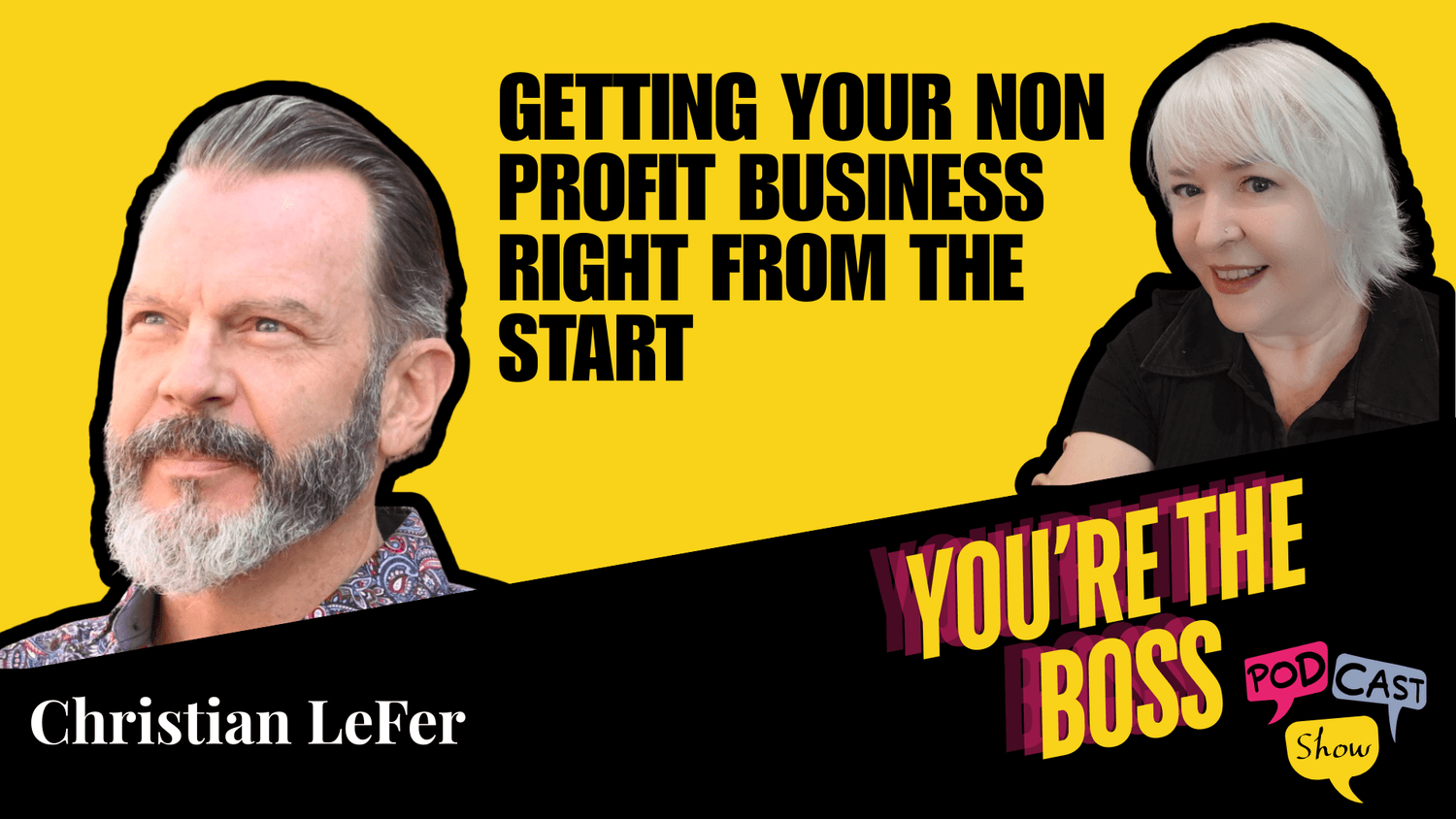
Watch the podcast by clicking the image above and select the You're the Boss Podcast Show playlist.
Ange Dove (00:02)
Welcome to You're the Boss podcast show. And today I have with me my guest, Christian LeFer. Christian, welcome to the show.
Christian LeFer (00:11)
Thank you so much. I'm excited to be here.
Ange Dove (00:13)
Yeah, it's good to have you. So Christian, just explain to us first of all the background about who you are and what you're doing.
Christian LeFer (00:26)
What I'm doing at the moment is helping to bring change to the world and really change the arc of history by helping thousands of people start nonprofits, tax-exempt nonprofits, mostly 501(c)(3)s, to enact good in the world.
This is a business entity type that can be used alongside a for-profit business, alongside a going concern, to enhance its value, project its value in the world as a good citizen and as somebody that’s giving back. Or it can be used as a business entity by itself that is non-taxable at the corporate level.
Ange Dove (01:01)
Okay, so this is a very interesting topic, I think, for me on this show at the moment because we haven’t really talked about nonprofit entities in the past. So this is new for the podcast, which is good.
Tell us first of all how you got into this actual business yourself, because I think it’s quite an interesting story about how you started. What happened to make you actually realize this is the way to go?
Christian LeFer (01:32)
Well, I think everyone who goes into business — or most people — there’s a backstory, right? There’s an origin story that causes us to become interested in something as a child. Whether it’s something exciting to us, or we love cars and go into that business, or we want to solve problems because we experienced scarcity in our lives and want to become a financial planner or something similar.
I grew up with my sister, who is my only sibling. When I was about eight years old and she was almost four, we discovered that she was developmentally disabled and not developing verbally.
At that time I didn’t think much about it. I just went on about my way. But I grew up around organizations like Special Olympics and many other organizations that instilled in me that when someone has a challenge in life — or when there’s something that could make the world better for a person, the environment, communities, animals, etc. — people gather around and help create a better life and environment.
Then around 2009–2010, I went to start a nonprofit and became morally outraged at how difficult it was. It’s easy to start a business or an LLC, but starting a nonprofit to do good can be incredibly difficult. So I decided to do something about it.
Ange Dove (03:18)
Right, okay, that’s really interesting. So what were the hurdles that you were coming up against as you tried to start the nonprofit?
Christian LeFer (03:28)
It takes incredibly long. Back then — and even now — the traditional process of starting a nonprofit has a number of long government forms, because you’re not just creating the entity like a limited liability company or corporation. You’re also getting tax status on that entity.
People often use the terms “501(c)(3)” and “nonprofit” interchangeably, but 501(c)(3) specifically refers to the IRS code that carves out a type of business entity that is not taxable at the corporate level. With that comes responsibility on the part of the organization. Congress created standards so people know the organization has gone through a process to qualify as an exempt activity — what the IRS calls charitable activity.
Traditionally, those processes can take up to a year. When I found this out and received a form letter back from the IRS with my agent’s phone number on it — and of course that agent was never available — I decided to change the last couple of digits on the phone number and just keep dialing nearby extensions until I reached someone.
I asked them: What takes so long? Why do files get delayed or denied? What would make your day easier as a bureaucrat reviewing these applications?
I collected those responses into what I called a “love letter to a bureaucrat,” and my first approval came through in about six weeks because of that.
Ange Dove (05:00)
Wow. Okay.
Christian LeFer (05:05)
That’s a huge difference from one year to six weeks. A lot of people aren’t necessarily doing it wrong, but there are lots of little things.
I also used to do direct mail communications, and when we sent letters we’d do about 20 little things to make it look personal — like your Aunt Gertrude typed it on her IBM Selectric. We’d use old-fashioned typewriter fonts, avoid machine barcodes, and even bend the stamp-applying machine slightly so the stamp would go on crooked.
I took that same thinking into nonprofit filings. I created cover pages, tables of contents, watermarked EINs — all these little organizational details that immediately showed the IRS agent that everything they needed was there, neatly organized.
It signaled to them that if they took this file to their desk, they could probably get through it quickly and head to lunch early — which is what every bureaucratic worker wants to do.
Ange Dove (07:02)
Yes. You just want it to be easy, right? Something organized where they can see straight away, “Okay, this ticks all the boxes. I’m doing this one first.”
Christian LeFer (07:15)
Exactly. And it’s not just the little tricks — it’s also the content, which is the hard part.
A lot of people do a complete brain dump in their application. They include speculative ideas they may never even pursue, which just creates confusion. Any application process is similar to applying for a mortgage. If you confuse the underwriter, you’ll get more questions. If you submit a perfect file, they’ll appreciate it and move it through quickly.
The most important thing is solving problems for everyone involved in the process — not just customers. Businesses think about customer experience all the time, but if you can also solve problems for vendors, delivery systems, partners, and everyone interacting with the business, that’s the real magic. That’s how businesses truly stand out.
Ange Dove (08:41)
So typically your applications for your customers now take how long?
Christian LeFer (08:48)
There are two different paths to 501(c)(3) status. There’s a shorter form introduced around 2019 and then a longer form. We track processing weekly, and at our last meeting the averages were around 18 days and 52 days respectively. That’s very fast.
A lot of it is making sure you don’t get pulled into lengthy back-and-forth conversations with the IRS. You want what’s called a merit close — where the file goes through on the merits of the application alone, without requests for additional information.
Ange Dove (09:24)
Okay. Before we get into your services directly, speak to us about the difference between a nonprofit and a charity, for example.
Christian LeFer (09:42)
A nonprofit is a charity — they’re essentially the same thing.
People use different terms. Sometimes you hear “foundation,” which can refer to a grant-making organization. Educational nonprofits might call themselves an “institute.”
But technically, a nonprofit corporation does not automatically have tax-exempt status. There are companies out there advertising “nonprofit setup” services that only create the corporation but never apply for tax-exempt status. That’s unfortunate because people often assume they’re getting the full package.
At Instant Nonprofit, we only do nonprofits all the way through to tax exemption.
One of the most exciting things we’re seeing is existing for-profit businesses creating nonprofit arms. Studies show employee retention improves dramatically when employees are engaged in charitable projects. So a roofing company, for example, might create the “Christian LeFer Roofing Foundation” to help repair roofs for people in poverty or disaster zones.
It helps businesses show up in the community as organizations that genuinely care.
Ange Dove (13:00)
Okay. Walk me through your done-for-you service then. You’re basically saying people can set up an additional nonprofit company alongside their business and you’ll handle everything for them, right?
Christian LeFer (13:19)
Correct. We do absolutely everything.
A customer comes into our system, checks out, and completes an organization profile with basic information like their name and address. Then we handle entity formation, articles of incorporation, bylaws — literally all the documents.
We obtain the EIN, and with the EIN plus the articles, they can open a bank account and immediately start raising tax-deductible donations — even before final IRS approval.
That’s because the IRS backdates tax-exempt status to the incorporation date as long as the application is filed within a reasonable time frame. So people can effectively start fundraising on day one.
Ange Dove (14:58)
Okay, so you do all that for them. Explain what you mentioned earlier — that some nonprofits are not tax-exempt.
Christian LeFer (15:09)
If they never apply for tax-exempt status with the IRS, then they’re not federally tax-exempt.
The major difference is that nonprofits don’t pay corporate income tax. If a nonprofit brings in $500,000 and spends $400,000, the remaining $100,000 can simply roll over into the next year without corporate taxation.
The second major benefit is that donations to the nonprofit are generally tax deductible to the donor.
Some nonprofits also sell products or services. If someone receives something of significant value in return, that portion isn’t deductible because they’re receiving value back. Churches are a good example — donations are deductible, but purchases from a bookstore or coffee shop may not be if they’re unrelated to the mission.
Ange Dove (17:18)
So, are there any other questions I should ask that would help the listeners?
Christian LeFer (17:30)
Absolutely. One common myth is around international involvement.
You can absolutely have international board members who are not U.S. citizens. Only one board member needs a U.S. tax identification number.
We recently helped individuals from Southeast Asia who run a wildlife preserve for endangered species. They wanted to establish a U.S. presence because the United States gives more to charity than all other nations combined.
We helped them obtain ITINs, EINs, and get fully operational as a U.S. nonprofit.
Another myth is that you cannot have friends or family on your board. You absolutely can.
When people start nonprofits, they often overcomplicate things. The easiest way is to ask trusted friends or family members to serve initially. As the organization grows, you can later bring in more experienced or high-profile board members.
We also help organizations streamline meetings. Early-stage nonprofits should keep things simple — one board meeting per year, less than an hour if possible.
Ange Dove (20:51)
So is there any minimum requirement for the number of people on a board?
Christian LeFer (20:58)
Yes. You must have three.
Those same three people typically serve as directors and officers. The required officer positions are president, treasurer, and secretary.
The president is usually the founder and visionary. The treasurer reads financial reports, even if they’re very simple. The secretary keeps records and meeting minutes.
In the beginning, the founder often ends up doing most of the work anyway — just like many startups.
Ange Dove (22:37)
If someone is thinking about starting either a normal business or a nonprofit, what’s the decision-making process?
Christian LeFer (22:59)
A major litmus test is whether you intend to eventually sell the business.
If you’re building transferable value — like software, customer databases, or recurring revenue — then a for-profit business probably makes more sense.
But if the value mainly comes from services benefiting the community, animals, the environment, or education, then a nonprofit may be ideal.
Therapy offices are a great example. Many therapists offer sliding-scale services and community support. A nonprofit structure can work very well there.
Ange Dove (25:06)
And what about profit distribution? I presume if it’s a nonprofit, you can’t take profit from the business?
Christian LeFer (25:16)
Correct. There are no shareholder distributions because nonprofits don’t have owners or shareholders. They’re governed by a board.
However, nonprofits absolutely can pay salaries and bonuses. People running large nonprofits should be compensated appropriately.
What regulators don’t like is excessive or abusive compensation structures — especially fundraising commissions. That’s where some organizations get negative publicity.
But honestly, in the 5,000+ nonprofits I’ve helped start, very few have had any kind of criminal or egregious activity. Most people genuinely want to do good.
Ange Dove (27:33)
Do you advise clients on how to manage money and operations properly so they don’t step over the line?
Christian LeFer (27:48)
Yes, absolutely.
Some customers want to move very quickly and build large-scale organizations. We help create policies, procedures, fundraising systems, operational structures, and major donor programs.
Most nonprofits are still small “mom-and-pop” style organizations, but for those aiming bigger, we can help them compress years of progress into a much shorter time frame.
Ange Dove (30:44)
Okay, just to round out now — give me a simple list of the services you provide.
Christian LeFer (30:57)
We provide a fully done-for-you nonprofit setup service, usually for 501(c)(3)s but also other nonprofit classifications like 501(c)(6) trade groups and 501(c)(4) advocacy organizations.
Customers spend minimal time with us — many smaller nonprofits complete their side of the process in about 17 minutes.
We help with:
Naming and mission statements
Articles of incorporation
Bylaws
Conflict of interest policies
EIN registration
Bank account setup guidance
IRS tax-exempt filing
Once organizations are operational, we also offer “Nonprofit Autopilot,” which helps maintain compliance and good standing year after year.
For larger organizations, we provide operational consulting, major gift fundraising support, and strategic guidance.
Ange Dove (33:21)
So basically a one-stop shop for everything nonprofit. Love it. Okay, so Christian?
Christian LeFer (33:27)
Yes — and we actually have a great gift for your listeners. If they go to instantnonprofit.com/podcast, there’s a free nonprofit startup kit available.
There’s no pressure or sales pitch. It’s simply designed to help people explore whether a nonprofit is right for them. It includes exercises for:
Choosing a board
Brainstorming names
Crafting a mission statement
Planning the organization
Everything is completely free.
Ange Dove (34:15)
Okay, so instantnonprofit.com/podcast. I’ll put the link wherever you’re watching or listening to this.
Christian, thank you so much for your time today and for talking about this. It’s been a fascinating topic.
Christian LeFer (34:32)
Thank you. Absolutely. I really enjoyed it. Have a great day.
Don't leave without your free gifts

Check out my page of freebies designed to help you make progress towards your goals.
From free training on making $10,000 months to how to create your brand message to access to the resources I use in my business that may help you too!
I've got some
gifts for you!
Check out my page of freebies designed to help you make progress towards your goals.
From free training on making $10,000 months to how to create your brand message to access to the resources I use in my business that may help you too!
About me

Hi there 👋 My name is Ange Dove, professional copywriter and messaging strategist. I help Gen X professionals find the words to express who they have become, and to build a career or business that owns it.

GET YOUR UNCHAINED AUDIT
Let’s have coffee online for 60 minutes on Zoom, where we'll look at your profile, your message, and your next chapter together and give you the roadmap to take your next steps.

GET THE NEWSLETTER
Straight-talking insights for experienced professionals who want to turn what they know into income, options and greater freedom over what comes next.


