Call: +65 6012 3433 | Whatsapp +65 87792453
Facts Tell, Stories Sell: Why Boring Presentations Kill Opportunity
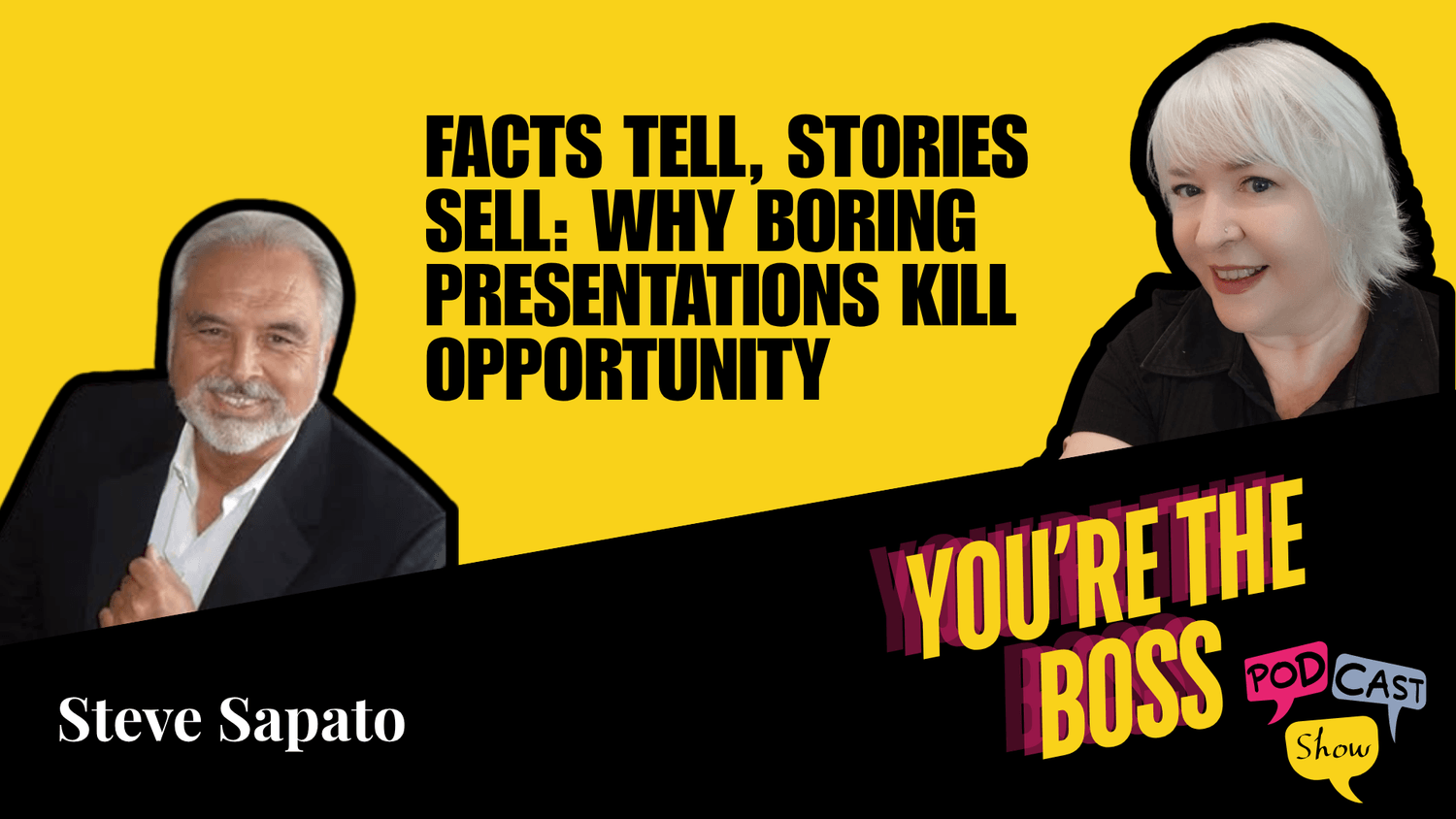
Click the image above to watch
Ange Dove (00:01)
Welcome to You're the Boss Podcast Show. And today I have a very special guest with me, Steve Sapato. Now, Steve is an elite MC and speaker for over 30 years, and he's spoken to thousands of people on hundreds of stages. And as a guest or a host, you will find him very energetic and entertaining. And I think you're gonna find that today in this episode.
He's also a professional presentation coach and nutball to defeat boring speakers. We'll talk more about that too. He's trained people on public speaking to gain confidence and improve how people react to them. Confidence, self-esteem, and belief, you will be glad to hear, are all learned skills. And that is what Steve is all about. So, Steve, welcome to the show.
Steve Sapato (00:54)
Thank you very much. I appreciate being here. I appreciate you having me on. And we're in absolutely opposite sides of the world, I think, right?
Ange Dove (00:57)
Yeah.
We are, yeah. I think we're almost what twelve hours apart, basically. I am your future, right?
Steve Sapato (01:07)
Twelve hours apart, yep. I just asked for she was eight thirty PM, I'm eight thirty AM. So yeah twelve
Ange Dove (01:12)
That's right. I'm just finishing and you're just starting your day. Yeah. Okay, Steve. So we can see at the background here your your banners. Yes, so we can get an idea of who you are there. So the most famous, unfamous speaker in America. It's a good title to have. And you're stopping boring speakers from what's that presenting boring parts, your left says behind your chair, boring boring meetings. Okay.
Steve Sapato (01:38)
Boring meetings. Yeah. Preventing boring speakers and preventing boring meetings. Yeah. Because nothing nothing worse than being bored. You know, that's one of the things I spent decades l sitting through meetings, you know, I've had different careers. And you sit through people who are just boring as sin, and you're just like, Why? Why are they boring? And the answer is because they've never been taught how not to be boring. Everybody thinks when I speak, I'm entertaining. That's what everybody thinks. You know, if you ask
Ange Dove (01:42)
Okay, love it.
Ange Dove (01:59)
Yeah.
Steve Sapato (02:05)
You ask people who just put on the worst presentation you ever go, you go, How'd that go? They It went pretty good. And you wanna go, No, it didn't.
Ange Dove (02:11)
Ha.
Steve Sapato (02:13)
But we don't tell people that. We don't tell people that they were boring. When the worst speaker comes off stage and they look at you and you know them and you go, hey, congratulations. Like, hey, Steve, you did a good job. Thanks a lot. Well, no, you didn't, but they're not gonna say you were boring, right? So it's it's really difficult that most people don't understand. Let's start off with what's your purpose in giving any speaking presentation? So a presentation, you're on stage. Why are you on stage? What do you hope to accomplish?
Ange Dove (02:15)
Yeah.
Ange Dove (02:29)
Right. Right.
Steve Sapato (02:42)
If you're there to sell your company, your organization, your your service, right, what are you hoping for when you're done? And I hope the answer is either lots of questions or lots of response. I mean, I've sat through meetings where the people got up to talk. I'm in a retirement community here in Florida in the United States, and people get up every Monday morning for Monday morning coffee and come in and so there's eighty to a hundred people and they sit there listening to different speakers. They actually come for the donuts, but
They have to listen to a speaker. And the speakers usually get up and want to talk about their business. And it's real simple. They spend 15 to 20 minutes talking about their business. I don't care if they're an audiologist, I don't care if they're a vapor barrier thing for mobile for mobile homes. I don't care what they're doing. What they have to do is get a response. And so what they end up doing is telling you all about, hey, this is a kind of equipment we use at our audiology business.
Ange Dove (03:13)
Yeah.
Ange Dove (03:40)
Mm.
Steve Sapato (03:42)
This is what we do for vapor barriers. This is what we do for all this other stuff. And the answer is why are you telling me that? I I don't care, right? I don't care what equipment you use. It doesn't matter to me. I don't know what other kind of equipment there is out there. The answer is can you fix my problem? And on several occasions I've followed them up because I'm also one of the presenters for different organizations that we have here and so I MC a lot of the groups so I get up and talk for them.
Ange Dove (04:11)
Right.
Steve Sapato (04:11)
And when they're done, I'll usually get up behind them and just ask us at one one person did a whole thing on audiology and they talked about all their equipment and all their shop and how long you've been doing it. And when they were all done, everybody went, Thanks a lot. And I got up there at the end and said, Hey, I have a question for you. Ladies, how many of you would like for your husbands to hear better? So, you know, you could get that done. All the ladies' hands went up. And I said, And guys, how many of you here, right?
Ange Dove (04:21)
Mm.
Steve Sapato (04:39)
Absolutely do not want a hearing aid because you don't know what what your wife has to say. And they all handled it. I said, but here's the key: no matter which one you chose, you should go over and talk to these people because they're giving a free hearing test. So while I'm talking, just go over there, register, sign up, get it done. And about 20 people got up and went over. The company didn't get that done. They didn't have that accomplishment. Okay, same thing with a vapor barrier. We have manufactured housing here. So our houses are about three feet off the ground, right?
Ange Dove (04:43)
Yeah.
Ange Dove (05:01)
Yeah.
Steve Sapato (05:08)
So you have to have a vapor barrier to keep the ground stuff from coming up. And if you have a hole in it, it create could create major problems down the road. This one company got up and told about all the stuff they do, and then they sat down, right? So they said, Hey, anybody who wants to come over for our free assessment, you know, come on over to the table and sign up. And everybody sat there looking at them. And when I got up, I went, Okay, I have a question for everybody. How many here can guarantee they don't have a hole in their vapor barrier? And nobody raised their hand. I said, So all of you.
Ange Dove (05:08)
Mm.
Steve Sapato (05:37)
Could have a hole in your vapor barrier, which caused all kinds of problems, right? And they all went, Well, yeah. I go, if you want to know for sure, go right now and sign up. So, you know, and about again, 20 to 30 people got up immediately and went over and signed up. What you're looking for with the result you're after keeps you from being boring. Don't I have a phrase and it's facts tell, stories sell. If you want to inform me.
Ange Dove (06:03)
Mm.
Steve Sapato (06:06)
Give me some facts. I could turn on the you know National Geographic Channel and watch facts, right? But if you want to get business, if you want to improve everything that you're going for, you have to tell stories. I got a thing out there. Well, you can see it right above my head, wherever that's at storytising. And that's how to tell your story in a way that their memories, their emotions, and their experiences relate it to you. Stop being boring. Stop hoping.
Ange Dove (06:11)
Mm-hmm.
Ange Dove (06:19)
Mm. Yeah. Story titing. Yeah.
Ange Dove (06:30)
Hmm.
Steve Sapato (06:33)
That you're not boring. Send me a clip. Send me a five-minute clip of a talk you gave. Now, 95% of the people listening won't be able to do that because they never record themselves speaking. Record yourself in the next one, send it to me. I'll be glad to evaluate it for you and send back how you could improve on it. So there's a free service for you right there.
Ange Dove (06:44)
Right. Mm.
Ange Dove (06:52)
Nice. So that's a free offer for you. Yeah, love that. Free offer for anybody watching this. Get your get your presentation. Five minutes, right? Analyzed by Steve, and he will tell you the truth. And he he won't tell you that you were interesting if you were not. So
Steve Sapato (07:03)
Yeah.
Steve Sapato (07:10)
We'll tell you the truth. That's right. Well she can tell. I love to talk. Obviously, she asked me one question and I spent you know five minutes telling you an answer. So what what else do you want to know?
Ange Dove (07:20)
Yeah.
Ange Dove (07:25)
Okay, so first of all, before we get into more of the secrets on storytelling and how to make your presentation interesting and not boring, just just let us know how you got started with this in the first place. Was it just the sheer frustration of listening to people for so many years or and then realizing that you could do it better than they could? And is that what got this going?
Steve Sapato (07:50)
No, as a matter of fact what got me I w I'm very old now, but when I was very young, I was twenty five years old working at an IBM corporation. My mother called me up. She had a couple of f women's organizations that she hosted and did work for and she called me up and she said, Hey, I just I I lost my speaker for tonight and I just went, I'm sorry, mom, I'm really sorry you lost your speaker. She went, Well, I need a speaker and I went, Mom, I I work as a salesman. I don't know any speakers, you know, that's not who I am. And she went, No, you're misunderstanding. I went
Ange Dove (07:57)
Right.
Steve Sapato (08:19)
What? And she went, You're my speaker for tonight. No, no, no, I'm not. And she went, yes, you are. And you know you can't turn your mom down, right? So I finally said, Okay, I acquiesced and said, Okay, mom, I'll be the speaker. What do you want me to talk on? And then she absolutely gave me a horrible response, which was anything you want to talk about. Well, y especially if you've never spoken before. What do you want to talk about? If somebody said right now you gotta go give
Ange Dove (08:22)
Ha ha.
Ha.
Steve Sapato (08:49)
A 20 minute talk to this group. What would you talk about? Right? And so it was really difficult to come up with a topic. I came up with one, of course, and finished it off. And I had a good time. That's what was interesting. And then the ladies asked me back for like another month later. And then I started getting other invites. And I started having a good time. Actually, and what I do, I teach my people, just so you know, I teach my people never to give a talk. I tell them to have a conversation with the audience.
Ange Dove (08:53)
Mm-hmm.
Steve Sapato (09:17)
So when I found out I could have a nice conversation with the audience and convey whatever message I wanted to convey, that's what started me on this journey. And then the more times I heard other people talk where they were just telling me facts, right? Give me facts. And I'm like, because I was also I owned a real estate appraisal company for 21 years. And I had had to attend for ongoing education, and most of those guys were just so boring. And I asked the question, I said, you know.
Ange Dove (09:30)
Mm. Mm.
Steve Sapato (09:44)
I mean, I'm looking at my friends, like, are you bored? They my god, this is horrible, right? And why? I can tell you for a fact that I'm even thinking of putting together a TV script on all the things that happen to real estate appraisers, right? So if you walk out of somebody's house on the house, you walk out on the back deck and you fall right through the deck because it's old and rotted and they didn't tell you. You know, you go into another one and you come out with fleas all over your pants. So
Ange Dove (09:59)
Okay.
Ange Dove (10:05)
Mm.
Steve Sapato (10:11)
There's all kinds of great stories you can tell that would entertain an audience. And yet this guy stood up there for eight hours of continuing education and bored us to death, right? Because he didn't know how to and and honest, he thought he was the greatest speaker in the world. So those are the kind of things that just have over the years spurred me on to go. I can help people be more entertaining when they talk, when they speak. I can help them get.
Ange Dove (10:14)
Yeah.
Ange Dove (10:20)
Ooh. my goodness.
Ange Dove (10:38)
Right.
Steve Sapato (10:39)
better results when they give a talk. I can help them achieve the desired results that they're after. So does that make sense? That helped you?
Ange Dove (10:47)
Mm.
Yes. Okay. So I've heard a little bit as you're talking about maybe some of the things people should try is one is ask questions. I heard you asking questions several times. So asking questions is a good way to engage the audience. Why does that work?
Steve Sapato (11:01)
yeah.
Steve Sapato (11:07)
Why does that work? Because, okay, the the the rule, and just so everybody can hear this, here's one rule that boy, if you live by this one rule, it'll change your life. Everybody has to answer a question that is asked of them. Now, whether you answer it verbally out loud or whether you answer it in your head, you still answer. If I say, hey, what's your name? Right? You don't have to say, I'm Steve Zapato out loud. You're thinking, well, you know, I'm Steve Zapato.
Ange Dove (11:08)
Mm-hmm.
Steve Sapato (11:37)
Right. So when they do that, you have captured them and caught their interest. And isn't that what it's all about? The more we can capture someone's interest. So questions ask keep us involved. Also, another cardinal rule the person who asks the questions is in charge or in control of the conversation. I can take any conversation and turn it to the direction I need it to go.
Ange Dove (11:49)
Right.
Steve Sapato (12:04)
every time by asking a question, a series of questions, or a different question. Because here's also the truth. I I don't have to answer your question, right? I mean I might be thinking the answer in my head, but if if I'm like you watch these politicians and some of them just they just go over here, right? Like, okay, why why didn't you give the answer here? And they go, well, you know, because Bob was over here doing this and we all get frustrated with that. Because it has no correlation. But if you're in charge of a conversation, you're asking people the right questions
And then when you know you want to take them to the close, you ask them a question that leads to the close. I've got a a come a business a course out there called Three Minutes to Yes. And it's how to take anybody from high, nice to meet you, to that place where they want to sit down and have an appointment with you because you can help them with their problem. Isn't that what we all want? If you said what's your biggest problem?
Ange Dove (12:44)
Mm. Okay.
Ange Dove (12:55)
Mm-hmm.
Ange Dove (13:00)
That is what every business owner wants. Yeah.
Steve Sapato (13:03)
What's your biggest problem? I'd say more making more money, right? I mean, I just said to my wife the other day, somebody had here in the United States had won the one point four billion dollar lottery. Now, one person, I'm like, that's that's not right, because I didn't get any part of that, right? But I told my wife, I said, if we could win five million dollars, she would never have to work again in her life, right? And I'd like to say I I'm making five million a year, but I'm not. So
Ange Dove (13:13)
Mm.
Ange Dove (13:26)
Mm-hmm. Mm-hmm.
Steve Sapato (13:30)
If we could win five million dollars, so I put my two dollars in the pot every couple weeks, and that that kind of thing changes people's lives. So when you understand that you have within your grasp, just by learning how I call it the QL method. I teach hands-on training for half a day teaching the QL method, which is the question listen method, QL. So if you question, you listen to the answer, then you ask another question and you listen to the answer.
then you can control that conversation to take them exactly where they want to go. So three minutes DS, the Q all method, all that stuff is to help you become excellent in your communication. That's so that's what I do.
Ange Dove (14:11)
Nice. And that's that's the key, right? Is that the the word listen is very crucial here, I think, because people don't listen very often, right? And I hear people saying like you you were given two ears and one mouth for a reason, right? Which
Steve Sapato (14:19)
Yeah.
Steve Sapato (14:29)
You know, people say that, but then they don't use it.
Ange Dove (14:33)
Yeah. Yeah. Right. So listening is crucial because the more the more you let them talk and they tell you what they want, and as long as you're listening for that and you can recognize it when you hear it, you can, as you said, guide the conversation to an appointment and eventually to a close, right?
Steve Sapato (14:52)
Yeah. That's right. That's right. That's and and the question goes back to what do you when you're out to accomplish something, what are you trying to accomplish? How do you want to accomplish it? When you want to accomplish it, right? And so all of that stuff is geared to a businessman. Matt I just I was putting together a post when you popped on to open the podcast. And see if I can I I learned a lesson I owned a nightclub in a bar.
Ange Dove (15:01)
Hmm. Hmm. Hmm.
Ange Dove (15:12)
Hmm, hm, hm.
Steve Sapato (15:20)
And business was mediocre. This is way back in two thousand five. Business was mediocre. And I was like, I don't know, man, you know, I've tried advertising, I've tried this, I've tried that, I've done all these things. It just wasn't pulling the people into my establishment, right? So I'm like, I don't get what I'm gonna do. Maybe I'll just end up closing up. And my manager said, Well, instead of just closing up, why don't you do a dollar a night where we just sell drinks for a dollar, anything they want, top shelf to regular.
Ange Dove (15:24)
Right.
Steve Sapato (15:49)
And I went, Well, we got nothing to lose, right? Because we're gonna go out of business. So when the regulars came in and a few other people, we said everything's a dollar tonight. I think it was a Tuesday or Thursday, anyway. Everything was a dollar. They went, What about this? I went, it's a dollar. And they went, Well, what if I want this? I went, It's a dollar. You're not listening, right? You're not listening, it's a dollar. And what happened was they all got on their cell phones and said
You better come over here to the boulevard because everything is a dollar. And within two hours, we were packed to the hilt. And we sold most of our booze. I had to call my booze guys distributors up and say, we need a new shipment. We're out, right? And what I learned was that one night of almost well virtually giving the booze away brought awareness to my establishment. So if you want more success, you've got to figure out how to market yourself, your business.
Ange Dove (16:25)
Right.
Ange Dove (16:30)
Yeah.
Ange Dove (16:38)
Mm, mm.
Ange Dove (16:42)
Right.
Steve Sapato (16:46)
And that's true. When you speak, what's the purpose of your conversation? What's the purpose that you're trying to accomplish whenever you talk to somebody, whether you're going to a cocktail party, right? Whether you're going here. So one of my sales offerings, one of my sales classes is all about the three minutes to yes, which is really whenever I go someplace, I never tell people what I do. People go, Why no? How do you get speak people to
Ange Dove (16:46)
Right.
Steve Sapato (17:16)
I never tell them what I do because I ask them. First of all, I'm a a speaker, right? And I teach people how to do these other things. So if I say to somebody, Hey, what brought you to the party tonight? And they tell I'm this, you know, say, and what do you do for a living? And they tell me this, and I go, How's business? And then they tell me how their business is. And nobody ever says bad, by the way. They all say good to great, right? it's good. And you go, could well, you know, what one thing do you think would make it better? And they go, if I could just
Ange Dove (17:20)
Nice.
Steve Sapato (17:43)
Boom. And then they tell you the one thing they need to make it better. Right? Can I can I help them with that? Maybe, depending on what that one thing is. So if you ask the right questions, then you find out if what you market, what you sell, what you have, is a solution to their problem. And that's what the name of the game is. What can you do? So I never tell people what I do for a living.
Ange Dove (17:47)
Yeah.
Ange Dove (17:53)
Yeah.
Ange Dove (17:59)
Mm.
Ange Dove (18:04)
Okay, so Okay. So if someone actually directly asks you 'cause you're at a networking event or whether and they say, Steve, what what do you do? What's your response? A question? Yeah.
Steve Sapato (18:14)
Hey, thanks. Well, I appreciate you asking me. You know, I hey because hardly anybody ever asks me that. Can I ask you another question first, though? Okay, and then I start asking you, and nobody ever comes back to say, Well, what do you do? They want to talk about themselves. People love to talk about themselves. So I very and I'll say I don't, it's not I never answer that question, but I very seldom answer that question because usually
Ange Dove (18:23)
Yeah.
Yeah.
You do. I love that.
Yeah.
Steve Sapato (18:42)
When I've got to where I need them to go, I'll say, okay, well, hey, so if you could have a solution to that problem, you probably want to sit down with somebody, right? And they go, Well, yeah. You go, okay, would Tuesday or Thursday next week work better for you? And the people are like, Well, probably Tuesday. You go, what time? And they tell you, and I Pull out your phone, let's book it right now. They never say, What do you do? All they want to know is, can you fix their problem? Yeah.
Ange Dove (18:52)
Yeah.
Ange Dove (18:57)
No lets.
Ange Dove (19:06)
Mm, mm. What can you do for me? Yeah. Yeah. Yeah. I love that. Okay. A question that has just crossed my mind as we're talking. because obviously that's in a conversational thing in a in a networking event or whatever. If you're on stage and you're making a presentation on stage, do you use PowerPoints at all? Or does that come into your presentations?
Steve Sapato (19:31)
If yeah, it depends on what I'm presenting. If you have to present some facts and figures, then you almost have to have the PowerPoint presentation. Now, here's what I tell all of my speakers, okay? You can have a PowerPoint presentation sitting over here that you give to the organizer that they can send out to all of their participants later, right? So I've got a a whole workup of slides and that kind of PowerPoints that they can look at at their own time.
Ange Dove (19:52)
Mm. Mm.
Ange Dove (19:58)
Right.
Steve Sapato (20:00)
When I'm on stage, PowerPoint is a killer. Because here's what you'll find. I can walk out on stage, and up here is my name that says Steve Zapato. Big letters, you know, 20 feet across, and it says Steve Zapato. And I go, Hi, I'm Ben Kingsley. And and almost nobody hears you say Ben Kingsley because they're reading Steve Zapato. Now they might go, wait, what did he say? Because they're coming back. They are focused on the written word and the visual.
Ange Dove (20:16)
Yeah.
Ange Dove (20:24)
Yeah.
Ange Dove (20:28)
Yeah. Hmm.
Steve Sapato (20:30)
They're not focused on what you have to say. I don't know if your listeners have heard it before, but all what's something like 80% of all of your communication is non-verbal. Almost nothing about what you say to the people really focus on is what they tell you. So you have to make sure what you say is very succinct, very impactful, holds your attention, grabs their attention, right, and conveys what you need and convey because that's why you hear so many good speakers say.
You need to write this down. This is something I'm gonna tell you, and you need to write this down because you're getting them back to I wonder what that is I need to write down. And it's important that most so when you're doing PowerPoint, here's what I see all the time. I've got, you know, Bob weighs 100 pounds sitting up on the on the PowerPoint. And I go, and Bob weighs a hundred pounds, and then we did this, and then we did that, and then we did this. And the people are still going, Bob weighs a hundred pounds. They'll read that five or six times because.
Ange Dove (21:00)
Hmm. Yeah.
Yeah. Okay, and their attention back and yeah. Yeah.
Ange Dove (21:24)
Ha ha ha.
Steve Sapato (21:28)
They're already bored with what you're saying. Sorry, me included, they're already bored with what you're saying. Because we can think a lot faster than most people are going to talk. So by the time I'm bored with you, I read Bob weighs a hundred pounds and I come back to you. And I go, What does that say? yeah, Bob weighs a hundred pounds and I come back to you. So most speakers fail miserably in the PowerPoint category because what you should do is put up a very succinct point, right? If you have
Let's say you have 10 things that you have to say, and they need to get. I got 10 of them. I'll start by saying, first of all, there's 10 things you need to get, and I'll put up the PowerPoint for all ten. Then I click and go to the next slide, and there's only one. Okay? And I go, so let's talk about number one. And then I close the PowerPoint down or I put up a blank screen because the people are going to keep going back to reading that rather than listening to me. So most people fail miserably.
Ange Dove (21:59)
Mm.
Ange Dove (22:19)
Okay.
Steve Sapato (22:26)
In putting up a blank screen. And then when I'm ready, I might put that back up again because some people want to read it again. But then I'll put up number two. Here's number two. This is what it says. This is what we're gonna do. And I give them fifteen, twenty seconds to write it down if they want to write it down. And then I take it down. And then I talk about point number two. But I never leave written information up on the screen and you never put ten points up there because they're just they're not gonna hear you at all, right? So yeah.
Ange Dove (22:38)
Mm.
Ange Dove (22:50)
god, yeah. Yeah. I go, okay, got that. I can turn off now. Right. Yeah. All right, fascinating. I I think and also I see a lot of mistakes on PowerPoints where people just shove a whole lot of information onto one slide, right? Which is ugh, nobody can nobody can digest all of that anyway. Right.
Steve Sapato (23:11)
Yeah, and the people aren't gonna ever hear you. They're never gonna hear you at all. If you've got a lot of stuff up there. Yeah. Well, I see you're breaking up. I hope we're still recording. But but yeah, people are gonna see a lot of stuff.
Ange Dove (23:15)
Yeah.
Yeah. Yeah. Okay, so so talks yeah, the I think we've we've got a bit of a patchy yeah, yeah. Okay, so tell me about story tising then. Where does that come into it? What is story ties in and how does that come into making a presentation?
Steve Sapato (23:42)
That started only about six years ago. And that was because everybody was pushing storytelling. You've got to be a good storyteller. You've got to be a good storyteller. And then I attended this one gentleman's he wanted it he wanted to teach people how to be great speakers. I all if somebody was in my realm here, I always want to go see somebody who says they can teach people how to be great speakers. I might learn something. That'd be cool, right? And so as I'm listening to this person.
Ange Dove (23:46)
Mm-hmm.
Steve Sapato (24:11)
They say you have to tell your origin story. And he says, as a matter of fact, I got two speakers that I've trained to come up and tell their origin story to tell you, you know, a talk. And these two people got up and sorry, but they were boring as heck, right? It was why? They did what he said, they were telling their origin story. But here's what I'm gonna ask.
Ange Dove (24:27)
Yeah.
Ange Dove (24:32)
Mm.
Steve Sapato (24:34)
Do you care if when I was nineteen years old I went through a rough patch in my life and I had to go do this or I went to prison or I went to this or then I had to go do this and I've been married eighteen times. You don't care, right? You what you care about is what I have to convey to you.
Ange Dove (24:45)
Mm.
Unless you're Yeah, unless you're being entertaining about it, yeah.
Steve Sapato (24:53)
Yeah, that's right. That's right. If you're a comedian, different story. And sometimes you as a speaker you almost have to be comedic and entertaining for a big portion, 'cause depending on what the audience is looking for, right? And so it's important. But for the most part, you telling your origin story is just boring. I I tell this story because it was again several years ago, but somebody was I went to watch this one group and the guy was
Ange Dove (25:03)
Yeah.
Steve Sapato (25:19)
a free climber. You what a free climber is? A guy who climbs rocks without any harnesses, or he just climbs with his hands on his feet. And you're like, geez, that's scary as heck. And he was telling a story about how he was about 200 feet above the ground and the rock face went out like this, and he crawled up the side, and I'm wondering, how did he do that? And he tells it in such a way that it was boring. He didn't make us believe that he was gonna die, he didn't make us feel the energy.
Ange Dove (25:21)
Mm-hmm. Yeah. Yeah.
Steve Sapato (25:47)
He didn't make us feel the excitement of of being out there on a cliff with just your fingerti. So he missed it. He told his story, but it wasn't entertaining. And so the same with origin stories, right? It's one of those deals where you have to use people's emotions, memories, and experiences. And you do that with questions and you do that with relating here's a here's a one I always use. It's when you were a kid growing up.
Ange Dove (25:58)
Right.
Steve Sapato (26:16)
Did you ever leave your own yard or your own block? Yeah. Well when did you go when did you know it was time to go home?
When did you know?
Ange Dove (26:26)
When the street lights came on.
Steve Sapato (26:28)
When the street lights came on, right? And from for 80% of America, that's still true. So if I'm telling stories and I relate it to, like, hey, we were all kids once. How did you know when it was time to go home? And we're all thinking of our own stuff. I go, for me, it was when the street lights came on. Or for me, it was when my dad gave this huge whistle. And by then I knew he was in big trouble, right? And so you relate it back to something that everybody goes, right? So it depends on who you're talking to, what they're
Ange Dove (26:34)
Yeah.
Ange Dove (26:44)
Uh-huh.
Ange Dove (26:54)
Yeah.
Steve Sapato (26:58)
what their origins are, you know, because some people have never had a yard. So if I talk to you about mowing a yard, a lot of people don't relate to that. But you know, you can talk about things. Taking pot bottles back when you were a kid. That's then you gotta be a certain age before you go, I remember taking pop bottles back. So it's all about asking the right questions or involving the audience in stories that use their memories, their emotions, and their experiences. So I changed it from storytelling, which could be really boring, to storyzing
Ange Dove (27:13)
Right.
Steve Sapato (27:27)
Which is entertaining your audience. That
Ange Dove (27:29)
Right. Nice. Nice. So so I mentioned at the very beginning of this when I was introducing you that these skills can be learned, right? As you said, right? So that's good news for everyone. so so you're of the belief then that anyone can be a good presenter, is that right? Yeah. Yeah.
Steve Sapato (27:50)
Absolutely, absolutely. You know, when I was growing up, I I've been on stage with some of the greats, right? And and I was on stage with Zig Ziggler in Peoria, Illinois in 1912. I mean, we were we're old. And and it's one of those deals where Zig Ziglar had this wonderful way of of entertaining people, okay? And yet at the same time you could learn. So he I remember he put up at one thing that I was at, he put up a a list.
Ange Dove (28:12)
Yeah.
Steve Sapato (28:19)
And everybody got one. So there was also handed out. And he said, I want you to put down, and I don't remember the phrases he used, but whether this is a skill and can be learned, or whether it's something you're born with and it's innate. And he put in stuff like love, you know, building of this, you know, feeling that, arguing, right? Screaming, hollering. And he ended up saying, when we were all gave us five minutes to check the boxes which one was which.
And at the end he said, All of those are a skill. Screaming when you're mad, right? Getting mad at somebody is and we're like, it's a skill. No, that's you're born with that. He went, You learn that because not one baby is born who starts off angry, really, right? Everything you learned, you learn from somebody who taught you how to be angry, somebody who taught you how to love, or somebody who taught you how to build something. So everything you are right now.
Ange Dove (29:05)
Mm, mm. Yeah.
Ange Dove (29:13)
All right. Yeah.
Steve Sapato (29:20)
You've learned. And that's important to understand. You can also unlearn them and learn a new way. So if you want to be a great speaker, please start off by getting with somebody who can help you become a good speaker, somebody who can help you get over your fear of speaking. We all speak, and I think that's one of the things I'm gonna pause here for a second and kind of change. We all talk, everybody talks, you have conversations all the time, and you don't ever go.
Ange Dove (29:21)
Mm.
Right.
Ange Dove (29:38)
Mm-hmm.
Ange Dove (29:42)
We'll speak. Yeah.
Steve Sapato (29:49)
Ooh, I'm afraid of having a conversation. Now, you might if it's a celebrity or your boss, that's a different story. But for the most part, you just have a conversation. And that's what I try and teach my people is when you're talking to the audience, you're having a conversation. They're not able to answer you necessarily, but they're all answering. So whatever you bring them to, they answer, and then you presume there's a response and you go to the next step. So it's a skip.
Ange Dove (29:57)
Yeah. Mm-hmm.
Ange Dove (30:05)
Mm.
In the head.
Ange Dove (30:13)
Right. Okay. So you're kind of making up the conversate you're filling in the gaps of the conversation yourself, right? In the okay, got it. Got it. Okay. Well, speaking of finding someone to teach you how to do this so you can do it well, where do we send the listeners to so they can find out how to learn from you?
Steve Sapato (30:20)
That's right. Exactly right.
Steve Sapato (30:34)
great. I thank you for asking that. go to Steve Sapato Seminars dot com. Steve Zapato Seminars. Now if you're just listening to this, if it's just a podcast, it's S-A-P-A-T-O, Steve Sapato Seminars dot com. And you can reach me. And then ask me whatever you need to ask.
Ange Dove (30:40)
Nice.
Ange Dove (30:50)
Right. Right. Nice. Love it. Well, we'll put the link below this video or audio, wherever you're listening or watching it, you'll be able to find the link to Steve's website there and go and check him out. And anybody who wants to improve their speaking skills, their presentation skills, it's a learned skill, you can learn it, and Steve is the person to learn it from. So Steve.
Thank you so much for being on today. You've been, as usual, very entertaining and full of stories. And the time has absolutely flown by. I can't believe it's been half an hour already and it just went so fast. So thank you so much for being on with us today.
Steve Sapato (31:21)
Been a pleasure.
Steve Sapato (31:35)
Your having me on. Thanks a lot.
Don't leave without your free gifts

Check out my page of freebies designed to help you make progress towards your goals.
From free training on making $10,000 months to how to create your brand message to access to the resources I use in my business that may help you too!
I've got some
gifts for you!
Check out my page of freebies designed to help you make progress towards your goals.
From free training on making $10,000 months to how to create your brand message to access to the resources I use in my business that may help you too!
About me

Hi there 👋 My name is Ange Dove, professional copywriter and messaging strategist. I help Gen X professionals find the words to express who they have become, and to build a career or business that owns it.

GET YOUR UNCHAINED AUDIT
Let’s have coffee online for 60 minutes on Zoom, where we'll look at your profile, your message, and your next chapter together and give you the roadmap to take your next steps.

GET THE NEWSLETTER
Straight-talking insights for experienced professionals who want to turn what they know into income, options and greater freedom over what comes next.


