Call: +65 6012 3433 | Whatsapp +65 87792453
Disciplined Business, Organised Life
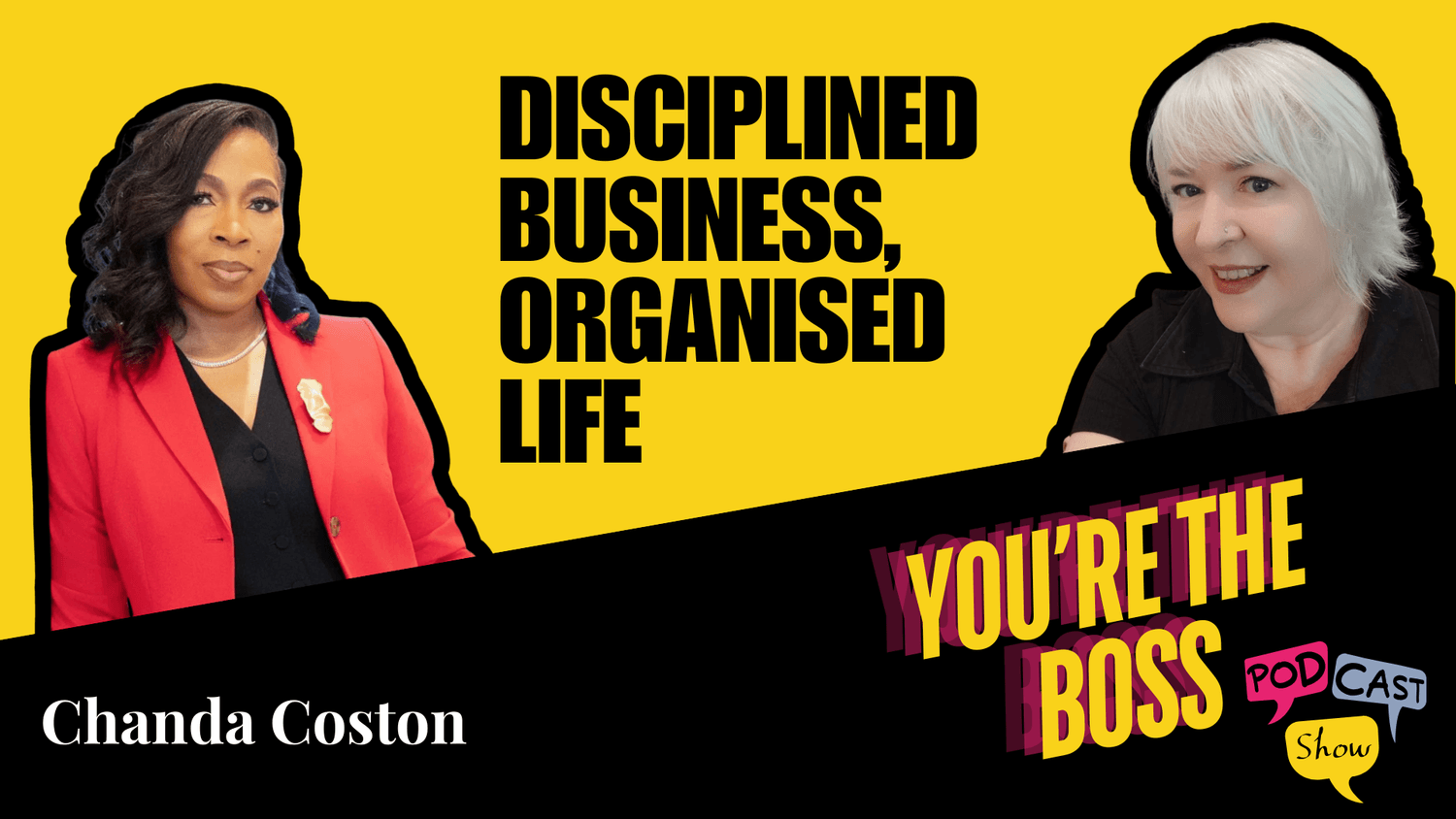
Click the image above to watch
Ange Dove (00:01)
So welcome to Your the Boss Podcast Show. Today I have Chanda Coston with me. Chanda is a business strategist, Navy veteran, and CEO of Chanda Co., where she equips women over 40 to move from overwhelm and scattered effort to structured, profitable execution.
With more than 20 years of leadership and project management experience, Chanda specializes in decision clarity, strategic structure, and building clear courses of action that turn vision into measurable results. She helps capable women stop operating reactively and start building businesses that actually work — anchored in systems, milestones, and measurable momentum.
So Chanda, welcome to the show.
Chanda Coston (00:57)
Hi, thanks Ange. I’m excited to be here. I think this is going to be a great conversation — one that’s much needed, per usual.
Ange Dove (01:01)
Yeah, I love what you’re doing. I absolutely love what you’re doing. And especially what resonated with me in that intro was the “scattered” part. So anyone feeling scattered — check out Chanda.
So you were originally in the Navy, right?
Chanda Coston (01:14)
Yes, yes, for sure.
Chanda Coston (01:29)
I did 10 years in the U.S. Navy enlisted. It was a great place for me to be at that moment. It was what I needed, and I think it was divine for sure.
Ange Dove (01:43)
Okay, so what kind of skills did you pick up in the Navy that have helped you in your business and helped the people you serve?
Chanda Coston (01:52)
For sure — the structure, the discipline, the tenacity, the “get it done no matter what” mindset. There’s just a go-get-it-ness that you get from being in the military.
I won’t say everyone experiences it the same way, but definitely those who embrace the culture, take it seriously, and rise to the top. I enjoyed my time in the military, and I think it was value-added for sure.
Ange Dove (02:19)
I love that because it kind of sends the message that, hey, you’ve got to work, right? Success doesn’t just come naturally. There’s got to be some elbow grease in there somewhere.
Chanda Coston (02:25)
Yeah, yes, for sure. Pull those sleeves up — let’s go!
Ange Dove (02:37)
So what led you to leaving the Navy? Did you immediately start your own business, or was there something in between?
Chanda Coston (02:47)
No, it was a journey. I actually went into the military because I left an abusive marriage, and I had three small children. The military gave me stability during those 10 years.
Eventually, I realized I wanted to be home with my children more, and that required me to leave the military. After that, I became a mom and went into corporate. I didn’t go directly into entrepreneurship.
From corporate, I started thinking, “I think I want to build my own business,” but I wasn’t really sure what that looked like. I was also thinking long-term because I needed insurance and stability, so I went to work for the government directly.
Here in America, if you work for the government and you didn’t retire from the military, you can buy back your military time and count it toward your government retirement. So I did that. I worked for the government, bought back my military time, and later left government work.
Then I moved into government contracting and started working for myself.
Ange Dove (03:44)
Okay, are you still entitled to that retirement?
Chanda Coston (03:48)
Yeah, they can’t take it from you. It’s sitting there. I was with the government for four years, and I had 10 years of military time, so I have 14 years sitting in the government retirement system if I ever decide to go back.
Ange Dove (04:06)
Which you’re probably not going to do, right?
Chanda Coston (04:12)
At the time, it felt like insurance — it made sense. But when I left, it was because I wanted to become a government contractor and work for myself.
I had already set my company up, but I couldn’t actively work in it yet because of conflict-of-interest rules. Shortly after that, I lost my brother to gun violence.
Even though I had started the business and secured contracts, my focus shifted toward building my nonprofit.
Ange Dove (04:40)
Okay.
Chanda Coston (04:41)
It was in that space that I realized there was something to mentoring and teaching. I had a mentoring program for young adults in the community, and I was teaching life-skills classes.
That’s when I started thinking, “What is this coaching thing?” My peers would ask me, “Can you coach me? Can you mentor me?”
As a consultant, everything is very black and white and professional. But with coaching, there’s an emotional component that I realized I really enjoyed. You still teach in both roles, but coaching allows you to be creative, and you get to watch people go from idea to completion.
You get to see someone grasp a concept, understand it, and bring it to life in their own way. And I thought, “I really like this.” That’s what started me on this journey.
Ange Dove (05:49)
I think with coaching as well, you get to see the results right in front of your eyes. That’s so gratifying.
Chanda Coston (05:53)
Yes, absolutely. You do see results in government consulting too, but it’s so mission-focused. It’s always: mission, mission, mission. Go, go, go. Burn up, burn out. “Great job — now onto the next thing.”
Coaching is different.
Ange Dove (06:14)
There’s a lot to unpack there. You mentioned that while you were in government or corporate work after the Navy, you suddenly decided you wanted to start your own business. What triggered that?
Chanda Coston (06:37)
I realized there was a lot of money in government contracting. I thought, “I’m good at my job, so why not do it for myself and make the money directly?” It felt like a no-brainer.
Ange Dove (06:59)
Nice. Is it one of those systems where you bid for projects? In Singapore, government work usually goes through bidding platforms. Is it similar there?
Chanda Coston (07:18)
Very similar. There’s a platform where requests for proposals are posted, and they tell you exactly how to submit and what’s required. If you feel you can meet the need, you submit your proposal.
Ange Dove (07:38)
Right, so you were lucky in a way because you’d already seen where the money was being spent. You could identify the opportunity from the inside.
Chanda Coston (08:04)
Exactly — the opportunity.
Ange Dove (08:05)
Then you mentioned your nonprofit. Interestingly, I actually recorded another podcast this morning with someone who helps people set up nonprofits. He helps them navigate all the legal paperwork and red tape.
He said he can cut the process from potentially a year down to just a couple of weeks in some cases, including helping them apply for tax-exempt status. So it’s interesting that you brought that up.
How do you manage both your nonprofit and your business?
Chanda Coston (09:08)
Everything I teach, I live by. I’m really big on time-management strategies. I actually plan my calendar a year ahead.
All of my events are already scheduled before the year begins. We plan one quarter ahead for the next quarter’s events. Because I already know what’s coming, I can prepare accordingly.
From a business perspective, I plan the same way. If you’re planning in the moment, you’re already late. Planning ahead tells you what funding you’ll need, whether you need venues, supplies, or additional support.
That way you’re not in the middle of chaos feeling like the sky is falling.
Ange Dove (10:03)
Right. So how do you help people who feel scattered and overwhelmed shift into that organized mindset?
Chanda Coston (10:33)
It depends on how much time I have with the client. Long-term clients go through a detailed survey where we identify limiting beliefs. I also provide a client resource guide with tools, apps, and recommendations based on their needs.
For someone I’m just meeting, we start with basics:
What are you pursuing?
Why are you pursuing it?
Is it a passion project, a business idea, or just someone else’s good idea?
Good ideas aren’t always your ideas.
You need a “why” that’s strong enough to pull you when motivation fades, because motivation is never enough.
If it’s a time issue, then we look at their calendar and how they’re spending their time. We identify the holes and gaps and build systems and strategies around them.
One of the books I recommend often is The 12 Week Year by Brian Moran. It’s closely aligned with project management and gives people practical clarity and structure. I listen to it at least once a year.
Most people eventually realize they’re wasting time — doom scrolling, doing busy work, staying active without actually moving outcomes forward. Running in place is not the same as making progress.
Once they see the gaps, the fix is often simpler than they expected — if they’re willing to do the work.
Ange Dove (13:13)
Which is always the key.
One thing I learned about time management is that it’s obvious once someone points it out, but not obvious when you’re living it. I met someone who created an app that helped manage short-, medium-, and long-term goals.
Usually our to-do lists are filled with urgent tasks, but he taught us that every day, at least one thing on the list should move a long-term goal forward.
Before that, I would always push those long-term goals aside because “they’re not urgent.” But then nothing ever moved forward.
Once I started doing even one task daily toward long-term goals, everything changed.
Chanda Coston (14:59)
Exactly. It’s about teaching little frameworks that move the needle forward so people experience quick wins. Then the brain says, “We did it! Let’s do more.”
That’s how you rewire behavior.
Ange Dove (15:12)
What about people who always say they’re busy, but they’re doing things that don’t actually move the needle? Should they hire help? When should that happen?
Chanda Coston (15:43)
Self-awareness is key. But accountability is powerful too.
There’s a statistic I quote all the time: if you tell someone your goal, you’re 65% more likely to achieve it. But if someone regularly checks in with you about that goal, your success rate jumps to 95%.
That’s huge.
People will often do more because someone else is watching. So I always encourage community. Even if you can’t afford a paid group, there are free Facebook communities and supportive spaces everywhere.
Find like-minded people who will celebrate your wins, support you through losses, and keep you moving forward.
Ange Dove (17:21)
Especially with women, we often give to others before we’re willing to receive ourselves. We’ll do things for everyone else before we do them for ourselves.
But like they say on airplanes — put your oxygen mask on first.
Chanda Coston (17:49)
Exactly right.
Ange Dove (17:55)
Let’s talk about mindset and limiting beliefs. What are limiting beliefs, and how do they stop people from succeeding?
Chanda Coston (18:20)
Limiting beliefs are beliefs that stop you from reaching your fullest potential or achieving the things you say you want.
For example, if your goal is to lose 20 pounds but you constantly tell yourself you can’t do it, or that it doesn’t matter, or people won’t like you anyway — those are limiting beliefs.
You change them by changing your internal conversations, the information you consume, and the people you surround yourself with. That’s why community matters so much.
Eventually the belief shifts from limiting to empowering.
There’s a quote by Henry Ford that I love: “Whether you think you can or you think you can’t, you’re right.”
Statistically speaking, I wasn’t supposed to accomplish many of the things I’ve done. But my mindset has always been: if someone else did it, I can learn how too.
I study what successful people did, adapt it to my situation, and move forward. That mindset changes how you think, act, and show up.
I love when women come to me with a “little idea” they’re unsure about. We talk through it, give it shape, and suddenly they come back energized because someone finally believed in the possibility.
Ange Dove (21:17)
There’s another quote that comes to mind: “Would those who say it can’t be done please get out of the way of those doing it?”
Surrounding yourself with the right people is so important. You want people who lift you up, not pull you down.
And the way you speak to yourself matters too. It’s easy to spiral downward when you’re alone, but community can pull you back up again.
Chanda Coston (22:12)
Exactly. That’s self-awareness for sure.
Ange Dove (22:14)
I also think when you speak things out loud, things start happening. Once you say, “This is what I want,” opportunities begin to appear.
Chanda Coston (22:25)
For sure.
Ange Dove (22:38)
We also talked earlier about transitioning during the right season of life. Can you explain that?
Chanda Coston (23:43)
Most of my clients are in transition or pivoting. They may be leaving a career to pursue a passion project, becoming empty nesters, or finally deciding it’s “their turn” after supporting everyone else.
At our age, we know time matters, so we want to make meaningful moves. But sometimes we bite off more than we can chew.
That’s why I use what I call the “30 Compass Framework.” I ask:
Are you passionate about it?
Are you good at it?
What problem does it solve?
Will people pay for it?
Does it fit the season of your life?
That last question is critical.
I have adult children, grandchildren, aging parents, a nonprofit, a business, my health, and personal goals. Before I add anything else, I evaluate my non-negotiables and my actual capacity.
As women, we’re used to taking care of everyone else. But when we finally get a chance to pursue something for ourselves, we often underestimate the cost in time and energy.
It doesn’t mean you can’t have the dream — it just means you may need to build it differently so you can actually enjoy your life while doing it.
Your business should fit around your life — not the other way around.
Ange Dove (26:27)
That really resonates with me. When I learned time management properly, I realized I’d been saying “yes” to everything without understanding my actual capacity.
All those little yeses add up. Once you truly see your calendar and commitments, you realize there literally aren’t enough hours in the week.
That’s when boundaries become essential.
Chanda Coston (27:10)
Exactly. Boundaries are everything.
When people constantly ask you to do things, you need a framework:
Does it move you forward?
How much time will it require?
Will it drain you?
If it makes sense, great. If not, be okay with saying no. Boundaries are the secret sauce to success.
Ange Dove (28:01)
Absolutely. “No” is a full sentence.
Chanda, it’s been so lovely speaking with you today. Lots of wonderful advice. Where can people find you?
Chanda Coston (28:48)
My website is chanda-co.com, and on social media I’m @chanda__co. I’d love to connect.
Ange Dove (29:00)
Perfect. I’ll include those details below wherever people are listening or watching this.
If you’ve enjoyed listening to Chanda — and I’m sure you have — and you want to transform your scattered life into something more organized and intentional, I highly recommend connecting with her.
Chanda, thank you so much for your time today.
Chanda Coston (29:26)
Likewise. It’s been a great conversation.
Don't leave without your free gifts

Check out my page of freebies designed to help you make progress towards your goals.
From free training on making $10,000 months to how to create your brand message to access to the resources I use in my business that may help you too!
I've got some
gifts for you!
Check out my page of freebies designed to help you make progress towards your goals.
From free training on making $10,000 months to how to create your brand message to access to the resources I use in my business that may help you too!
About me

Hi there 👋 My name is Ange Dove, professional copywriter and messaging strategist. I help Gen X professionals find the words to express who they have become, and to build a career or business that owns it.

GET YOUR UNCHAINED AUDIT
Let’s have coffee online for 60 minutes on Zoom, where we'll look at your profile, your message, and your next chapter together and give you the roadmap to take your next steps.

GET THE NEWSLETTER
Straight-talking insights for experienced professionals who want to turn what they know into income, options and greater freedom over what comes next.


